
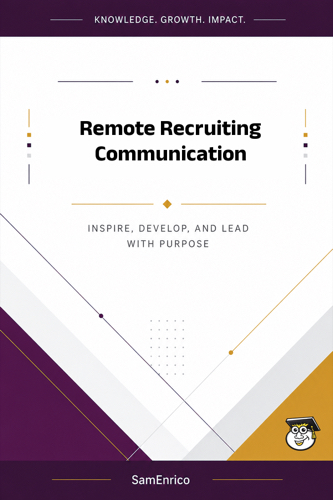
Non-FictionSelf-HelpRecruiting
Remote Recruiting Communication eBook
Teaches conducting virtual interviews and candidat
Teaches conducting virtual interviews and candidate outreach effectively.
Formats
Free sample
Chapter 1: The Flat Stanley Effect--–- You have forty-five seconds. That is the average time a candidate spends on a video call before they decide, consciously or not, whether they trust you, whether they want to work for you, and whether they will accept an offer if extended. Forty-five seconds. Not the forty-five minutes of the interview. Not the forty-five hours of preparation.
Forty-five seconds. And the terrifying truth is that most of those forty-five seconds have nothing to do with your qualifications, your company's mission, or the salary range you are about to discuss. They have everything to do with a psychological phenomenon that every recruiter must understand but almost no one talks about: the Flat Stanley Effect.Named after the children's book character who was flattened to a two-dimensional sheet of paper and mailed in an envelope, the Flat Stanley Effect describes what happens when humans interact through screens. We become flat. Not just visually flat—though the camera does compress our three-dimensional presence into a rectangle—but emotionally flat.
We lose the subtle cues of body language, the warmth of shared physical space, and the unconscious synchrony that happens when two people breathe the same air. Candidates feel this flattening acutely. They report feeling like they are performing for a lens rather than conversing with a person. Recruiters feel it too, though many cannot name it. They finish a video call and think, "Something was off," without realizing that what was off was the fundamental architecture of human connection being stripped away.This chapter is not about camera angles or lighting.
(Those come in Chapter 2.) This chapter is about the psychology beneath the pixels. Why do candidates freeze up? Why do you, the recruiter, feel less confident on video than in person? Why do some of the most qualified candidates come across as wooden, awkward, or disengaged? The answer lies in three psychological forces: Tech Anxiety, The 7-Second Rule, and Parasocial Mismatch.
Understand these forces, and you will stop misreading candidates. You will stop losing great hires to bad first impressions. And you will learn how to add depth back into a two-dimensional medium.The Invisible Weight of Tech Anxiety Let us begin with a confession that most recruiting books avoid: technology makes people afraid. Not the dramatic fear of a horror movie, but the low-grade, cortisol-spiking anxiety of uncertainty. Will my audio work?
Is my background acceptable? What if my child runs into the room? What if my internet lags at the exact moment I am asked a critical question?This is Tech Anxiety, and it is the single greatest barrier to authentic communication in remote recruiting.The data is striking. A 2023 study from the Journal of Organizational Psychology found that 82 percent of candidates report higher anxiety levels during video interviews than during in-person interviews. Not slightly higher.
Significantly higher. Candidates describe physical symptoms: sweaty palms, racing hearts, a sensation of being "trapped" in their own frames. One candidate in a focus group said, "In person, I can read the room. On video, I'm just staring at myself, watching myself fail in real time."That last detail is crucial. Unlike an in-person interview where you see the interviewer, a video call often shows you your own face in a small window.
This is called "mirror anxiety." You become the audience for your own performance. Every nervous glance, every awkward pause, every hair out of place is reflected back at you. It is like giving a speech while watching yourself in a mirror. No wonder candidates underperform.But Tech Anxiety does not only affect candidates. Recruiters suffer from it too, though they are less likely to admit it.
You worry about your own tech failures. You worry that the candidate is judging your background, your lighting, your frozen expression. You rush through questions because you fear the call will drop. And when something does go wrong—a freeze, an echo, a sudden exit—you panic, apologize excessively, and lose the thread of the conversation.Here is what the research says about Tech Anxiety: it is contagious. When one person on a call is anxious, the other person's cortisol levels rise within ninety seconds.
You do not need to say, "I am nervous." Your micro-expressions, your rushed speech, your fidgeting hands communicate it unconsciously. And then the candidate becomes more anxious. And then you become more anxious. It is a feedback loop that destroys rapport before the first real question is asked.The solution is not to eliminate Tech Anxiety—that is impossible. The solution is to name it, normalize it, and then redirect it.
In Chapter 8, we will cover the technical playbook for disasters. But for this chapter, focus on the psychological move: acknowledgment without apology. When you start a call, say something like, "Let's take thirty seconds to make sure your audio is clear and your video is steady. I want us to be present, not troubleshooting." That is not an apology. It is a permission slip.
You are giving the candidate permission to stop worrying about the tech so they can focus on the conversation.One more critical point about Tech Anxiety: it does not discriminate, but it does affect different candidates differently. Candidates from lower-income backgrounds may have older equipment, slower internet, or less controlled environments. Candidates with ADHD may struggle with the cognitive load of monitoring their own video feed while listening to questions. Candidates who are neurodivergent may find the lack of non-verbal cues disorienting. A recruiter who assumes that all candidates experience video interviews the same way will systematically filter out talented people who simply have different relationships with technology.The antidote is structured empathy.
Before the interview, send a clear tech checklist (see Appendix). During the interview, watch for signs of Tech Anxiety—frequent glances at the self-view window, stiff posture, unusually long pauses—and interrupt them gently. Say, "I notice you glancing at your camera. Everything okay on your end?" Nine times out of ten, the candidate will exhale and say, "Yes, sorry, I was just checking my background." That exhale is the moment anxiety leaves the room. You have given them permission to stop performing and start conversing.The 7-Second Rule: Why First Impressions Are Faster Than You Think You have heard that first impressions matter.
You have probably heard that they are formed within the first thirty seconds of a conversation. That is true for in-person meetings. For video calls, the timeline is far more compressed.Researchers at the University of Toronto conducted a study in which participants watched silent, three-second video clips of people they had never met. After just three seconds, participants made judgments about the person's competence, trustworthiness, and likeability—and those judgments correlated strongly with judgments made by people who had watched full, ten-minute interviews. Three seconds.
A sneeze takes longer.On a video call, the 7-Second Rule governs the interaction. Within seven seconds of a call starting, both parties have formed a stable, lasting impression of the other person. That impression is based on almost nothing substantive: the quality of the lighting, the angle of the camera, the expression on your face as you wait for the connection to stabilize, the background behind…
This is the end of the free sample. Get the eBook to keep going. Buy now
About this book
Details
- Author
- Valentine Dani
- Publisher
- SamEnrico
- Language
- English
- Genre
- Non-Fiction, Self-Help, Recruiting
- Released
- 2026-06-10
- Pages (approx.)
- 141
- Available as
- eBook, Audiobook

Read better in the ZLOADR app
Your eBooks on your phone or tablet. Sign in with your SamEnrico account and start reading.
More by Valentine Dani
 Uber Tax Deduction BibleValentine Dani$11.99
 The Face Torso ShiftValentine Dani$11.99
 Anticipatory Grief and Final ConversationsValentine Dani$11.99
 Punitive Discipline ChildhoodValentine Dani$11.99
 The Student Athlete StressValentine Dani$11.99
 Breaking the Gambling Cycle WorkbookValentine Dani$11.99
 Growth Hormone Childhood DeficitsValentine Dani$11.99
 Murdoch Wall StreetValentine Dani$11.99
 The Great Unraveling: How a Single Trade Triggered a Global Financial EarthquakeValentine Dani$11.99
 Silk Road to Digital Gold: The Untold Story of China’s E-Commerce PioneersValentine Dani$11.99
 Data Analytics for Business DecisionsValentine Dani$11.99
 Understanding Atypical LipodystrophyValentine Dani$17.99
You may also like
 Hong Kong Handover 1997Dunn Johnnie$11.99
 Zumba For Postnatal Recovery CourseNeal Christian$11.99
 Zumba for BeginnersLadner Nikia$11.99
 YouTube Comment Mining GuideHumes Pandora$12.99
 Worry Box MeditationCarlin Rudy$11.99
 Workplace Stress MeditationNguyen Lynn$11.99
 Workplace Stress and Sleep RepairHawley Ivory$11.99
 Workplace Perfectionism CureDelaney Jeffry$11.99
 Workplace Injustice Anger GuideWallen Isabelle$11.99
 Work Addiction and Burnout LinkGreenwood Ester$11.99
 Women in Yoga and WellnessBeattie Galina$11.99
 Women in Stand Up ComedyChun Evangeline$11.99