
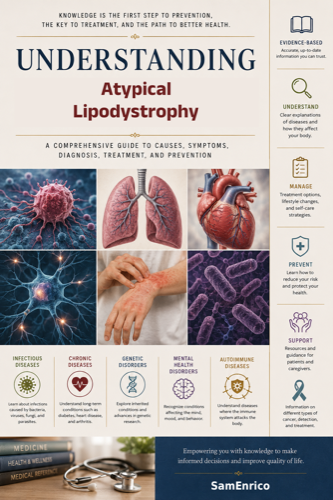
Non-FictionInformativeEducational
Understanding Atypical Lipodystrophy
This disease publication, published by SamEnrico,
This disease publication, published by SamEnrico, covers Understanding Atypical Lipodystrophy
Formats
About this book
Free sample
Chapter 1: The Missing Organ...--–- Every medical student learns that the human body has 78 organs. The heart pumps. The liver filters. The pancreas secretes. But there is an organ—large, dynamic, and metabolically essential—that textbooks have historically treated as little more than storage space.
It wraps around your muscles, cushions your internal structures, and influences everything from your appetite to your fertility. This organ is your adipose tissue. And when it begins to disappear—not through diet, not through exercise, but through a process you cannot control—your entire metabolic system collapses in ways that most doctors never learn to recognize.This is the story of atypical lipodystrophy. But to understand this disease, you must first unlearn what you thought you knew about body fat.The Organ You Never Knew You Had For decades, fat was dismissed as inert packing material. Medical training emphasized its role in insulation and energy storage, but rarely taught that adipose tissue is, in fact, the largest endocrine organ in the human body.
An adult of normal weight carries approximately 30 billion adipocytes—fat cells—that collectively weigh 10 to 15 kilograms. These cells do not sit passively. They secrete hormones, regulate inflammation, control energy balance, and communicate continuously with the brain, the liver, the muscles, and the pancreas.The two most critical hormones produced by adipose tissue are leptin and adiponectin. Leptin, discovered only in 1994, signals to the hypothalamus that the body has sufficient energy stores. When leptin levels rise, appetite decreases, and energy expenditure increases.
When leptin levels fall, the brain perceives starvation and drives relentless hunger. Adiponectin, discovered in 1995, enhances insulin sensitivity throughout the body, facilitating the uptake of glucose into muscle and the oxidation of fatty acids in the liver. Together, these hormones maintain metabolic harmony.In lipodystrophy, adipose tissue is either congenitally absent, progressively lost, or functionally defective. The result is not merely a cosmetic change in appearance. The result is a catastrophic hormone deficiency state—specifically, leptin and adiponectin deficiency—that drives some of the most severe metabolic disease seen in clinical medicine.Why This Book Focuses on "Atypical" Lipodystrophy Most physicians have…
This is the end of the free sample. Get the eBook to keep going. Buy now
Contents
- Chapter 1
- Chapter 2
- Chapter 3
- Chapter 4
- Chapter 5
- Chapter 6
- Chapter 7
- Chapter 8
- Chapter 9
- Chapter 10
- Chapter 11
- Chapter 12
Details
- Author
- Valentine Dani
- Publisher
- SamEnrico
- Language
- English
- Genre
- Non-Fiction, Informative, Educational
- Released
- 2026-06-02
- Pages (approx.)
- 138
- Available as
- eBook, Audiobook

Read better in the ZLOADR app
Your eBooks on your phone or tablet. Sign in with your SamEnrico account and start reading.
More by Valentine Dani
 Remote Recruiting CommunicationValentine Dani$11.99
 Uber Tax Deduction BibleValentine Dani$11.99
 The Face Torso ShiftValentine Dani$11.99
 Anticipatory Grief and Final ConversationsValentine Dani$11.99
 Punitive Discipline ChildhoodValentine Dani$11.99
 The Student Athlete StressValentine Dani$11.99
 Breaking the Gambling Cycle WorkbookValentine Dani$11.99
 Growth Hormone Childhood DeficitsValentine Dani$11.99
 Murdoch Wall StreetValentine Dani$11.99
 The Great Unraveling: How a Single Trade Triggered a Global Financial EarthquakeValentine Dani$11.99
 Silk Road to Digital Gold: The Untold Story of China’s E-Commerce PioneersValentine Dani$11.99
 Data Analytics for Business DecisionsValentine Dani$11.99
You may also like
 Hong Kong Handover 1997Dunn Johnnie$11.99
 Zumba For Postnatal Recovery CourseNeal Christian$11.99
 Zumba for BeginnersLadner Nikia$11.99
 YouTube Comment Mining GuideHumes Pandora$12.99
 Worry Box MeditationCarlin Rudy$11.99
 Workplace Stress MeditationNguyen Lynn$11.99
 Workplace Stress and Sleep RepairHawley Ivory$11.99
 Workplace Perfectionism CureDelaney Jeffry$11.99
 Workplace Injustice Anger GuideWallen Isabelle$11.99
 Work Addiction and Burnout LinkGreenwood Ester$11.99
 Women in Yoga and WellnessBeattie Galina$11.99
 Women in Stand Up ComedyChun Evangeline$11.99