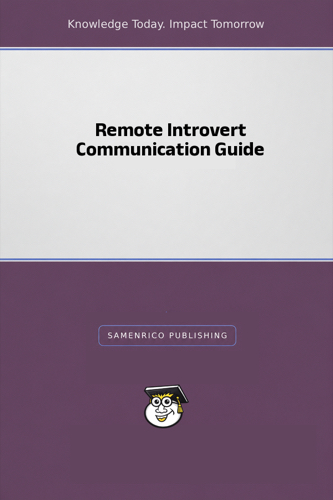
Remote Introvert Communication Guide eBook
Teaches quieter team members to participate effect
Teaches quieter team members to participate effectively in digital settings.
Formats
Free sample
Chapter 1: The Neurological Edge--–- The morning light filtered through the blinds as Maya stared at her screen, the Zoom grid staring back like twenty small television sets all tuned to different channels of human expectation. Her finger hovered over the unmute button. Someone had just asked a question—she wasn't sure who—and the silence that followed felt like a spotlight searching for a runner. Her heart rate climbed. Her mind, which had been clear and focused just seconds ago while reviewing her notes in solitude, suddenly became a fog of half-formed sentences.
She stayed muted. Someone else answered. The moment passed. Maya exhaled, but the exhale carried something heavier than relief: the quiet confirmation of another meeting where her voice had stayed inside her head.This scene repeats across thousands of home offices, coffee shops, and bedroom desks every single day. The introvert who writes brilliant emails, who solves complex problems in solitude, who notices the subtle dynamics everyone else misses—freezes when the red recording light of a video call blinks on.
The common explanation, the one Maya told herself, was simple: I'm just not good at talking in groups. I need to be more assertive. I need to be more like them.But what if that explanation was not only unhelpful but scientifically backwards? What if the reason Maya struggled to unmute had nothing to do with a personality flaw and everything to do with a different—and entirely valid—neurological operating system? What if the very neural pathways that made her freeze in the rapid-fire chaos of a video call were the same pathways that made her exceptional at deep analysis, strategic thinking, and written communication?This chapter will fundamentally reframe how you understand your introversion in the remote workplace.
By the time you finish reading, you will no longer see your quietness as a liability to overcome. You will see it as a neurological edge—a different wiring that, in the digital-first world, has suddenly become not just acceptable but advantageous.The Chemistry of Quiet: Dopamine, Acetylcholine, and You To understand why remote work has changed the game for introverts, we must first look inside the brain. For decades, personality science operated on observable behaviors: introverts prefer low-stimulation environments, extroverts seek high-stimulation social settings. But recent advances in neuroscience have revealed the biological machinery beneath those behaviors.Dr. Colin De Young and his colleagues at the University of Minnesota identified that the brain's dopamine system functions differently in introverts and extroverts.
Dopamine is often called the "reward neurotransmitter"—it floods the brain when we encounter novelty, excitement, and social reward. Extroverts have a more reactive dopamine system. When they walk into a crowded room, when they banter with colleagues, when they answer a question on the fly, their brains release a satisfying hit of dopamine. They are neurologically rewarded for seeking and engaging in high-stimulation social environments.Introverts, by contrast, have a different baseline. Their dopamine systems are more easily overstimulated.
That crowded room that energizes the extrovert? For the introvert, it triggers a stress response. But here is where the story gets interesting—and where the advantage emerges.Introverts have a more active acetylcholine pathway. Acetylcholine is a different neurotransmitter entirely. It is associated with attention, deep focus, memory formation, and the feeling of calm concentration.
While dopamine rewards external engagement, acetylcholine rewards internal engagement—the pleasure of getting lost in a complex problem, the satisfaction of a well-constructed argument, the quiet joy of learning something deeply.Think of it this way: The extrovert's brain says, "Talking to people feels good. Let's do more of it." The introvert's brain says, "Thinking deeply feels good. Let's do more of that." Neither is superior. They are simply different reward systems calibrated for different environments.But here is the critical insight for the remote worker: The physical office was built for the dopamine-driven brain. Open floor plans, impromptu hallway conversations, brainstorming sessions where the loudest voice wins—these environments reward rapid external processing.
The introvert, forced to operate in this environment, experiences chronic overstimulation. Their acetylcholine-rich brain wants to go deep, but the environment keeps pulling them shallow.Remote work has changed that equation. The open floor plan is gone. The impromptu hallway conversations have been replaced by scheduled messages. The brainstorming session now happens in a shared document where everyone types simultaneously.
The environment has shifted from dopamine-dominant to acetylcholine-friendly.You are not broken. You were just living in a world built for a different brain.The Thinking Versus Talking Gap: Why Extroverts Lose Their Advantage Online One of the most underappreciated insights in communication research comes from a simple observation about when people think. Extroverts tend to think by talking. They externalize their cognitive process, using conversation as a tool to sort through ideas. You have seen this in meetings: the person who starts speaking before they know what they want to say, who meanders through half-formed thoughts until they arrive at a conclusion somewhere around minute three of their monologue.
This is not a flaw in the extrovert—it is their natural cognitive style. Talking is their thinking.Introverts, by contrast, think before talking. They process internally, turning an idea over in their minds, examining it from multiple angles, arriving at a conclusion, then speaking. This is why introverts often report that they "have the answer" but struggle to find the right moment to say it. By the time they have finished thinking, the conversation has moved on.In a physical room, the extrovert's style has a distinct advantage.
The person who speaks early shapes the conversation. The person who speaks often becomes the perceived leader. The introvert, still processing, appears quiet, maybe even disengaged. The environment rewards speed over depth.Now consider the remote meeting. The video call introduces a slight delay in audio transmission—milliseconds that feel like eternities to the extrovert's rhythm.
The chat window runs parallel to the conversation. The "raise hand" feature formalizes turn-taking. The mute button creates a default state of silence. Every single feature of the remote meeting platform slows down the conversation and privileges the person who has already thought through what they want to say.The extrovert who thrived on rapid back-and-forth now finds themselves frustrated. The gaps feel awkward.
The technology gets in the way of their flow. The introvert, who was already thinking before speaking, barely notices the difference—except now, they have time to unmute.Dr. Adam Grant's research on introverted and extroverted leaders revealed something counterintuitive: introverted leaders often achieve better outcomes than extroverted leaders when managing proactive teams. Why? Because introverted leaders are more likely to listen to good ideas and less likely to impose their own.
Extroverted leaders, by contrast, tend to dominate the conversation, inadvertently suppressing input from others.The remote workplace amplifies this dynamic. The introvert who listens carefully, synthesizes quietly, and then speaks with precision is suddenly the ideal participant—not the one who needs fixing.The Asynchronous Advantage: Why Writing Has Become the New Talking If the shift from physical to remote meetings favors the introvert's thinking style, the rise of asynchronous communication represents an even更大 shift. Consider how much of your work communication now happens without…
This is the end of the free sample. Get the eBook to keep going. Buy now
About this book
Details
- Author
- Burdette Marketta
- Publisher
- SamEnrico
- Language
- English
- Genre
- Non-Fiction, Self-Help, Introverts
- Released
- 2026-06-07
- Pages (approx.)
- 129
- Available as
- eBook, Audiobook

Read better in the ZLOADR app
Your eBooks on your phone or tablet. Sign in with your SamEnrico account and start reading.
More by Burdette Marketta
 The Shopping Cart HandleBurdette Marketta$11.99
 Hearst King FeaturesBurdette Marketta$11.99
 Food Addiction And Trauma ConnectionBurdette Marketta$11.99
 Gambling Cue Detection CourseBurdette Marketta$11.99
 The Library Overcrowding StressBurdette Marketta$11.99
 Anticipatory Grief and MeaningBurdette Marketta$11.99
 Maternal Gatekeeping ChildhoodBurdette Marketta$11.99
 Swimmer Shoulder Flexibility CourseBurdette Marketta$11.99
 The Curse of the Cardinal: How a 31-Year Title Drought Shaped a DynastyBurdette Marketta$11.99
 The Golden Voice of Axum: The Hymns of King Ezana and the Birth of African Christian MusicBurdette Marketta$11.99
 Frozen Rivalry: The Race to the North Pole and the Men Who Defined ItBurdette Marketta$11.99
 The Complete Guide to the Ultrametabolism PlanBurdette Marketta$11.99