
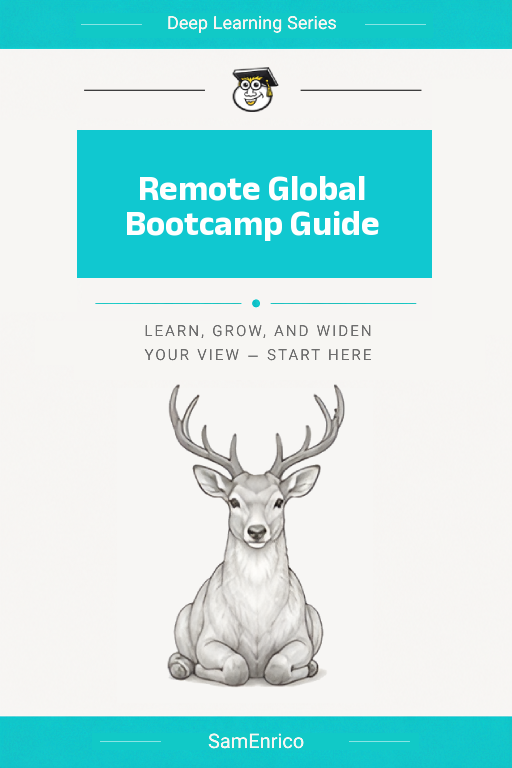
Non-FictionStudent's ShortcutRemote LearningGlobal Access
Remote Global Bootcamp Guide eBook
Join coding bootcamps from anywhere using time zon
Join coding bootcamps from anywhere using time zone friendly schedules and international payment options.
Formats
Free sample
Chapter 1: The Geography Lie...--–- The first lie you were told about becoming a software developer is that you need to live in San Francisco, New York, or London. The second lie is that you need to spend $20,000 on a local bootcamp. The third lie—the most dangerous one—is that your location determines your worth. None of this is true, and the proof is already working in a coffee shop in Bangkok, a beach town in Brazil, and a basement apartment in rural Poland. These developers earn US salaries while living where their currency stretches three times as far.
They did not win a geographic lottery. They learned a system. And that system starts with unlearning everything you thought you knew about where and how to build a career in tech.The $20,000 Mistake You Haven't Made Yet Let me tell you about Maria. She lived in Medellín, Colombia, and she wanted to become a developer. Every piece of conventional advice told her to save up, move to the United States on a student visa, and enroll in a prestigious in-person bootcamp.
The total cost would have been 18,000fortuition,18,000 for tuition, 18,000fortuition,24,000 for living expenses in a US city, and another 5,000forflightsandvisafees.Thatisnearly5,000 for flights and visa fees. That is nearly 5,000forflightsandvisafees.Thatisnearly50,000 just to get started. Maria did not have 50,000.Shehad50,000. She had 50,000.Shehad2,000 and a laptop with a cracked screen. Today, two years later, she works as a front-end developer for a remote-first company based in Austin, Texas.
Her salary is 85,000peryear.Sheneverleft Medellıˊn.Sheneverpaid85,000 per year. She never left Medellín. She never paid 85,000peryear.Sheneverleft Medellıˊn.Sheneverpaid18,000 for a bootcamp. She learned through a combination of free resources, a low-cost global bootcamp that charged $500 per month, and the system outlined in this book. Maria is not exceptional.
She is just the first of hundreds of examples I have collected while researching this book.The traditional model of developer education is built on a geography lie. The lie says that talent is concentrated in specific cities, that you must physically relocate to access opportunity, and that the quality of your education correlates with how much you pay for a classroom seat. None of these statements survive contact with reality in 2026. The remote-first economy has flattened the world faster than any technology before it. Companies like Git Lab, Zapier, and Automattic have operated as fully distributed organizations for years, hiring developers based on skill tests and portfolio reviews rather than passport stamps.
When the COVID-19 pandemic forced every other company to experiment with remote work, millions of managers discovered something uncomfortable for the old geography lie: productivity did not drop. In many cases, it increased. Developers without commutes, without open-plan office distractions, and without performative face time delivered more code, faster.The data supports this. A 2025 study of remote engineering teams found that developers working from locations of their choice were 22 percent more productive than their office-bound counterparts. The same study found that retention rates for remote engineers were 35 percent higher, largely because developers could live where they wanted without sacrificing career progression.
Companies noticed. By early 2026, over 60 percent of software development job postings explicitly offered remote or hybrid options, and nearly 25 percent were fully remote with no location restrictions. The geography lie is dying. But the education system has not caught up.Two Roads, One Destination Before we go any further, you need to make a choice. This book serves two distinct audiences, and the path you choose will determine which chapters you prioritize.
The good news is that both paths lead to the same destination: a global career as a software developer. The bad news is that neither path is easy, and pretending otherwise wastes your time and money.Path One: The Structured Bootcamp Route You are the kind of person who thrives with deadlines, accountability, and a cohort of peers pushing you forward. You want someone else to design the curriculum, review your code, and tell you when you are ready to start applying for jobs. You are willing to pay for structure because you know that the fastest route to a job is often not the cheapest route. You are right about that, but you need to choose the right bootcamp—and most people choose poorly because they evaluate bootcamps the same way they evaluate local restaurants: by walking distance and word of mouth.
That is a mistake when the entire world is your campus.Path Two: The Self-Taught Route You are the kind of person who learns by doing. You do not need a teacher to hold your hand. You need a roadmap, a set of high-quality resources, and permission to build things that break. You are skeptical of bootcamp tuition costs, and you have the discipline to wake up at 6:00 AM to study before work or after putting the kids to bed. You are willing to trade money for time—specifically, you will spend more time figuring things out because you are not paying for shortcuts.
This path is slower but cheaper. It requires more grit but less capital. It is the path Maria took, and it is the path that thousands of successful self-taught developers have taken before you.This book works for both paths, but you need to know which one you are on. If you are on Path One, you will read Chapters 1 through 3 carefully to choose the right bootcamp, then skip to Chapters 8 through 12 to learn how to succeed in a remote global bootcamp environment. If you are on Path Two, you will read Chapters 1 and 2 for mindset and time zone strategy, then dive into Chapters 4 through 7 for the technical curriculum, followed by Chapters 8 through 12 for the remote workflow and career launch.
Chapter 3—the digital wallet setup—is important for both paths. If you are paying for a bootcamp, read Chapter 3 before you send a single dollar. If you are self-taught, read Chapter 3 when you are ready to start freelancing or applying for jobs, or read it now as preparation.To help you decide, here is a simple decision matrix. Answer these five questions honestly.Question 1: Do you have at least 15 hours per week to dedicate to focused study?Yes, consistently. → Proceed to Question 2.No, or inconsistently.
→ Path One may be better. Structured deadlines help when time is scarce.Question 2: Have you ever completed a self-directed online course from start to finish without quitting?Yes, multiple times. → Path Two is viable.No, or I quit most of them. → Path One likely fits better.Question 3: Do you have 3,000to3,000 to 3,000to15,000 available for tuition (or access to financing)?Yes. → Both paths are open.No.
→ Path Two is your only option, but that is fine. Many successful developers started with zero budget.Question 4: Do you need a job within six months, or can you take twelve to eighteen months to build skills?Six months or less. → Path One, but be very careful. Accelerated bootcamps work for some people and fail for others.Twelve months or more. → Path Two works well.Question 5: Do you prefer learning alone or in groups?Alone.
→ Path Two.In groups. → Path One, or Path Two with a study group you organize yourself.If you answered mostly…
This is the end of the free sample. Get the eBook to keep going. Buy now
About this book
Details
- Author
- Iverson Karin
- Publisher
- SamEnrico
- Language
- English
- Genre
- Non-Fiction, Student's Shortcut, Remote Learning, Global Access
- Released
- 2026-05-30
- Pages (approx.)
- 138
- Available as
- eBook, Audiobook

Read better in the ZLOADR app
Your eBooks on your phone or tablet. Sign in with your SamEnrico account and start reading.
More by Iverson Karin
 HGH and Hair Loss ConnectionIverson Karin$11.99
 Crisis Communication Presentation NervesIverson Karin$11.99Crisis Communication Presentation NervesIverson Karin$11.99
 Parental Anger Micro Habits GuideIverson Karin$11.99
 Self Hypnosis for AbundanceIverson Karin$11.99
 Panic Disorder Virtual Reality Therapy GuideIverson Karin$11.99
 The 444 Days: The Forgotten Hostage Crisis That Shocked the WorldIverson Karin$11.99
 Letters Across the Wire: Love in the Battle of BritainIverson Karin$11.99
 Understanding Branchial Arch Syndrome X LinkedIverson Karin$17.99
 Immigration ParalegalIverson Karin$11.99
 Ecommerce Returns Policy OutlookIverson Karin$12.99
 How to Become a Sawyer IiIverson Karin$11.99
You may also like
 Hong Kong Handover 1997Dunn Johnnie$11.99
 Zumba For Postnatal Recovery CourseNeal Christian$11.99
 Zumba for BeginnersLadner Nikia$11.99
 YouTube Comment Mining GuideHumes Pandora$12.99
 Worry Box MeditationCarlin Rudy$11.99
 Workplace Stress MeditationNguyen Lynn$11.99
 Workplace Stress and Sleep RepairHawley Ivory$11.99
 Workplace Perfectionism CureDelaney Jeffry$11.99
 Workplace Injustice Anger GuideWallen Isabelle$11.99
 Work Addiction and Burnout LinkGreenwood Ester$11.99
 Women in Yoga and WellnessBeattie Galina$11.99
 Women in Stand Up ComedyChun Evangeline$11.99