
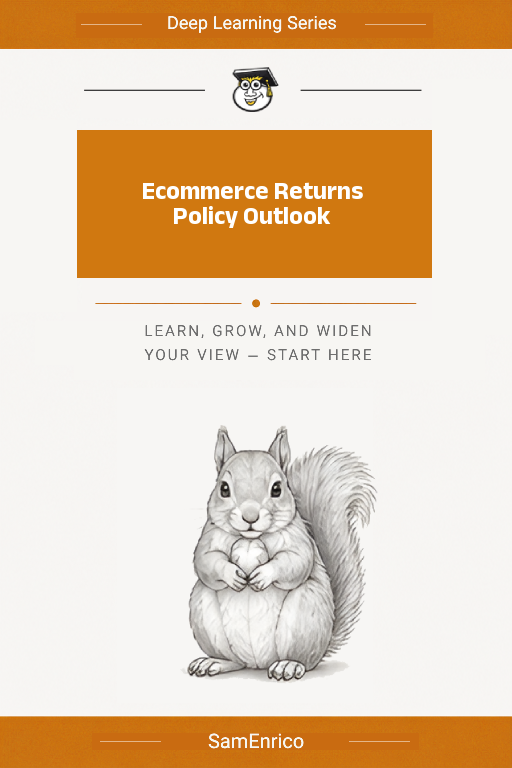
Non-FictionForecast & OutlookPolicy Trends
Ecommerce Returns Policy Outlook
Forecast free returns phase-out, restocking fee ad
Forecast free returns phase-out, restocking fee adoption, and in-store return preference shifts through 2030.
Formats
About this book
Free sample
Chapter 1: The Billion-Dollar Blindspot--–- In 2019, a mid-sized fashion retailer in Manchester did something unusual. It calculated, for the first time in its fifteen-year history, the full cost of its “hassle-free, free returns” policy. The number that emerged from the spreadsheet caused the chief financial officer to request a second audit. She assumed an error had been made. No error existed.
The company had been spending, on average, 23 percent of every item’s selling price to process and dispose of the goods customers sent back. For some product categories—particularly multi-size orders of the same dress—the figure exceeded 40 percent. That year, the retailer quietly eliminated free returns for all customers outside its top loyalty tier. Within six months, its return rate fell by 28 percent. Its net profit margin increased by 4.2 percentage points.
Not a single competitor noticed for nearly a year.This story is not exceptional. It is, in fact, the norm. Across the global ecommerce industry, returns have become the single largest unmanaged cost center in modern retail—a blindspot so pervasive that even sophisticated operators routinely underestimate its true impact by a factor of two or three. The phrase “free returns” has been repeated so often, for so long, that it has acquired the gravitational pull of common sense. Except it is not common sense.
It is a subsidy. And like all subsidies, it distorts behavior, conceals inefficiency, and eventually runs out.This book is about that reckoning. It is about the €312.4 billion reverse logistics market projected for 2030, the 30-40 percent return rates that have become normalized in online fashion, and the quiet revolution in returns policy that will reshape ecommerce over the next seven years. But before we can forecast the future, we must understand how we arrived at this present—how a logistical necessity became a marketing weapon, how that weapon turned on its users, and why the era of the free-for-all return is now ending faster than most industry participants realize.The Scale of the Problem Let us begin with numbers, because numbers do not negotiate. In 2024, global ecommerce sales surpassed 6.3trillion.Ofthatamount,anestimated6.3 trillion.…
This is the end of the free sample. Get the eBook to keep going. Buy now
Contents
- Chapter 1
- Chapter 2
- Chapter 3
- Chapter 4
- Chapter 5
- Chapter 6
- Chapter 7
- Chapter 8
- Chapter 9
- Chapter 10
- Chapter 11
- Chapter 12
Details
- Author
- Iverson Karin
- Publisher
- SamEnrico
- Language
- English
- Genre
- Non-Fiction, Forecast & Outlook, Policy Trends
- Released
- 2026-05-28
- Pages (approx.)
- 141
- Available as
- eBook, Audiobook

Read better in the ZLOADR app
Your eBooks on your phone or tablet. Sign in with your SamEnrico account and start reading.
More by Iverson Karin
 HGH and Hair Loss ConnectionIverson Karin$11.99
 Crisis Communication Presentation NervesIverson Karin$11.99Crisis Communication Presentation NervesIverson Karin$11.99
 Parental Anger Micro Habits GuideIverson Karin$11.99
 Self Hypnosis for AbundanceIverson Karin$11.99
 Panic Disorder Virtual Reality Therapy GuideIverson Karin$11.99
 The 444 Days: The Forgotten Hostage Crisis That Shocked the WorldIverson Karin$11.99
 Letters Across the Wire: Love in the Battle of BritainIverson Karin$11.99
 Understanding Branchial Arch Syndrome X LinkedIverson Karin$17.99
 Immigration ParalegalIverson Karin$11.99
 Remote Global Bootcamp GuideIverson Karin$12.99
 How to Become a Sawyer IiIverson Karin$11.99
You may also like
 Hong Kong Handover 1997Dunn Johnnie$11.99
 Zumba For Postnatal Recovery CourseNeal Christian$11.99
 Zumba for BeginnersLadner Nikia$11.99
 YouTube Comment Mining GuideHumes Pandora$12.99
 Worry Box MeditationCarlin Rudy$11.99
 Workplace Stress MeditationNguyen Lynn$11.99
 Workplace Stress and Sleep RepairHawley Ivory$11.99
 Workplace Perfectionism CureDelaney Jeffry$11.99
 Workplace Injustice Anger GuideWallen Isabelle$11.99
 Work Addiction and Burnout LinkGreenwood Ester$11.99
 Women in Yoga and WellnessBeattie Galina$11.99
 Women in Stand Up ComedyChun Evangeline$11.99