
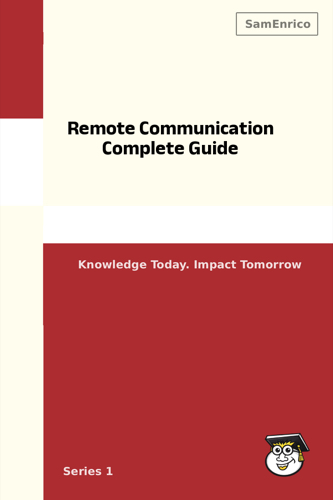
Remote Communication Complete Guide eBook
Comprehensive resource for all digital settings.
Comprehensive resource for all digital settings.
Formats
Free sample
Chapter 1: The Emoji Trap--–- The Slack message arrived at 2:47 PM on a Tuesday. It contained exactly two words: “Looks good.” Followed by a thumbs-up emoji. By Friday, three people had submitted their resignations, a $200,000 client contract was on hold, and the marketing director was in a screaming match with product development. All because of an emoji.This is not hyperbole. This is the reality of remote communication in the 2020s, where the smallest digital gesture can trigger an avalanche of misunderstanding.
The thumbs-up emoji—universally intended as affirmation—was read by the recipient as sarcastic dismissal. Why? Because the sender had just rejected a different proposal from that same colleague hours earlier. The context bled through. The recipient assumed the worst.
Nobody picked up the phone to clarify. And by the time anyone realized what had happened, the damage was done.Welcome to the central problem of remote work: We are communicating more than ever, but understanding less than ever.The average knowledge worker now sends and receives over 120 emails, 80 Slack messages, and attends 15 video calls every single day. That is nearly 250 separate digital interactions. And yet, according to a 2023 study by the Harvard Business Review, 67% of remote workers report that misunderstandings have increased since switching to hybrid or fully remote arrangements. The problem is not the tools.
The problem is that we are using a chainsaw to slice bread and a butter knife to cut down trees. We have lost the ability to match the message to the medium.This book exists to fix that. And this first chapter is where the foundation is laid.The Anatomy of a Digital Disaster Before we can build better habits, we need to understand exactly why digital communication fails so spectacularly. The answer lies in a concept called Media Richness Theory, developed by Richard Daft and Robert Lengel in the 1980s—long before anyone had heard of Zoom or Slack. Their insight was startlingly prescient: different communication channels have different capacities to convey information, and using the wrong channel for the wrong message creates confusion, resentment, and failure.Media richness is measured along four dimensions:1.
Immediate feedback. Can the other person ask clarifying questions in real time? A video call has high immediate feedback. An email has zero.2. Multiple cues.
Does the channel convey tone of voice, body language, facial expression, and eye contact? A phone call has tone but no visuals. Text has nothing.3. Language variety. Can the channel support natural human conversation, or does it force formal, structured language?
A Slack DM is conversational but stripped. A legal document is precise but cold.4. Personal focus. Does the channel feel human and tailored to the individual, or generic and broadcast? A handwritten note is deeply personal.
A mass email is not.Here is where the disaster unfolds: Most of us default to our favorite tool, not the right tool. The person who loves Slack uses it for everything—from "Where's the coffee?" to "I need to discuss your performance issues." The person who loves email sends novel-length messages for questions that could be answered in ten seconds. And the person who loves video calls schedules thirty-minute meetings for announcements that could have been a two-line message.The thumbs-up catastrophe described at the opening of this chapter is a textbook case of low-richness medium, high-richness need. The sender needed to convey reassurance, context, and warmth after a difficult prior interaction. Instead, they sent a single emoji through a medium (Slack) that strips away tone, body language, and the ability to clarify.
The recipient, lacking any additional cues, filled the void with the worst possible interpretation.This is not a failure of intention. It is a failure of medium selection. And it happens thousands of times every day in companies around the world.The Ping Philosophy: Asking the Right Questions In his groundbreaking book Ping: The Secrets of Successful Virtual Communication, organizational psychologist Andrew Brodsky distilled Media Richness Theory into a simple, practical framework that anyone can use. He calls it the Ping Philosophy, and it consists of three questions you must ask yourself before every single digital message:Question One: Is this message ambiguous?Ambiguity means there is room for multiple interpretations. "Can we talk?" is ambiguous.
"Can we discuss the Q3 budget variance for five minutes at 2 PM?" is not. "Looks good" after a rejected proposal is ambiguous. "I like the direction of this, and I have two small edits on page three" is not.Question Two: Is this message emotionally charged?Emotionally charged messages include criticism, feedback, bad news, apologies, expressions of frustration, or even effusive praise (which can feel performative in text). If the message could make someone feel defensive, sad, angry, or anxious, it is emotionally charged.Question Three: Does this message need back-and-forth?If the topic requires clarification, negotiation, brainstorming, or problem-solving, it needs real-time interaction. If it is a one-way update or a simple confirmation, it does not.If you answer YES to any of these three questions, you need a rich medium—video call or phone.
If you answer NO to all three, a lean medium (email, doc) or medium medium (Slack chat) is appropriate.Let us test this against the thumbs-up catastrophe. Was the message ambiguous? Yes—"Looks good" after a rejection history is highly ambiguous. Was it emotionally charged? Yes—the recipient had just been rejected and needed reassurance.
Did it need back-and-forth? Possibly not, but the ambiguity and emotional charge made the lean medium disastrous.The sender should have answered YES to Questions One and Two, recognized the need for a rich medium, and picked up the phone. A thirty-second call would have saved three resignations and a $200,000 contract.The Decision Matrix: Your One-Page Reference Guide The Ping Philosophy is powerful, but it requires active thinking in the moment—something that is hard to do when you are racing through 250 daily messages. That is why this chapter provides a one-page decision matrix that you can tape to your monitor, keep in your notebook, or save as a desktop background.Before we present the matrix, we must define two critical terms that will appear throughout this book: urgency and stakes. These dimensions cut across media richness and determine not only which tool to use but how quickly to respond.Urgency has two levels:Time-critical: Requires a response within one hour.
Examples: server outage, client deadline crisis, safety issue.Non-urgent: Can wait four hours or more. Examples: project update, general question, social check-in.Stakes has two levels:High-stakes: Financial, emotional, or relational impact if misunderstood. Examples: performance feedback, contract negotiation, apology, sensitive personal news.Low-stakes: Little to no impact if misinterpreted. Examples: lunch plans, calendar invites, routine status updates.Now, here is the matrix:Situation Recommended Medium Example High-stakes + Time-critical Rich (video or phone)"We lost a client. Call now."High-stakes + Non-urgent Rich (video or phone, scheduled)"Let's discuss your performance review Tuesday."Low-stakes + Time-critical Medium (Slack/IM)"Server is down—check now."Low-stakes + Non-urgent Lean (email or doc)"Here is the Q3 report for your records."A critical note on ambiguity and emotion: Even if stakes are low and urgency is low, if the message is ambiguous or emotionally charged, you must move one level richer.…
This is the end of the free sample. Get the eBook to keep going. Buy now
About this book
Details
- Author
- Terrell Tandra
- Publisher
- SamEnrico
- Language
- English
- Genre
- Non-Fiction, Self-Help, Complete
- Released
- 2026-06-10
- Pages (approx.)
- 145
- Available as
- eBook, Audiobook

Read better in the ZLOADR app
Your eBooks on your phone or tablet. Sign in with your SamEnrico account and start reading.
More by Terrell Tandra
 Refeed Day Calorie GuideTerrell Tandra$11.99
 Parental Anger Morning RoutineTerrell Tandra$11.99
 Franchising Your Local Brand Across Borders Forced Localization LawsTerrell Tandra$11.99
 Urge Surfing Technique GuideTerrell Tandra$11.99
 The Unseen Sentence: How a Flawed Algorithm Doomed ThousandsTerrell Tandra$11.99
 Swipe Right for History: How a Forgotten Photo Changed the WorldTerrell Tandra$11.99
 Understanding Deafness Conductive Ptosis Skeletal AnomaliesTerrell Tandra$17.99
 Community Engagement StrategyTerrell Tandra$12.99
 Nonprofit Penalty GuideTerrell Tandra$12.99
 Field RepresentativeTerrell Tandra$11.99
 How to Start a Hobby in Map MakingTerrell Tandra$11.99
You may also like
 Self Hypnosis Complete Sleep GuideZeller Evelin$11.99
 Road Rage Complete Management GuideDumas Ciera$11.99
 TM Complete Beginners GuideAhern Jimmie$11.99
 MBSR Complete Home CoursePannell Garret$11.99
 Loneliness Complete Self Help GuidePinto Mavis$11.99
 Public Speaking Complete GuideHollingsworth Sherwood$11.99
 Personal Ing For Success Success CompleteSpriggs Mika$11.99
 High Pressure Professions CompleteFernandes Jong$11.99
 Complicated Grief Complete GuideFrame Emil$11.99
 Metta Complete Practice GuideWilson Rose$11.99
 Meditation For Better Sleep CompleteCollado Zelda$11.99
 Anger De escalation Complete GuideYamamoto Larue$11.99