
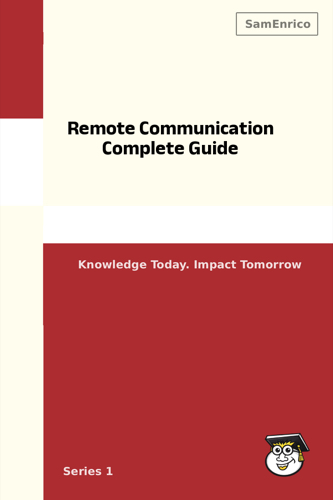
Remote Communication Complete Guide Audiobook
Comprehensive resource for all digital settings.
Comprehensive resource for all digital settings.
Formats
Free sample
Chapter 1: The Emoji Trap--–- The Slack message arrived at 2:47 PM on a Tuesday. It contained exactly two words: “Looks good.” Followed by a thumbs-up emoji. By Friday, three people had submitted their resignations, a $200,000 client contract was on hold, and the marketing director was in a screaming match with product development. All because of an emoji.This is not hyperbole. This is the reality of remote communication in the 2020s, where the smallest digital gesture can trigger an avalanche of misunderstanding.
The thumbs-up emoji—universally intended as affirmation—was read by the recipient as sarcastic dismissal. Why? Because the sender had just rejected a different proposal from that same colleague hours earlier. The context bled through. The recipient assumed the worst.
Nobody picked up the phone to clarify. And by the time anyone realized what had happened, the damage was done.Welcome to the central problem of remote work: We are communicating more than ever, but understanding less than ever.The average knowledge worker now sends and receives over 120 emails, 80 Slack messages, and attends 15 video calls every single day. That is nearly 250 separate digital interactions. And yet, according to a 2023 study by the Harvard Business Review, 67% of remote workers report that misunderstandings have increased since switching to hybrid or fully remote arrangements. The problem is not the tools.
The problem is that we are using a chainsaw to slice bread and a butter knife to cut down trees. We have lost the ability to match the message to the medium.This book exists to fix that. And this first chapter is where the foundation is laid.The Anatomy of a Digital Disaster Before we can build better habits, we need to understand exactly why digital communication fails so spectacularly. The answer lies in a concept called Media Richness Theory, developed by Richard Daft and Robert Lengel in the 1980s—long before anyone had heard of Zoom or Slack. Their insight was startlingly prescient: different communication channels have different capacities to convey information, and using the wrong channel for the wrong message creates confusion, resentment, and failure.Media richness is measured along four dimensions:1.
Immediate feedback. Can the other person ask clarifying questions in real time? A video call has high immediate feedback. An email has zero.2. Multiple cues.
Does the channel convey tone of voice, body language, facial expression, and eye contact? A phone call has tone but no…
This is the end of the free sample. Get the Audiobook to keep going. Buy now
About this book
Details
- Author
- Terrell Tandra
- Publisher
- SamEnrico
- Language
- English
- Genre
- Non-Fiction, Self-Help, Complete
- Released
- 2026-06-10
- Pages (approx.)
- 145
- Available as
- eBook, Audiobook

Listen in the VoxFlicks app
Audiobooks and audio dramas wherever you go. Sign in with your SamEnrico account and press play.
More by Terrell Tandra
 Refeed Day Calorie GuideTerrell Tandra$11.99
 Parental Anger Morning RoutineTerrell Tandra$11.99
 Franchising Your Local Brand Across Borders Forced Localization LawsTerrell Tandra$11.99
 Urge Surfing Technique GuideTerrell Tandra$11.99
 The Unseen Sentence: How a Flawed Algorithm Doomed ThousandsTerrell Tandra$11.99
 Swipe Right for History: How a Forgotten Photo Changed the WorldTerrell Tandra$11.99
 Understanding Deafness Conductive Ptosis Skeletal AnomaliesTerrell Tandra$17.99
 Community Engagement StrategyTerrell Tandra$12.99
 Nonprofit Penalty GuideTerrell Tandra$12.99
 Field RepresentativeTerrell Tandra$11.99
 How to Start a Hobby in Map MakingTerrell Tandra$11.99
You may also like
 Self Hypnosis Complete Sleep GuideZeller Evelin$11.99
 Road Rage Complete Management GuideDumas Ciera$11.99
 TM Complete Beginners GuideAhern Jimmie$11.99
 MBSR Complete Home CoursePannell Garret$11.99
 Loneliness Complete Self Help GuidePinto Mavis$11.99
 Public Speaking Complete GuideHollingsworth Sherwood$11.99
 Personal Ing For Success Success CompleteSpriggs Mika$11.99
 High Pressure Professions CompleteFernandes Jong$11.99
 Complicated Grief Complete GuideFrame Emil$11.99
 Metta Complete Practice GuideWilson Rose$11.99
 Meditation For Better Sleep CompleteCollado Zelda$11.99
 Anger De escalation Complete GuideYamamoto Larue$11.99