
Non-FictionStudent's ShortcutDelivery Mode
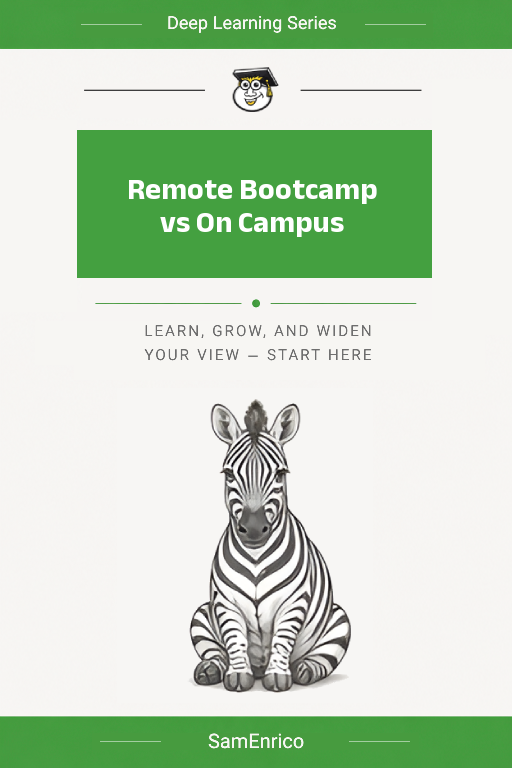
Remote Bootcamp vs On Campus eBook
Compare online coding bootcamps with in person pro
Compare online coding bootcamps with in person programs for networking and discipline differences.
Formats
Free sample
Chapter 1: The Mirror Test--You are about to make a decision that will cost you somewhere between five thousand and twenty thousand dollars, consume three to six months of your life, and quite possibly determine whether you become a software developer or remain someone who dreams of becoming one. The bootcamp industry wants you to believe that the most important question is which curriculum to choose—Python or Java Script, data science or full-stack web development, three months or six months. They want you to compare interest rates, job placement statistics, and alumni testimonials. They want you to believe that the choice is rational, data-driven, and objective.They are wrong.The most important question has nothing to do with curriculum, price, or placement rates. The most important question is this: what kind of worker do you want to become?
Not what kind of developer—what kind of worker. Because the hard truth that no bootcamp salesperson will tell you is that the curriculum is largely the same across reputable programs. Every bootcamp teaches you to build web applications. Every bootcamp covers databases, authentication, APIs, and front-end frameworks. Every bootcamp claims to prepare you for a junior developer role.
The curriculum is not the differentiator.The container is the differentiator.Where you learn—the physical or digital space you inhabit for twelve to twenty-four weeks—shapes not just what you learn but who you become. A remote bootcamp builds a different kind of professional than an on-campus program. One produces graduates who are comfortable with asynchronous communication, self-directed deep work, and global networks. The other produces graduates who thrive under social pressure, develop tactical accountability, and build local trust. Neither is universally better.
But one is almost certainly better for you.This book exists because the bootcamp industry has failed to help you make this distinction. They want you to believe that online and in-person are interchangeable—just different delivery methods for the same product. They are not interchangeable. They are fundamentally different experiences that develop fundamentally different skills. Choosing the wrong container for your personality, your life circumstances, and your career goals is like training for a marathon by swimming laps.
You will work hard. You will improve. But you will arrive at the starting line unprepared for the specific demands of your race.This book will not tell you which bootcamp to attend. It will not rank programs or declare a winner in the remote versus on-campus debate. Instead, it will give you a mirror.
It will help you see yourself clearly—your habits, your tolerances, your vulnerabilities, and your strengths. And then it will help you choose the struggle you are most likely to survive.Because that is the secret that no one tells you: every bootcamp is a struggle. There is no easy path. There is no shortcut. There is only the question of which difficulties you are equipped to handle and which difficulties will break you.The Two Students Who Could Be You Let me introduce you to two people.
Their names have been changed, but their stories are real. As you read, ask yourself which one sounds more like you.Alex is twenty-nine years old, working as a administrative assistant in a small insurance office in rural Kansas. He has been teaching himself to code for eighteen months. He completed the free Code Camp responsive web design certification. He built a small weather app using a public API.
He understands variables, functions, and basic array methods. But he has never finished a large project. He starts with enthusiasm, works intensely for a week or two, then hits a difficult problem—a bug he cannot solve, a concept that will not click—and he pauses. The pause becomes a week. The week becomes a month.
By the time he returns to his code, he has forgotten half of what he learned. He starts over. The cycle repeats.Alex is considering a remote bootcamp. He likes the idea of setting his own schedule. He worries about the cost of moving to a city with an on-campus program.
He has a girlfriend, a lease, and a dog. But he also fears the isolation. When he gets stuck now, he has no one to ask. He watches You Tube tutorials until his eyes blur. He posts questions on Stack Overflow and waits hours for answers that sometimes never come.
He suspects that a remote bootcamp might feel exactly like what he is already failing at—just more expensive and more shameful when he drops out.Jordan is twenty-four, a recent college graduate with a degree in English literature. She has never written a line of code. She does not know what a variable is. She chose literature because she loved discussing books in seminars, feeding off the energy of her classmates, staying up late arguing about symbolism and theme. She has always studied in groups.
Alone in her dorm room, she procrastinated. In the library with friends, she produced her best work.Jordan is considering an on-campus bootcamp. She likes the idea of structure, of showing up to a classroom every morning, of having instructors and peers physically present. She has saved money from a year of serving tables and is willing to relocate. But she worries about the cost—twenty thousand dollars is terrifying—and she worries about keeping up.
She has heard stories of bootcamp students who code for fourteen hours a day, who arrived already knowing three programming languages, who make her feel like she is already behind before she has even started. She is not sure she can survive that pressure.Alex and Jordan are not hypothetical constructs. They are composites of real people I have interviewed, coached, and watched struggle and succeed. Alex represents the remote-leaning student: someone with existing self-study experience, real-world obligations that make relocation difficult, and a history of struggling with consistency. Jordan represents the on-campus-leaning student: someone who thrives on social energy, has the freedom to relocate, and has no prior coding experience but deep doubts about her ability to keep up.Here is what happened to the real people behind these composites.The Alex-like student chose a remote bootcamp.
He failed. He did not fail because the curriculum was too hard or the teachers were bad. He failed because the container did not fit him. The flexibility he thought he wanted became a curse. When he hit the same difficult problems that had derailed him before, there was no one standing next to him to say "ask for help now." There was no classroom to commute to, no ritual to signal that learning time had begun.
His bed, his couch, his kitchen table—all of them were contaminated by the expectation of rest, not focus. He dropped out in week seven.The Jordan-like student chose an on-campus bootcamp. She succeeded. She succeeded not because she was smarter or more disciplined than Alex. She succeeded because the container fit her.
The pressure that terrified her before she started turned out to be exactly what she needed. When she felt lost in week two, she raised her hand—not because she was brave but because the person next to her raised their hand…
This is the end of the free sample. Get the eBook to keep going. Buy now
About this book
Details
- Author
- Moriarty Claris
- Publisher
- SamEnrico
- Language
- English
- Genre
- Non-Fiction, Student's Shortcut, Delivery Mode
- Released
- 2026-06-01
- Pages (approx.)
- 137
- Available as
- eBook, Audiobook

Read better in the ZLOADR app
Your eBooks on your phone or tablet. Sign in with your SamEnrico account and start reading.
More by Moriarty Claris
 Germany Renewable IncentivesMoriarty Claris$11.99
 Imposter Syndrome Writing GuideMoriarty Claris$11.99
 Earth Wind and FireMoriarty Claris$11.99
 Anger and JealousyMoriarty Claris$11.99
 The Attention Span Workout CourseMoriarty Claris$11.99
 Virtual Assistant HandbookMoriarty Claris$11.99
 Paleo Blood Sugar ControlMoriarty Claris$11.99
 Glide Path Income ShiftMoriarty Claris$11.99
 The Fake Sheikh: How a Fraudster Fooled the WorldMoriarty Claris$11.99
 The Face of Eternity: Apelles and Alexander the Great's Lost MasterpieceMoriarty Claris$11.99
 A Collector's Handbook to the Cadillac 355Moriarty Claris$11.99
 How to Become a Marker Machine AttendantMoriarty Claris$11.99
You may also like
 Hong Kong Handover 1997Dunn Johnnie$11.99
 Zumba For Postnatal Recovery CourseNeal Christian$11.99
 Zumba for BeginnersLadner Nikia$11.99
 YouTube Comment Mining GuideHumes Pandora$12.99
 Worry Box MeditationCarlin Rudy$11.99
 Workplace Stress MeditationNguyen Lynn$11.99
 Workplace Stress and Sleep RepairHawley Ivory$11.99
 Workplace Perfectionism CureDelaney Jeffry$11.99
 Workplace Injustice Anger GuideWallen Isabelle$11.99
 Work Addiction and Burnout LinkGreenwood Ester$11.99
 Women in Yoga and WellnessBeattie Galina$11.99
 Women in Stand Up ComedyChun Evangeline$11.99