
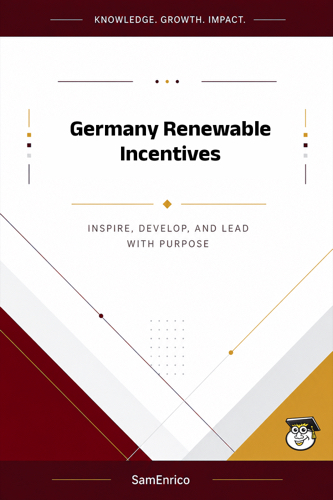
Non-FictionAnnual CheckupGerman Energy
Germany Renewable Incentives
Explores EEG surcharge, KfW loans, and solar feed
Explores EEG surcharge, KfW loans, and solar feed in tariffs for 2025.
Formats
About this book
Free sample
Chapter 1: The Money Revolution...--–- In 2000, the average German household paid about 18 pfennigs per kilowatt-hour for electricity. By 2025, that same household pays approximately 40 euro cents per kilowatt-hour – more than double, even after adjusting for currency changes. Yet here is the paradox that this entire book will unravel: while grid electricity prices have soared, the cost of generating your own solar electricity has collapsed by over 85 percent. In 2005, a typical 5 kilowatt rooftop system cost €35,000. In 2025, the same system costs approximately €8,000 to €10,000 before any incentives.
When you layer on the three pillars of German renewable incentives – EEG feed-in tariffs, Kf W financing, and tax exemptions – the effective cost can fall below €5,000, with payback periods under seven years.This chapter does not simply recite the history of Germany's Renewable Energy Sources Act, known universally as the EEG. That would be dry, academic, and precisely the kind of reading that puts down payments on hold. Instead, this chapter tells the story of how a single piece of legislation transformed Germany from an energy importer dependent on coal and nuclear power into the world's laboratory for renewable energy deployment. More importantly for you, the reader, this chapter reveals the three fundamental financial shifts that made 2025 the single best year in a generation to invest in solar energy – and why waiting until 2026 could cost you thousands.The Energy Transition That Changed Everything Germany's Energiewende, or energy transition, did not begin with a grand master plan. It began with a series of small, almost accidental policy decisions that created an unstoppable economic logic.
In 1991, the first Electricity Feed Act required grid operators to purchase electricity from independent renewable producers, but at rates so low that few bothered. The real turning point came on April 1, 2000, when the EEG took effect. That date – April Fool's Day – seemed ironic at the time. Skeptics laughed at the idea that solar power, which then cost over 50 euro cents per kilowatt-hour to produce, could ever compete with coal at 4 euro cents. Those skeptics were not wrong about the math of 2000.
They were wrong about the power of guaranteed pricing over two decades.The original EEG introduced what economists call a feed-in…
This is the end of the free sample. Get the eBook to keep going. Buy now
Contents
- Chapter 1
- Chapter 2
- Chapter 3
- Chapter 4
- Chapter 5
- Chapter 6
- Chapter 7
- Chapter 8
- Chapter 9
- Chapter 10
- Chapter 11
- Chapter 12
Details
- Author
- Moriarty Claris
- Publisher
- SamEnrico
- Language
- English
- Genre
- Non-Fiction, Annual Checkup, German Energy
- Released
- 2026-06-10
- Pages (approx.)
- 140
- Available as
- eBook, Audiobook

Read better in the ZLOADR app
Your eBooks on your phone or tablet. Sign in with your SamEnrico account and start reading.
More by Moriarty Claris
 Imposter Syndrome Writing GuideMoriarty Claris$11.99
 Earth Wind and FireMoriarty Claris$11.99
 Anger and JealousyMoriarty Claris$11.99
 The Attention Span Workout CourseMoriarty Claris$11.99
 Virtual Assistant HandbookMoriarty Claris$11.99
 Paleo Blood Sugar ControlMoriarty Claris$11.99
 Glide Path Income ShiftMoriarty Claris$11.99
 The Fake Sheikh: How a Fraudster Fooled the WorldMoriarty Claris$11.99
 The Face of Eternity: Apelles and Alexander the Great's Lost MasterpieceMoriarty Claris$11.99
 A Collector's Handbook to the Cadillac 355Moriarty Claris$11.99
 How to Become a Marker Machine AttendantMoriarty Claris$11.99
 Remote Bootcamp vs On CampusMoriarty Claris$12.99
You may also like
 Hong Kong Handover 1997Dunn Johnnie$11.99
 Zumba For Postnatal Recovery CourseNeal Christian$11.99
 Zumba for BeginnersLadner Nikia$11.99
 YouTube Comment Mining GuideHumes Pandora$12.99
 Worry Box MeditationCarlin Rudy$11.99
 Workplace Stress MeditationNguyen Lynn$11.99
 Workplace Stress and Sleep RepairHawley Ivory$11.99
 Workplace Perfectionism CureDelaney Jeffry$11.99
 Workplace Injustice Anger GuideWallen Isabelle$11.99
 Work Addiction and Burnout LinkGreenwood Ester$11.99
 Women in Yoga and WellnessBeattie Galina$11.99
 Women in Stand Up ComedyChun Evangeline$11.99