
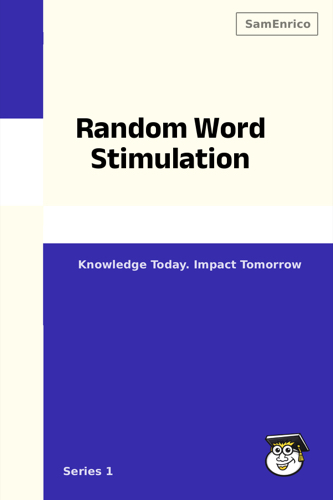
Non-FictionSelf-HelpAssociative Thinking
Random Word Stimulation eBook
Use unrelated words to spark new connections using
Use unrelated words to spark new connections using this brainstorming workbook.
Formats
Free sample
Chapter 1: The Word You Fear...--When you pulled this book off the shelf, a small part of you already knew what was coming. You’ve been stuck before. You’ll be stuck again. And somewhere beneath the polite optimism of “I just need to think harder” lies a quiet dread: What if the ideas have run out?That dread is not a personal failing. It is a predictable feature of the human brain—a feature that has kept you alive but also keeps you recycling the same seven solutions to every problem.
This chapter will show you why most brainstorming fails before it starts, and why one random, seemingly useless word can do what hours of grinding never could.By the end of this chapter, you will have experienced the method firsthand. You will have generated an idea that surprised you. And you will understand why “thinking harder” is almost never the answer.The Paradox of the Empty Page There is a famous experiment in creativity research that has been replicated dozens of times. Researchers gather two groups of people and ask them to brainstorm ideas for a simple challenge—say, new uses for a brick. Group A is told, “Be creative.
Try to come up with original ideas.” Group B is given no special instruction.Group A almost always performs worse than Group B.The reason is painful but important: when you try to force creativity, your brain panics. It scans for the most recent, most familiar, most safe ideas it can find. You don’t reach for the strange, the absurd, or the untested. You reach for what worked last time, because your brain’s deepest priority is not novelty—it is survival. And survival favors the known.This is the paradox of the empty page.
The harder you stare at it, the more it stares back with the same old answers.Now consider what happens when researchers add a twist. They give Group A a random word before they begin—say, “kangaroo.” Then they ask for new uses for a brick. The results change dramatically. Group A now generates ideas that are not only more numerous but more original. They suggest bricks that “hop” between locations, bricks with “pouches” for storage, bricks that “kick” into place.The random word did not give them an answer.
It gave them a provocation. And that provocation broke the paralysis of the empty page.This book is built on that simple, counterintuitive truth: you don’t need better ideas. You need better triggers.The Three Lies Your Brain Tells You When You’re Stuck Before we go any further, let’s name the enemy. When you feel stuck—whether on a work problem, a creative project, or a personal decision—your brain serves up three comforting lies. Recognizing these lies is the first step to breaking their grip.Lie #1: “I just need to think harder.”This is the lie of effort.
It tells you that your lack of ideas is a lack of trying. If you would just stare longer, grind more, push through the fatigue, the answer would appear.The truth is the opposite. Effort without novelty is just spinning in place. Thinking harder on the same problem with the same tools produces the same ideas, only more anxiously. What you need is not more effort but a different input.Lie #2: “The first idea is probably the best.”This is the lie of intuition.
It feels true because the first idea arrives with a burst of confidence. It feels right. But research on creative cognition shows that first ideas are almost always the most conventional. They are the ideas your brain has already filed under “safe.”The best ideas are usually the third, fourth, or fifth. They arrive later, often after you’ve dismissed something as stupid.
They are uncomfortable. And that discomfort is precisely why they are valuable.Lie #3: “I’m just not creative.”This is the lie of identity. It is the most damaging lie of all, because it turns a temporary state (being stuck) into a permanent trait (being uncreative). The research is clear: creativity is not a personality trait you either have or don’t have. It is a process you can learn.
It is a muscle you can train.The only difference between “creative” people and everyone else is that creative people have more triggers in their toolkit. They have more ways to start. This book is your toolkit.Why Randomness Works When Logic Fails Let’s get specific about the mechanism. Why does a completely unrelated word—say, “zebra”—help you solve a problem about, for example, warehouse efficiency?The answer lies in how your brain stores and retrieves information.Imagine your memory as a vast, dark library. Every experience, every fact, every image you have ever encountered is shelved somewhere in that library.
But the shelves are organized by association. The word “marketing” is shelved near “advertising,” “customers,” “budget,” and “campaign.” When you try to solve a marketing problem, your brain sends a librarian into that aisle. She returns with the same books every time.A random word like “zebra” lives in a completely different aisle. Zebra is shelved near “stripes,” “Africa,” “herd,” “grassland,” and “camouflage.” When you force a connection between “zebra” and “warehouse efficiency,” your librarian has to walk from the zebra aisle to the warehouse aisle. In that walk, she passes shelves she has never visited before.
She sees books she has never opened.Those books are your new ideas.This is not metaphor. This is neuroscience. The process is called bisociation—the collision of two unrelated frames of reference. When your brain forces a connection between two domains that have no logical relationship, it literally builds new neural pathways. Those pathways did not exist before.
They are the physical substrate of a novel idea.Structured brainstorming keeps you in one aisle. Random word stimulation forces you to walk between aisles. And the walk itself is where the magic happens.The Two Non-Negotiable Rules of This Method Every tool has rules. These are not suggestions. They are the difference between the method working and failing.Rule #1: Quantity Before Quality In your first pass, you must write down every link that comes to mind.
Every single one. Do not censor. Do not judge. Do not say, “That’s stupid” or “That won’t work” or “Someone else has probably thought of that.”Why? Because the part of your brain that judges ideas (the prefrontal cortex) is slow, cautious, and risk-averse.
The part that generates ideas (the default mode network) is fast, associative, and sloppy. If you let the judge sit next to the generator, the judge will interrupt every five seconds. You will generate three ideas and then give up.The rule is this: generate first, judge later. Set a timer. Do not stop until the timer goes off.
You can delete the terrible ideas afterward. But you cannot retrieve the brilliant idea you never wrote down because you decided it was stupid at second two.Rule #2: Ugly Ideas Matter The ideas that arrive first are usually neat, polite, and obvious. They are the ideas you could have had without any…
This is the end of the free sample. Get the eBook to keep going. Buy now
About this book
Details
- Author
- Coble Leonila
- Publisher
- SamEnrico
- Language
- English
- Genre
- Non-Fiction, Self-Help, Associative Thinking
- Released
- 2026-06-08
- Pages (approx.)
- 136
- Available as
- eBook, Audiobook

Read better in the ZLOADR app
Your eBooks on your phone or tablet. Sign in with your SamEnrico account and start reading.
More by Coble Leonila
 New Sibling Dream ReactionsCoble Leonila$11.99
 Hunger Anger Management GuideCoble Leonila$11.99
 Hinton Fellow Inmates ExecutedCoble Leonila$11.99
 Procrastination and Low Self EsteemCoble Leonila$11.99
 Gibraltar British FortressCoble Leonila$11.99
 British Retribution AtrocitiesCoble Leonila$11.99
 Dream Journaling for GriefCoble Leonila$11.99
 Marcel Marceau: The Silent Triumph of a Global IconCoble Leonila$11.99
 The Octopus Whisperers: How Inky the Octopus Outsmarted the WorldCoble Leonila$11.99
 The Photographer's Guide to Fancy PortraitCoble Leonila$11.99
 How to Become a Perforating-machine OperatorCoble Leonila$11.99
 Grant Writing for Disability Services GuideCoble Leonila$12.99
You may also like
 Hong Kong Handover 1997Dunn Johnnie$11.99
 Zumba For Postnatal Recovery CourseNeal Christian$11.99
 Zumba for BeginnersLadner Nikia$11.99
 YouTube Comment Mining GuideHumes Pandora$12.99
 Worry Box MeditationCarlin Rudy$11.99
 Workplace Stress MeditationNguyen Lynn$11.99
 Workplace Stress and Sleep RepairHawley Ivory$11.99
 Workplace Perfectionism CureDelaney Jeffry$11.99
 Workplace Injustice Anger GuideWallen Isabelle$11.99
 Work Addiction and Burnout LinkGreenwood Ester$11.99
 Women in Yoga and WellnessBeattie Galina$11.99
 Women in Stand Up ComedyChun Evangeline$11.99