
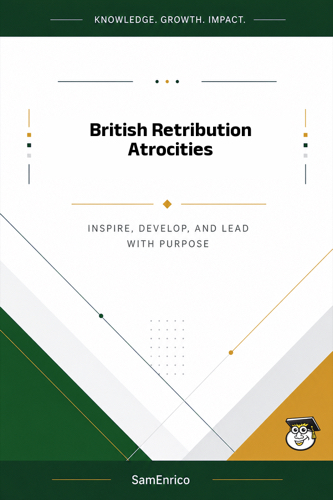
Non-FictionHistoryColonial Atrocities
British Retribution Atrocities
The wave of punitive executions and village burnin
The wave of punitive executions and village burnings after the revolt.
Formats
About this book
Free sample
Chapter 1: The Crawling Orders...--The dust had not yet settled on the Meerut parade ground when the first rope was tied. It was May 11, 1857, and the British garrison at Meerut—still trembling from the previous day's outbreak, still counting its dead, still refusing to believe that the sepoys they had trained for decades had turned their muskets against their officers—made a decision that would echo across the North Indian plains for the next two years and define the brutal logic of the retaliation to come. The decision was simple, almost banal in its cruelty: capture, interrogate, and hang. No trial. No court-martial.
No distinction between rebel and civilian, between the man who had fired a shot and the man who had simply looked away.The rope tightened, and the British Empire began its descent into a savagery it had always insisted was the exclusive province of the "native."The Anatomy of a Breakdown To understand the British retribution that followed the 1857 uprising, one must first understand the psychological collapse that preceded it. The East India Company's army in 1857 was not a foreign occupying force in the conventional sense. It was an integrated, almost intimate instrument of power. British officers had served alongside their sepoy subordinates for decades. They had eaten together—or at least, the officers had presided over meals while sepoys stood guard.
They had campaigned together in Afghanistan, in the Punjab, in Burma. They had trusted these men with their lives. And when that trust shattered in a matter of days—when the very soldiers who had protected British women and children turned around and, in some cases, killed them—the psychological rupture was absolute.The first reports to reach British commanders were fragmentary, contradictory, and almost certainly exaggerated in the retelling. At Meerut on May 10, sepoys had released their imprisoned comrades, killed approximately fifty European men, women, and children, and set fire to the cantonment. At Delhi, the aged Mughal emperor Bahadur Shah Zafar—a pensioner of the Company, a man the British had assumed was utterly toothless—was proclaimed the leader of a restored Mughal empire.…
This is the end of the free sample. Get the eBook to keep going. Buy now
Contents
- Chapter 1
- Chapter 2
- Chapter 3
- Chapter 4
- Chapter 5
- Chapter 6
- Chapter 7
- Chapter 8
- Chapter 9
- Chapter 10
- Chapter 11
- Chapter 12
Details
- Author
- Coble Leonila
- Publisher
- SamEnrico
- Language
- English
- Genre
- Non-Fiction, History, Colonial Atrocities
- Released
- 2026-06-06
- Pages (approx.)
- 135
- Available as
- eBook, Audiobook

Read better in the ZLOADR app
Your eBooks on your phone or tablet. Sign in with your SamEnrico account and start reading.
More by Coble Leonila
 New Sibling Dream ReactionsCoble Leonila$11.99
 Hunger Anger Management GuideCoble Leonila$11.99
 Hinton Fellow Inmates ExecutedCoble Leonila$11.99
 Random Word StimulationCoble Leonila$11.99
 Procrastination and Low Self EsteemCoble Leonila$11.99
 Gibraltar British FortressCoble Leonila$11.99
 Dream Journaling for GriefCoble Leonila$11.99
 Marcel Marceau: The Silent Triumph of a Global IconCoble Leonila$11.99
 The Octopus Whisperers: How Inky the Octopus Outsmarted the WorldCoble Leonila$11.99
 The Photographer's Guide to Fancy PortraitCoble Leonila$11.99
 How to Become a Perforating-machine OperatorCoble Leonila$11.99
 Grant Writing for Disability Services GuideCoble Leonila$12.99
You may also like
 Hong Kong Handover 1997Dunn Johnnie$11.99
 Zumba For Postnatal Recovery CourseNeal Christian$11.99
 Zumba for BeginnersLadner Nikia$11.99
 YouTube Comment Mining GuideHumes Pandora$12.99
 Worry Box MeditationCarlin Rudy$11.99
 Workplace Stress MeditationNguyen Lynn$11.99
 Workplace Stress and Sleep RepairHawley Ivory$11.99
 Workplace Perfectionism CureDelaney Jeffry$11.99
 Workplace Injustice Anger GuideWallen Isabelle$11.99
 Work Addiction and Burnout LinkGreenwood Ester$11.99
 Women in Yoga and WellnessBeattie Galina$11.99
 Women in Stand Up ComedyChun Evangeline$11.99