
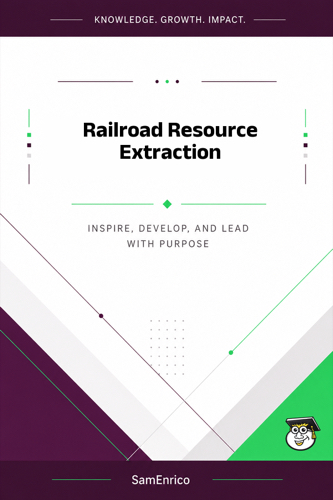
Non-FictionHistoryInfrastructure
Railroad Resource Extraction eBook
Railways built solely to move minerals to ports, n
Railways built solely to move minerals to ports, not connect Africa.
Formats
Free sample
Chapter 1: The Steel Funnel...--–- The railway arrived on a Tuesday. Not with a parade or a ribbon-cutting, but with a hundred thousand tons of iron and a thousand white men who did not speak the language of the land they were crossing. By Friday, the first train had run—not carrying passengers, not carrying food, not carrying mail. It carried rock. Copper rock, specifically, dragged from the Katanga mines to the Atlantic, a distance of nearly a thousand miles, and every mile of track was laid with the understanding that no local would ever ride it unless he was chained inside a cattle car.This is not the story of railways that built nations.
This is the story of railways that emptied them.The Great Distinction: Two Kinds of Steel Every schoolchild knows the heroic railway narrative. In the United States, the transcontinental railroad (completed 1869) tied a continent together, enabled homesteading, and created a national market. In Canada, the Canadian Pacific Railway (1885) was a condition of confederation itself—"the railway first, the nation second," as historians like to say. In Russia, the Trans-Siberian Railway (1916) connected Moscow to Vladivostok, binding an empire across eight time zones. These are the "Settlement Railways" of popular memory: engines of integration, arteries of commerce, instruments of national destiny.But there is another kind of railway, and it has never received a heroic biography.
This is the "Extraction Railway"—a point-to-point funnel designed for one purpose only: to move mineral wealth from a colonized interior to a coastal port, where it can be shipped to a foreign industrial center. Extraction railways do not connect markets; they bypass them. They do not enable homesteading; they enable land theft. They do not knit nations together; they hollow them out from the inside.The difference is not merely one of intent. It is baked into the very geometry of the track.
Settlement railways have branches, spurs, and feeder lines—they reach out to agricultural communities, connect towns, create a web of economic activity. Extraction railways are straight lines. They run from the mine to the port and nowhere else. They are designed to be efficient at one thing: draining wealth. Everything else—human dignity, ecological health, local economic development—is either an obstacle to be removed or an externality to be ignored.This book is about the second kind of railway.
It is about the steel funnels that wired the mineral wealth of Africa to the industrial furnaces of Europe, leaving behind nothing but rust, disease, and underdevelopment. It is about the "Corridor of Extraction"—a technological system that functioned as a weapon of colonial capitalism. And it begins with a myth that still haunts the historical imagination: Cecil Rhodes' dream of a railway from Cape Town to Cairo.The Rhodesian Colossus: Myth and Reality Cecil John Rhodes (1853–1902) was many things: diamond magnate, prime minister of the Cape Colony, arch-imperialist, and the namesake of Rhodesia (now Zimbabwe and Zambia). He was also a railway obsessive. His grand vision—the "Cape to Cairo" railway—would run the length of Africa, binding British possessions from the southern tip to the Nile.
In his imagination, the railway would be a ribbon of civilization, carrying commerce, Christianity, and colonial administration across the continent. It would make Africa British, and it would make Rhodes rich.The myth persists to this day. Schoolchildren in Britain and its former colonies still learn about Rhodes' grand plan. Travel writers still muse about what might have been. And the phrase "Cape to Cairo" still conjures an image of continental unity, of steel knitting Africa together.But the reality was something else entirely.Rhodes never built a railway from Cape Town to Cairo.
He barely tried. What he actually built—through his British South Africa Company (BSAC), chartered in 1889—was a series of disconnected extraction lines that ran from the interior mines to the nearest ports. The Cape-to-Cairo idea was a public relations fiction, a way to dress up resource extraction as imperial statesmanship.Consider the actual route. From Cape Town, the railway ran north to Kimberley (diamonds) and then to Johannesburg (gold). That made sense: the Rand gold fields were the richest ever discovered, and they needed an outlet to the sea.
From Johannesburg, the line continued north to Bulawayo and then to the Katanga copper mines in the Congo. That also made sense: copper was the industrial metal of the age, and it needed to reach the coast. But at no point did the line proceed further north than the Congo. It never reached the Nile. It never reached Cairo.
It never even reached the Sudanese border.What Rhodes built was not a continental connector. It was what one economic historian has called a "Colossus"—a massive steel funnel that wired the mines of Katanga and the Rand directly to the ports of Beira (in Portuguese East Africa, now Mozambique) and Cape Town. The line served no African economies along the way. It had no spurs for local agriculture. It had no passenger stations for African travelers.
It was a machine for moving copper, gold, and diamonds—and for moving African labor to the mines to extract those minerals.The Cape-to-Cairo myth, in other words, was a lie. But it was a useful lie. It allowed Rhodes and the BSAC to present themselves as nation-builders rather than resource strippers. It obscured the true nature of the extraction railway: a technology of dispossession, not development.The Architecture of the Funnel: How Extraction Railways Work To understand the extraction railway, one must understand its anatomy. Unlike a settlement railway, which spreads outward like a tree, an extraction railway is a straight line.
It has:A mine head at one end, where the mineral wealth is pulled from the earth.A port at the other end, where the ore is loaded onto ships.Nothing in between—or rather, nothing that serves local populations.Consider the Benguela Railway, which will serve as our archetype throughout this book. Built between 1902 and 1928, the Benguela line ran from the port of Lobito in Angola to the Katanga copper mines in the Belgian Congo (now Democratic Republic of Congo). It was 1,300 kilometers long (approximately 800 miles). It crossed four major river systems. It required the construction of dozens of bridges, including the spectacular bridge over the Congo River at Matadi.
It cost hundreds of lives, mostly African laborers who died from disease, malnutrition, and accidents.And it had precisely four stations that served any significant population. Four stations on an 800-mile line. The rest of the infrastructure was designed for one purpose only: to move copper ore as quickly and cheaply as possible.The Benguela line was built by a private British company, the Benguela Railway Company, which had been granted a concession by the Portuguese government (which controlled Angola) and by the Congo Free State (which controlled the copper mines). The concession gave the company absolute rights over the land within 20 kilometers on either side of the track. They could levy taxes.
They could expel local residents. They could cut down trees for fuel and sleepers. They could divert water for the steam engines. They could do all of this without any obligation…
This is the end of the free sample. Get the eBook to keep going. Buy now
About this book
Details
- Author
- Childers Terica
- Publisher
- SamEnrico
- Language
- English
- Genre
- Non-Fiction, History, Infrastructure
- Released
- 2026-06-08
- Pages (approx.)
- 137
- Available as
- eBook, Audiobook

Read better in the ZLOADR app
Your eBooks on your phone or tablet. Sign in with your SamEnrico account and start reading.
More by Childers Terica
 Exercise For GADChilders Terica$11.99
 Net Operating Loss Carryforward WorkbookChilders Terica$11.99
 Change Resilience GuideChilders Terica$11.99
 Campfire Circle VisualizationChilders Terica$11.99
 GAD And Promotion AnxietyChilders Terica$11.99
 The Open Ended AdvantageChilders Terica$11.99
 Entrepreneur Work AddictionChilders Terica$11.99
 The Serpent’s Gambit: Anubis and the Spies of the UnderworldChilders Terica$11.99
 The Enigma of the Lost Pythagorean ScrollChilders Terica$11.99
 How to Produce Heating RadiatorsChilders Terica$11.99
 A Collector's Handbook to the Fiat 850 Sport CoupéChilders Terica$11.99
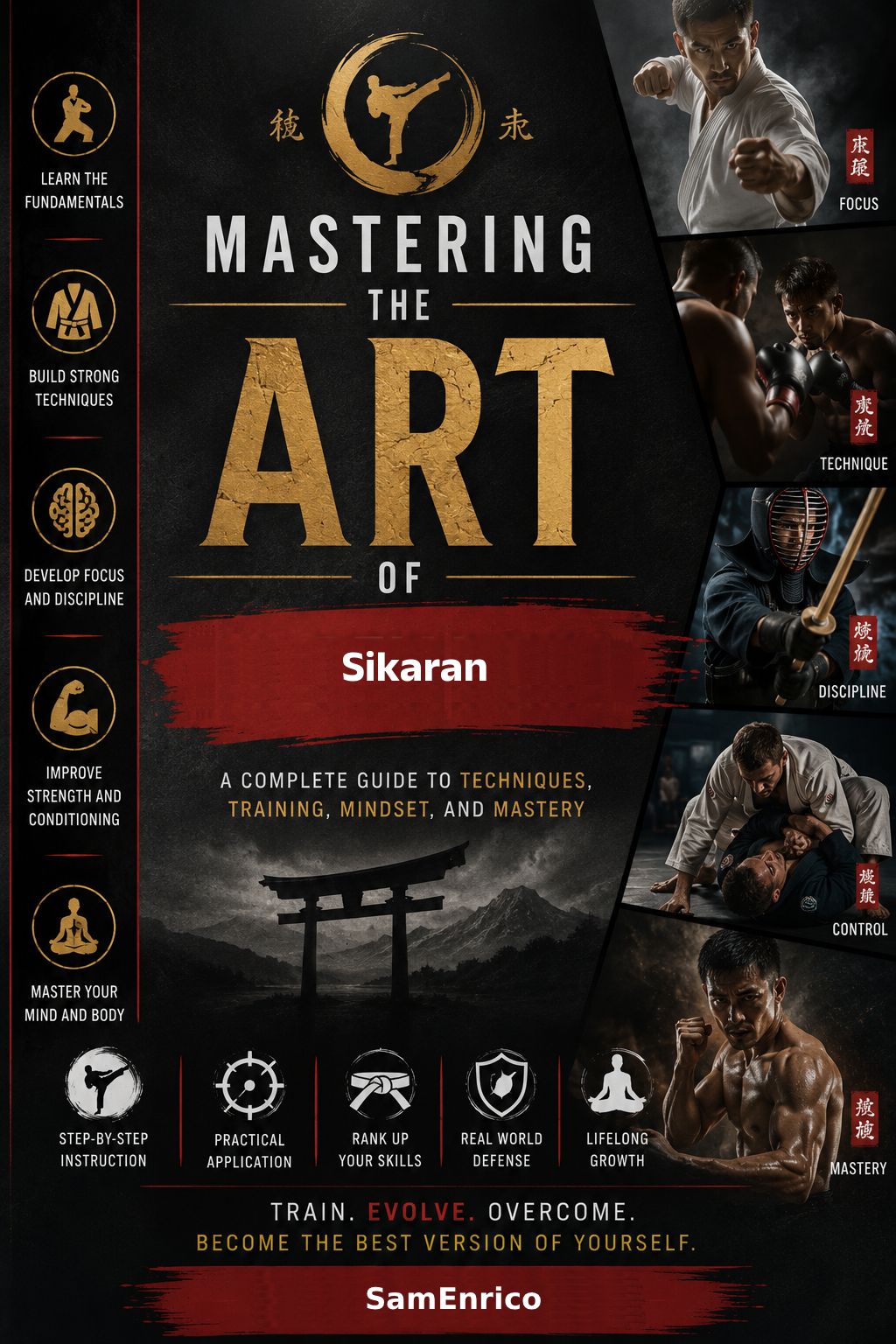 Mastering The Art of SikaranChilders Terica$11.99
You may also like
 Hong Kong Handover 1997Dunn Johnnie$11.99
 Zumba For Postnatal Recovery CourseNeal Christian$11.99
 Zumba for BeginnersLadner Nikia$11.99
 YouTube Comment Mining GuideHumes Pandora$12.99
 Worry Box MeditationCarlin Rudy$11.99
 Workplace Stress MeditationNguyen Lynn$11.99
 Workplace Stress and Sleep RepairHawley Ivory$11.99
 Workplace Perfectionism CureDelaney Jeffry$11.99
 Workplace Injustice Anger GuideWallen Isabelle$11.99
 Work Addiction and Burnout LinkGreenwood Ester$11.99
 Women in Yoga and WellnessBeattie Galina$11.99
 Women in Stand Up ComedyChun Evangeline$11.99