
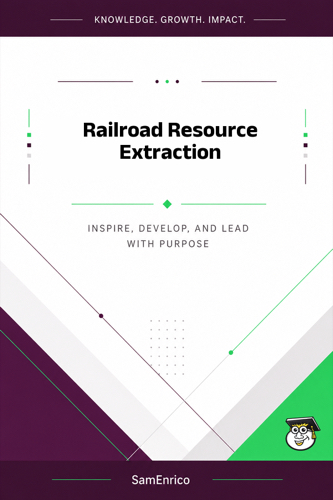
Non-FictionHistoryInfrastructure
Railroad Resource Extraction Audiobook
Railways built solely to move minerals to ports, n
Railways built solely to move minerals to ports, not connect Africa.
Formats
Free sample
Chapter 1: The Steel Funnel...--–- The railway arrived on a Tuesday. Not with a parade or a ribbon-cutting, but with a hundred thousand tons of iron and a thousand white men who did not speak the language of the land they were crossing. By Friday, the first train had run—not carrying passengers, not carrying food, not carrying mail. It carried rock. Copper rock, specifically, dragged from the Katanga mines to the Atlantic, a distance of nearly a thousand miles, and every mile of track was laid with the understanding that no local would ever ride it unless he was chained inside a cattle car.This is not the story of railways that built nations.
This is the story of railways that emptied them.The Great Distinction: Two Kinds of Steel Every schoolchild knows the heroic railway narrative. In the United States, the transcontinental railroad (completed 1869) tied a continent together, enabled homesteading, and created a national market. In Canada, the Canadian Pacific Railway (1885) was a condition of confederation itself—"the railway first, the nation second," as historians like to say. In Russia, the Trans-Siberian Railway (1916) connected Moscow to Vladivostok, binding an empire across eight time zones. These are the "Settlement Railways" of popular memory: engines of integration, arteries of commerce, instruments of national destiny.But there is another kind of railway, and it has never received a heroic biography.
This is the "Extraction Railway"—a point-to-point funnel designed for one purpose only: to move mineral wealth from a colonized interior to a coastal port, where it can be shipped to a foreign industrial center. Extraction railways do not connect markets; they bypass them. They do not enable homesteading; they enable land theft. They do not knit nations together; they hollow them out from the inside.The difference is not merely one of intent. It is baked into the very geometry of the track.
Settlement railways have branches, spurs, and feeder lines—they reach out to agricultural communities, connect towns, create a web of economic activity. Extraction railways are straight lines. They run from the mine to the port and nowhere else. They are designed to be efficient at one thing: draining wealth. Everything else—human dignity, ecological health, local economic development—is either an obstacle to be removed or an externality to be ignored.This book is about the second kind of railway.
It is about the steel funnels that wired the mineral wealth of Africa to the industrial furnaces of Europe, leaving…
This is the end of the free sample. Get the Audiobook to keep going. Buy now
About this book
Details
- Author
- Childers Terica
- Publisher
- SamEnrico
- Language
- English
- Genre
- Non-Fiction, History, Infrastructure
- Released
- 2026-06-08
- Pages (approx.)
- 137
- Available as
- eBook, Audiobook

Listen in the VoxFlicks app
Audiobooks and audio dramas wherever you go. Sign in with your SamEnrico account and press play.
More by Childers Terica
 Exercise For GADChilders Terica$11.99
 Net Operating Loss Carryforward WorkbookChilders Terica$11.99
 Change Resilience GuideChilders Terica$11.99
 Campfire Circle VisualizationChilders Terica$11.99
 GAD And Promotion AnxietyChilders Terica$11.99
 The Open Ended AdvantageChilders Terica$11.99
 Entrepreneur Work AddictionChilders Terica$11.99
 The Serpent’s Gambit: Anubis and the Spies of the UnderworldChilders Terica$11.99
 The Enigma of the Lost Pythagorean ScrollChilders Terica$11.99
 How to Produce Heating RadiatorsChilders Terica$11.99
 A Collector's Handbook to the Fiat 850 Sport CoupéChilders Terica$11.99
 Mastering The Art of SikaranChilders Terica$11.99
You may also like
 Hong Kong Handover 1997Dunn Johnnie$11.99
 Zumba For Postnatal Recovery CourseNeal Christian$11.99
 Zumba for BeginnersLadner Nikia$11.99
 YouTube Comment Mining GuideHumes Pandora$12.99
 Worry Box MeditationCarlin Rudy$11.99
 Workplace Stress MeditationNguyen Lynn$11.99
 Workplace Stress and Sleep RepairHawley Ivory$11.99
 Workplace Perfectionism CureDelaney Jeffry$11.99
 Workplace Injustice Anger GuideWallen Isabelle$11.99
 Work Addiction and Burnout LinkGreenwood Ester$11.99
 Women in Yoga and WellnessBeattie Galina$11.99
 Women in Stand Up ComedyChun Evangeline$11.99