
Non-FictionForecast & OutlookQuantum Tech
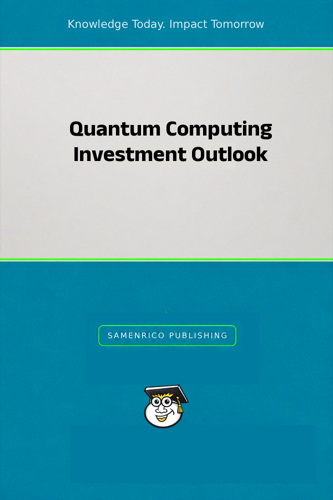
Quantum Computing Investment Outlook eBook
Allocates early capital to hardware, error correct
Allocates early capital to hardware, error correction, and algorithm development.
Formats
Free sample
Chapter 1: The $800 Billion Blind Spot--The most expensive mistake in technology investing today is not backing the wrong quantum computing company. It is measuring the right companies by the wrong metric.Walk into any quantum computing conference, scan the press releases from publicly traded startups, or skim the marketing materials from venture-backed firms, and you will see the same number repeated like a mantra: qubit count. “We have 100 qubits.” “Our roadmap shows 1,000 qubits by 2027.” “We are on track for 100,000 qubits within the decade.” These numbers are presented as the definitive measure of progress, the horsepower of the quantum age, the simple metric that tells you who is winning and who is losing.They are also dangerously misleading.In the late 1990s, the personal computer industry was obsessed with clock speed. Intel and AMD battled to push megahertz ever higher. Consumers learned that a 500 MHz processor was better than a 400 MHz processor.
Investors rewarded companies that delivered faster clock speeds. And then the party ended. Around 2003, the clock speed race hit a wall. Processors became too hot, too power-hungry, and physically impossible to push further. The industry was forced to pivot to a new paradigm: multi-core processors.
Suddenly, clock speed became almost irrelevant. A 2.0 GHz dual-core processor could outperform a 3.0 GHz single-core processor for many tasks. Investors who had bet everything on clock speed leaders found themselves holding the wrong horses.Quantum computing is heading toward the exact same inflection point, except the stakes are an order of magnitude larger and the timeline is compressed.Today, the market is pricing quantum companies primarily on raw qubit counts. Ion Q, Rigetti, D-Wave—their stock prices move with qubit announcements. Private startups like Psi Quantum and Quantinuum raise billions on the back of qubit roadmaps.
Venture capitalists pour money into any company that promises more qubits faster. This is the clock speed mania of 1999, repeated in a new domain.But just as clock speed became obsolete when the industry hit thermal and power limits, raw qubit count is already becoming obsolete as the quantum industry confronts its own fundamental constraint: noise.A qubit is a remarkably fragile thing. It exists in a superposition of states, simultaneously zero and one, until the environment collapses it into a definite value. Temperature fluctuations, electromagnetic interference, cosmic rays, even the thermal radiation from a researcher standing too close can destroy a qubit’s quantum state in microseconds. This process is called decoherence, and it is the single greatest enemy of useful quantum computing.Here is the dirty secret that qubit-count press releases do not advertise: most of those qubits are useless for any practical computation.
They are too noisy, too short-lived, too poorly connected to their neighbors. A quantum computer with 1,000 noisy qubits may be less powerful than a quantum computer with 100 high-quality qubits. Yet the market routinely values the 1,000-qubit machine more highly, simply because the number is larger.This mispricing creates the single greatest opportunity in technology investing today.The market is systematically undervaluing the right metrics—coherence times, gate fidelities, connectivity, error rates—and overvaluing the wrong one. Investors who understand this disconnect can buy into companies with superior underlying technology at a discount, while avoiding the hype-driven bubbles that will inevitably burst when the industry pivots from raw qubit count to system-level architecture.This chapter is about that pivot. It will give you the frameworks, the metrics, and the historical perspective to see through the qubit-count hype.
By the end, you will understand why the next decade will see an $800 billion reallocation of capital across the quantum value chain—and how to position yourself ahead of that shift.The NISQ Era and the Fault-Tolerant Horizon Before we can understand why qubit count is the wrong metric, we need to understand the two distinct eras of quantum computing and why the transition between them will reshape the entire investment landscape.The first era is called NISQ: Noisy Intermediate-Scale Quantum. This term was coined by the physicist John Preskill in 2018, and it describes exactly where we are today. NISQ devices have between 50 and a few thousand qubits. They are powerful enough to perform computations that are difficult or impossible for classical computers. But they are noisy.
The error rates are high. Decoherence limits the length of any computation. A NISQ machine cannot run an algorithm that requires millions of sequential operations because the qubits will lose their quantum state long before the algorithm completes.Think of a NISQ device as a race car with a fantastic engine but terrible brakes. It can go very fast for a short distance, but it cannot complete a long race. It is useful for specific, short-horizon problems—certain types of optimization, some quantum chemistry simulations, specific machine learning tasks.
But it cannot do the things that make quantum computing truly revolutionary: breaking RSA encryption, simulating complex molecules for drug discovery with perfect accuracy, or solving massive logistics problems with exponential speedups.The second era is called FTQC: Fault-Tolerant Quantum Computing. An FTQC machine can run arbitrarily long computations without failure. It achieves this through error correction—redundantly encoding quantum information across many physical qubits so that errors can be detected and corrected before they corrupt the computation. In an FTQC machine, the unit of computation is not the physical qubit but the logical qubit: a collection of physical qubits working together as a single, reliable quantum bit.The transition from NISQ to FTQC is the single most important technological milestone in quantum computing, and it will be the single most important investment signal of the next decade.Here is why this transition matters for investors. During the NISQ era, raw qubit count appears to be a reasonable proxy for progress.
More qubits generally mean more computational power, even if those qubits are noisy. But as the industry approaches the fault-tolerant threshold—the point at which error correction becomes effective enough to create reliable logical qubits—the value of raw qubits collapses, and the value of qubit quality skyrockets.Imagine two companies. Company A has 2,000 physical qubits, but they are noisy, with gate fidelities of 98% and coherence times of 50 microseconds. Company B has 500 physical qubits, but they are pristine, with gate fidelities of 99.9% and coherence times of 1 millisecond. Today, the market would value Company A more highly because 2,000 is larger than 500.
But if Company B can use its high-quality qubits to achieve the fault-tolerant threshold with only 500 physical qubits, while Company A needs 10,000 physical qubits to reach the same threshold, Company B’s technology is vastly more valuable. Company B will reach useful FTQC years earlier, with far less capital expenditure, and will dominate the market.The market does not yet price this difference correctly. Most investors lack the technical vocabulary to distinguish between Company A and Company B. They see qubit counts, they see press releases, they see stock prices moving on headlines. This is your edge.The Clock Speed Parallel: A History Lesson in Mispricing The quantum qubit-count mania is not unprecedented.
It is a direct replay of the clock speed wars of the late 1990s and early 2000s, and that history offers a precise roadmap for what is about to happen.From the early 1990s until about 2003, the…
This is the end of the free sample. Get the eBook to keep going. Buy now
About this book
Details
- Author
- Sweeney Librada
- Publisher
- SamEnrico
- Language
- English
- Genre
- Non-Fiction, Forecast & Outlook, Quantum Tech
- Released
- 2026-06-05
- Pages (approx.)
- 146
- Available as
- eBook, Audiobook

Read better in the ZLOADR app
Your eBooks on your phone or tablet. Sign in with your SamEnrico account and start reading.
More by Sweeney Librada
 Loci for Chess OpeningsSweeney Librada$11.99
 Food Insecurity TraumaSweeney Librada$11.99
 Eye Contact Communication ManualSweeney Librada$11.99
 Remote Review for ExecutivesSweeney Librada$11.99
 Sand and Serpents: The Forgotten War of the HyksosSweeney Librada$11.99
 Understanding Paraparesis Amyotrophy of Hands and FeetSweeney Librada$17.99
 How to Become a Sewing Machine Operator ISweeney Librada$11.99
 Transportation ESG BenchmarkSweeney Librada$12.99
 Tech Mentor LinkedIn Search GuideSweeney Librada$12.99
 Figure of MeritSweeney Librada$11.99
You may also like
 Hong Kong Handover 1997Dunn Johnnie$11.99
 Zumba For Postnatal Recovery CourseNeal Christian$11.99
 Zumba for BeginnersLadner Nikia$11.99
 YouTube Comment Mining GuideHumes Pandora$12.99
 Worry Box MeditationCarlin Rudy$11.99
 Workplace Stress MeditationNguyen Lynn$11.99
 Workplace Stress and Sleep RepairHawley Ivory$11.99
 Workplace Perfectionism CureDelaney Jeffry$11.99
 Workplace Injustice Anger GuideWallen Isabelle$11.99
 Work Addiction and Burnout LinkGreenwood Ester$11.99
 Women in Yoga and WellnessBeattie Galina$11.99
 Women in Stand Up ComedyChun Evangeline$11.99