
Non-FictionForecast & OutlookQuantum Tech
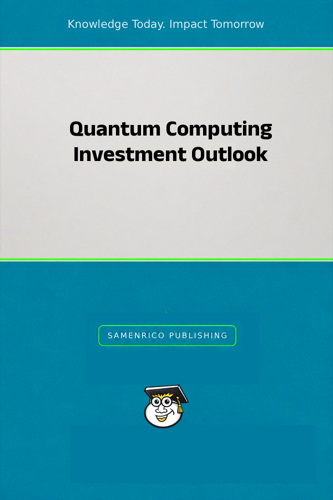
Quantum Computing Investment Outlook Audiobook
Allocates early capital to hardware, error correct
Allocates early capital to hardware, error correction, and algorithm development.
Formats
Free sample
Chapter 1: The $800 Billion Blind Spot--The most expensive mistake in technology investing today is not backing the wrong quantum computing company. It is measuring the right companies by the wrong metric.Walk into any quantum computing conference, scan the press releases from publicly traded startups, or skim the marketing materials from venture-backed firms, and you will see the same number repeated like a mantra: qubit count. “We have 100 qubits.” “Our roadmap shows 1,000 qubits by 2027.” “We are on track for 100,000 qubits within the decade.” These numbers are presented as the definitive measure of progress, the horsepower of the quantum age, the simple metric that tells you who is winning and who is losing.They are also dangerously misleading.In the late 1990s, the personal computer industry was obsessed with clock speed. Intel and AMD battled to push megahertz ever higher. Consumers learned that a 500 MHz processor was better than a 400 MHz processor.
Investors rewarded companies that delivered faster clock speeds. And then the party ended. Around 2003, the clock speed race hit a wall. Processors became too hot, too power-hungry, and physically impossible to push further. The industry was forced to pivot to a new paradigm: multi-core processors.
Suddenly, clock speed became almost irrelevant. A 2.0 GHz dual-core processor could outperform a 3.0 GHz single-core processor for many tasks. Investors who had bet everything on clock speed leaders found themselves holding the wrong horses.Quantum computing is heading toward the exact same inflection point, except the stakes are an order of magnitude larger and the timeline is compressed.Today, the market is pricing quantum companies primarily on raw qubit counts. Ion Q, Rigetti, D-Wave—their stock prices move with qubit announcements. Private startups like Psi Quantum and Quantinuum raise billions on the back of qubit roadmaps.
Venture capitalists pour money into any company that promises more qubits faster. This is the clock speed mania of 1999, repeated in a new domain.But just as clock speed became obsolete when the industry hit thermal and power limits, raw qubit count is already becoming obsolete as the quantum industry confronts its own fundamental constraint: noise.A qubit is a remarkably fragile thing. It exists in a superposition of states, simultaneously zero and one, until the environment collapses it into a definite value. Temperature fluctuations, electromagnetic interference, cosmic rays, even the thermal radiation from a researcher standing too close can destroy a qubit’s quantum state in microseconds. This process is…
This is the end of the free sample. Get the Audiobook to keep going. Buy now
About this book
Details
- Author
- Sweeney Librada
- Publisher
- SamEnrico
- Language
- English
- Genre
- Non-Fiction, Forecast & Outlook, Quantum Tech
- Released
- 2026-06-05
- Pages (approx.)
- 146
- Available as
- eBook, Audiobook

Listen in the VoxFlicks app
Audiobooks and audio dramas wherever you go. Sign in with your SamEnrico account and press play.
More by Sweeney Librada
 Loci for Chess OpeningsSweeney Librada$11.99
 Food Insecurity TraumaSweeney Librada$11.99
 Eye Contact Communication ManualSweeney Librada$11.99
 Remote Review for ExecutivesSweeney Librada$11.99
 Sand and Serpents: The Forgotten War of the HyksosSweeney Librada$11.99
 Understanding Paraparesis Amyotrophy of Hands and FeetSweeney Librada$17.99
 How to Become a Sewing Machine Operator ISweeney Librada$11.99
 Transportation ESG BenchmarkSweeney Librada$12.99
 Tech Mentor LinkedIn Search GuideSweeney Librada$12.99
 Figure of MeritSweeney Librada$11.99
You may also like
 Hong Kong Handover 1997Dunn Johnnie$11.99
 Zumba For Postnatal Recovery CourseNeal Christian$11.99
 Zumba for BeginnersLadner Nikia$11.99
 YouTube Comment Mining GuideHumes Pandora$12.99
 Worry Box MeditationCarlin Rudy$11.99
 Workplace Stress MeditationNguyen Lynn$11.99
 Workplace Stress and Sleep RepairHawley Ivory$11.99
 Workplace Perfectionism CureDelaney Jeffry$11.99
 Workplace Injustice Anger GuideWallen Isabelle$11.99
 Work Addiction and Burnout LinkGreenwood Ester$11.99
 Women in Yoga and WellnessBeattie Galina$11.99
 Women in Stand Up ComedyChun Evangeline$11.99