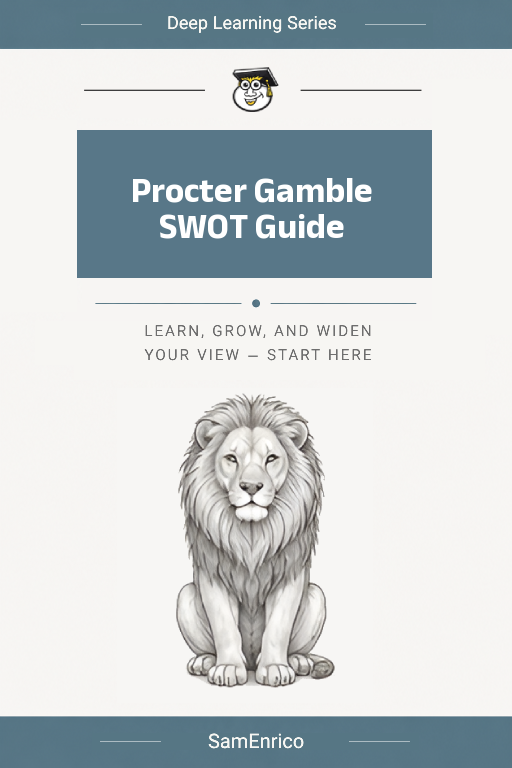
Procter Gamble SWOT Guide
Evaluate brand portfolio, supply chain efficiency,
by Gilliam Nada
Evaluate brand portfolio, supply chain efficiency, emerging market growth, and private label competition.
Formats
About this book
Free sample
Chapter 1: The Fortress Illusion...--–- On a Tuesday morning in Cincinnati, a brand manager for a billion-dollar product realized something terrifying. The spreadsheet in front of her showed flat volume growth for the sixth consecutive quarter. Prices had risen 8 percent. Promotional spending was up 12 percent. And yet, market share had not budged.
Meanwhile, across town, a buyer for a national retailer was preparing a presentation for her CEO titled "Private Label Expansion: 15 Categories, 30 Percent Savings, Zero Customer Complaints." The brand manager did not know about that presentation. But she could feel it in her bones. Something had shifted. The fortress was no longer holding.This is the reality of Procter & Gamble in the 2020s, and it is the reality of any company that has relied on brand scale as its primary defense. For decades, the logic was simple and unassailable.
Large brands with large marketing budgets and large distribution networks created a moat that smaller competitors could not cross. Retailers needed P&G more than P&G needed them. Consumers trusted names like Tide, Pampers, and Crest with an almost religious certainty. The portfolio of twenty-five billion-dollar brands was not just a collection of products. It was a mutual insurance policy.
When razor sales softened because men grew beards, home care surged because those same men spilled coffee on their countertops. When diapers faced headwinds from declining birth rates in developed markets, fabric care compensated with pandemic-era nesting behavior. The portfolio appeared to be a perfect machine. But machines break.This chapter argues that the fortress portfolio is an illusion when viewed through the wrong lens. It is not a static defense.
It is a dynamic system that requires constant pruning, rebalancing, and brutal honesty about which categories are truly defensible and which are slowly being conquered by private labels, digital natives, and the silent erosion of consumer loyalty. The chapter introduces the Fortress-Prison Paradox, a framework that explains why the same portfolio that protects P&G during stable economic periods becomes a prison during inflationary disruption and category fragmentation. Understanding this paradox is the first step toward building a…
This is the end of the free sample. Get the eBook to keep going. Buy now
Contents
- Chapter 1
- Chapter 2
- Chapter 3
- Chapter 4
- Chapter 5
- Chapter 6
- Chapter 7
- Chapter 8
- Chapter 9
- Chapter 10
- Chapter 11
- Chapter 12
Details
- Author
- Gilliam Nada
- Publisher
- SamEnrico
- Language
- English
- Genre
- Non-Fiction, Strategic Atlas, CPG
- Released
- 2026-05-30
- Pages (approx.)
- 137
- Available as
- eBook, Audiobook

Read better in the ZLOADR app
Your eBooks on your phone or tablet. Sign in with your SamEnrico account and start reading.
More by Gilliam Nada
 Emotional Intelligence in TechGilliam Nada$11.99
 TM For Elderly Practitioners CourseGilliam Nada$11.99
 Microneedle Patch VaccineGilliam Nada$11.99
 Lighthouse Beam GuideGilliam Nada$11.99
 Self Esteem for People With DisabilityGilliam Nada$11.99
 The Last Dive of the LeviathanGilliam Nada$11.99
 Understanding Mutations In Estradiol ReceptorGilliam Nada$17.99
 How to Become a Spool MakerGilliam Nada$11.99
 AI Financial Data CollaborationGilliam Nada$12.99
 The Screenwriter's StructureGilliam Nada$11.99