
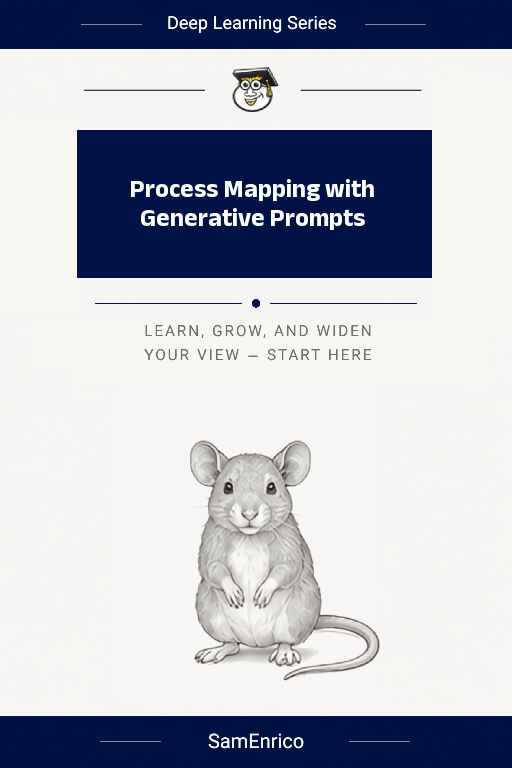
Non-FictionAI OperatorProcess ImprovementBPM
Process Mapping with Generative Prompts eBook
Automate As-Is and To-Be process diagram creation
Automate As-Is and To-Be process diagram creation using prompt chains. Validate logic, identify bottlenecks, and generate BPMN 2.0 compliant flows.
Formats
Free sample
Chapter 1: The Drawing Trap--–- The senior business analyst had spent three weeks mapping the procurement process. Forty-seven sticky notes covered the wall. Twenty-three interviews had been transcribed. The Visio diagram had 112 shapes, meticulously aligned, color-coded by swimlane, and reviewed by four stakeholders. During the final presentation, the Head of Procurement raised his hand and asked a simple question: "If the PO exceeds $50,000, why does it go to Legal before Finance? That's backwards. We fixed that six months ago."The room went silent. The analyst felt the blood drain from her face. She had interviewed Legal. She had interviewed Finance. Both had described the process as it used to be, not as it is. The correction meant deleting 14 tasks, reordering 23 sequence flows, and revalidating every gateway decision. Three weeks of work would be redone in three days—if she worked through the weekend.This is not a failure of skill or effort. It is a failure of method.For decades, process mapping has remained stuck in the drafting paradigm. Business analysts, process consultants, and BPM practitioners have been trained to think of themselves as diagrammers—people who translate verbal descriptions into visual notation through manual clicking, dragging, connecting, and aligning. The tools have evolved from whiteboards to Visio to Lucidchart to draw.io, but the fundamental activity has not changed. You listen. You interpret. You draw. You redraw. You align. You realign. You validate. You rebuild.The drafting paradigm has four invisible bottlenecks that, together, consume an estimated 80% of the time spent on process mapping. These bottlenecks are not caused by lazy analysts or poorly designed tools. They are structural. They are baked into the very assumption that process mapping is a drawing activity.Bottleneck One: Translation Loss When a stakeholder says "Then we send it to the compliance team for review," what does that become in BPMN? Is it a user task? A business rule task? A sub-process? Does it happen in the same lane or does it cross a pool boundary? Every verbal description loses information in translation. The analyst must guess. The stakeholder later says "That's not what I meant." The cycle repeats.Bottleneck Two: Revision Friction In a text document, changing the word "quickly" to "within 24 hours" takes one second. In a diagram, moving a task from one swimlane to another requires selecting the shape, dragging it across the canvas, readjusting every sequence flow that intersects, and revalidating that no gateway logic was broken. A change that should take five seconds takes five minutes. Over a 200-shape diagram, revision friction accumulates into days of wasted time.Bottleneck Three: Consistency Failure The human eye is terrible at detecting logical inconsistencies across a large diagram. Does every split gateway have a corresponding merge? Is every task reachable from a start event? Does every sequence flow have a source and target? These questions require systematic validation, but the drafting paradigm offers only manual inspection. Consistency failures survive to stakeholder review, where they are discovered too late.Bottleneck Four: Validation Blindness The person who draws a diagram cannot see its logical flaws. This is a well-documented cognitive phenomenon called the creator blind spot. When you build something, your brain fills in missing connections automatically. You see what you intended to draw, not what you actually drew. Third-party reviewers see the gaps immediately—but only after the diagram is "finished."Together, these four bottlenecks explain why the average enterprise process mapping project takes 6-8 weeks and produces a diagram that is already obsolete before it is approved.There is another way.The Prompt Paradigm: From Drafter to Director What if you stopped drawing and started directing?Consider the difference between a film director and a storyboard artist. The storyboard artist draws every frame by hand—meticulous, time-consuming, and brittle. A single change requires redrawing dozens of frames. The director, by contrast, does not draw. The director speaks intent: "The camera tracks left as the protagonist enters the room. The lighting shifts from warm to cool. The background actors freeze." The cinematographer, the gaffer, and the production designer execute the vision. The director directs.Generative AI is your cinematographer for process mapping. You do not need to draw shapes, align swimlanes, or format sequence flows. You need to specify what the process does and under what conditions it changes. The AI handles the syntax, the layout, and the formatting.This is the prompt paradigm: a shift from manual drafting to natural language directing.In the drafting paradigm, you ask yourself: "Where do I put this shape?"In the prompt paradigm, you ask: "What rule governs this decision?"In the drafting paradigm, you spend hours aligning boxes. In the prompt paradigm, you spend minutes describing logic.In the drafting paradigm, you discover errors during stakeholder review. In the prompt paradigm, you discover them during automated validation.The difference is not incremental. It is transformational.Consider the same procurement process from the opening story. Under the prompt paradigm, the analyst would not have created a Visio diagram. She would have created a Context Pack—a structured text document containing the glossary, role registry, and constraint catalog for the procurement domain. She would have fed interview transcripts into an extraction chain that converts raw text into structured activity flows. She would have generated a BPMN diagram using a prompt chain—a sequence of smaller, interdependent prompts that build the diagram piece by piece. When the Head of Procurement said "That's backwards," she would have typed: "Swap the 'Legal Review' and 'Finance Approval' tasks, then reconnect all sequence flows and update the gateway conditions accordingly." The AI would have executed the change in seconds, not days.This book teaches you how to do exactly that.Introducing the PEER Framework The methodology at the heart of this book is called PEER: Plan, Extract, Execute, Refine. It is a four-phase cycle for building validated BPMN 2.0 diagrams using generative AI. Each phase corresponds to a specific set of activities and a specific set of prompt patterns.Plan is where you build the foundation. You define the scope of the process, identify the roles and systems involved, and create the Golden Source Document—the single, version-controlled source of truth that the AI will query throughout the mapping process. The Plan phase answers the question: What are we mapping, and what rules govern it?Extract is where you convert raw information into structured process logic. You feed interview transcripts, email threads, meeting notes, and existing documentation into extraction prompts that identify tasks, sequence flows, decision points, and data objects. The Extract phase answers the question: What does the current process actually do?Execute is where you generate the diagram. You use prompt chains to build the As-Is model, apply constraints to design the To-Be model, and enforce BPMN 2.0 compliance through syntax prompts. The Execute phase answers the question: How do we represent the process visually?Refine is where you validate and improve. You run semantic validation prompts to detect logical errors, identify bottlenecks, test compliance, and estimate cognitive load. You iterate through conversational refinement commands until the diagram meets stakeholder approval. The Refine phase answers the question: Is the process correct, and how can it be better?The PEER framework is not linear. It is a cycle. You may return to Plan after discovering missing constraints during Refine. You may re-enter Extract after realizing that a stakeholder interview…
This is the end of the free sample. Get the eBook to keep going. Buy now
About this book
Details
- Author
- Swain Joaquin
- Publisher
- SamEnrico
- Language
- English
- Genre
- Non-Fiction, AI Operator, Process Improvement, BPM
- Released
- 2026-05-29
- Pages (approx.)
- 131
- Available as
- eBook, Audiobook

Read better in the ZLOADR app
Your eBooks on your phone or tablet. Sign in with your SamEnrico account and start reading.
More by Swain Joaquin
 TM for Oncology StaffSwain Joaquin$11.99
 Sleep Recovery for WorkersSwain Joaquin$11.99
 Heat Exposure HGH ResponseSwain Joaquin$11.99
 Workout Routine LociSwain Joaquin$11.99
 Diamond Heist Anniversary ReportsSwain Joaquin$11.99
 Talking About Money With PartnerSwain Joaquin$11.99
 Nicotine And Dental Health GuideSwain Joaquin$11.99
 HGH And Testosterone LinkSwain Joaquin$11.99
 EU Level Green Tax CreditsSwain Joaquin$11.99
 Whispers of the Frozen Throne: The Last Ice Queen of GreenlandSwain Joaquin$11.99
 The Medici Code: Florence's Golden Web of Art and PowerSwain Joaquin$11.99
 The Ballad of the Missing Billionaire: The Strange Disappearance of Jho LowSwain Joaquin$11.99
You may also like
 Hong Kong Handover 1997Dunn Johnnie$11.99
 Zumba For Postnatal Recovery CourseNeal Christian$11.99
 Zumba for BeginnersLadner Nikia$11.99
 YouTube Comment Mining GuideHumes Pandora$12.99
 Worry Box MeditationCarlin Rudy$11.99
 Workplace Stress MeditationNguyen Lynn$11.99
 Workplace Stress and Sleep RepairHawley Ivory$11.99
 Workplace Perfectionism CureDelaney Jeffry$11.99
 Workplace Injustice Anger GuideWallen Isabelle$11.99
 Work Addiction and Burnout LinkGreenwood Ester$11.99
 Women in Yoga and WellnessBeattie Galina$11.99
 Women in Stand Up ComedyChun Evangeline$11.99