
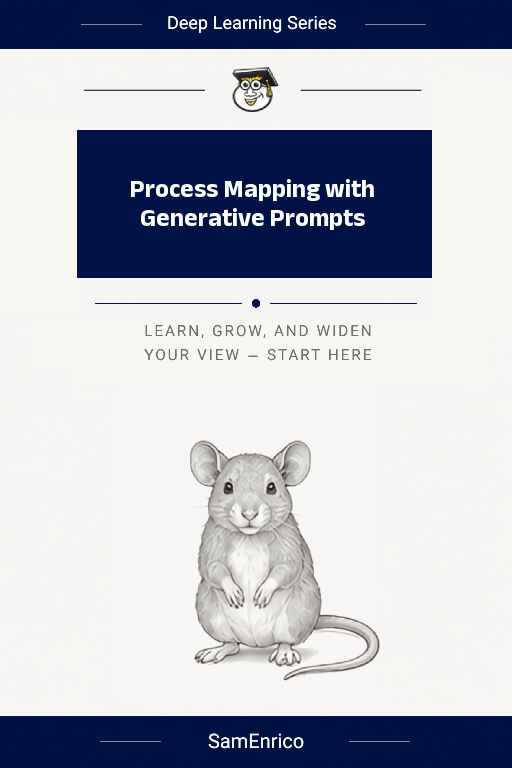
Non-FictionAI OperatorProcess ImprovementBPM
Process Mapping with Generative Prompts
Automate As-Is and To-Be process diagram creation
Automate As-Is and To-Be process diagram creation using prompt chains. Validate logic, identify bottlenecks, and generate BPMN 2.0 compliant flows.
Formats
About this book
Free sample
Chapter 1: The Drawing Trap--–- The senior business analyst had spent three weeks mapping the procurement process. Forty-seven sticky notes covered the wall. Twenty-three interviews had been transcribed. The Visio diagram had 112 shapes, meticulously aligned, color-coded by swimlane, and reviewed by four stakeholders. During the final presentation, the Head of Procurement raised his hand and asked a simple question: "If the PO exceeds $50,000, why does it go to Legal before Finance? That's backwards. We fixed that six months ago."The room went silent. The analyst felt the blood drain from her face. She had interviewed Legal. She had interviewed Finance. Both had described the process as it used to be, not as it is. The correction meant deleting 14 tasks, reordering 23 sequence flows, and revalidating every gateway decision. Three weeks of work would be redone in three days—if she worked through the weekend.This is not a failure of skill or effort. It is a failure of method.For decades, process mapping has remained stuck in the drafting paradigm. Business analysts, process consultants, and BPM practitioners have been trained to think of themselves as diagrammers—people who translate verbal descriptions into visual notation through manual clicking, dragging, connecting, and aligning. The tools have evolved from whiteboards to Visio to Lucidchart to draw.io, but the fundamental activity has not changed. You listen. You interpret. You draw. You redraw. You align. You realign. You validate. You rebuild.The drafting paradigm has four invisible bottlenecks that, together, consume an estimated 80% of the time spent on process mapping. These bottlenecks are not caused by lazy analysts or poorly designed tools. They are structural. They are baked into the very assumption that process mapping is a drawing activity.Bottleneck One: Translation Loss When a stakeholder says "Then we send it to the compliance team for review," what does that become in BPMN? Is it a user task? A business rule task? A sub-process? Does it happen in the same lane or does it cross a pool boundary? Every verbal description loses information in translation. The analyst must guess. The stakeholder later says "That's not what I meant."…
This is the end of the free sample. Get the eBook to keep going. Buy now
Contents
- Chapter 1
- Chapter 2
- Chapter 3
- Chapter 4
- Chapter 5
- Chapter 6
- Chapter 7
- Chapter 8
- Chapter 9
- Chapter 10
- Chapter 11
- Chapter 12
Details
- Author
- Swain Joaquin
- Publisher
- SamEnrico
- Language
- English
- Genre
- Non-Fiction, AI Operator, Process Improvement, BPM
- Released
- 2026-05-29
- Pages (approx.)
- 131
- Available as
- eBook, Audiobook

Read better in the ZLOADR app
Your eBooks on your phone or tablet. Sign in with your SamEnrico account and start reading.
More by Swain Joaquin
 TM for Oncology StaffSwain Joaquin$11.99
 Sleep Recovery for WorkersSwain Joaquin$11.99
 Heat Exposure HGH ResponseSwain Joaquin$11.99
 Workout Routine LociSwain Joaquin$11.99
 Diamond Heist Anniversary ReportsSwain Joaquin$11.99
 Talking About Money With PartnerSwain Joaquin$11.99
 Nicotine And Dental Health GuideSwain Joaquin$11.99
 HGH And Testosterone LinkSwain Joaquin$11.99
 EU Level Green Tax CreditsSwain Joaquin$11.99
 Whispers of the Frozen Throne: The Last Ice Queen of GreenlandSwain Joaquin$11.99
 The Medici Code: Florence's Golden Web of Art and PowerSwain Joaquin$11.99
 The Ballad of the Missing Billionaire: The Strange Disappearance of Jho LowSwain Joaquin$11.99
You may also like
 Hong Kong Handover 1997Dunn Johnnie$11.99
 Zumba For Postnatal Recovery CourseNeal Christian$11.99
 Zumba for BeginnersLadner Nikia$11.99
 YouTube Comment Mining GuideHumes Pandora$12.99
 Worry Box MeditationCarlin Rudy$11.99
 Workplace Stress MeditationNguyen Lynn$11.99
 Workplace Stress and Sleep RepairHawley Ivory$11.99
 Workplace Perfectionism CureDelaney Jeffry$11.99
 Workplace Injustice Anger GuideWallen Isabelle$11.99
 Work Addiction and Burnout LinkGreenwood Ester$11.99
 Women in Yoga and WellnessBeattie Galina$11.99
 Women in Stand Up ComedyChun Evangeline$11.99