
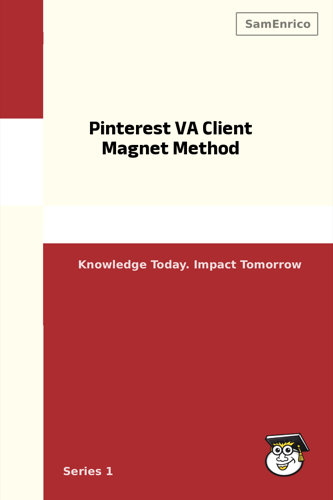
Non-FictionSide Hustle Architect
Pinterest VA Client Magnet Method eBook
Attract high paying Pinterest clients without cold
Attract high paying Pinterest clients without cold pitching using content marketing and social proof.
Formats
Free sample
Chapter 1: The $47 Confession--–- I was staring at my bank account on a Tuesday morning in February, and the number felt like a personal attack. $47.23. Not $47.23 with a comma hiding three more digits. Just forty-seven dollars and twenty-three cents. My rent was due in six days.
My phone bill had already been declined twice. And I had just sent my one hundred and forty-seventh cold pitch—a carefully crafted Linked In message to a business owner who I knew would never reply.She didn't.None of them did. Or if they replied, it was a polite "not right now" or, worse, "what's your hourly rate?" followed by silence when I said $35/hour. I was a Virtual Assistant with impressive skills, a polished resume, and absolutely zero leverage. I was hunting clients like a starving animal, and they could smell the desperation from miles away.That was the moment everything changed.
Not because I found a magic formula or a secret hack. But because I finally admitted something to myself: cold pitching was a form of financial self-harm, and I needed to stop.The Dirty Secret Nobody Tells You About Cold Pitching Let me be brutally honest about something most "gurus" won't say. Cold pitching—sending unsolicited DMs, emails, or Linked In messages to strangers—has a success rate so low that it would be illegal to call it a business strategy. I know because I tracked every single pitch I sent over six months. I created a spreadsheet with columns for date, platform, message content, follow-up attempts, and outcome.
The results were humiliating.Out of 147 cold pitches:112 received no reply at all (76%).28 received a polite "no thanks" or "not hiring" (19%).5 received a "maybe later" that never materialized (3.4%).2 turned into discovery calls (1.3%).0 turned into paying clients (0%).I spent approximately 35 hours crafting those 147 messages. At my target rate of $35/hour, that was $1,225 of unpaid labor. For zero return. If cold pitching were an investment, it would be the worst-performing asset in history.But here's what's even more painful. Every time I sent a cold pitch, I was reinforcing a terrible identity.
I was "the person who asks for help." I was "the beggar." I was not "the expert." And the clients who did reply—the rare ones—treated me accordingly. They asked for discounts. They demanded unlimited revisions. They paid late. Why?
Because they knew I had no other options. I had proven it by showing up in their DMs uninvited.Cold pitching doesn't just waste your time. It poisons your positioning. It announces to the world that you are hunting, and hunters are hungry. And hungry people do not command premium rates.The Day I Quit Pitching (And What Happened Next)After the $47.23 morning, I made a radical decision.
I would not send another cold pitch for 90 days. No DMs. No emails to strangers. No "just following up" messages. Nothing.
I would either figure out how to attract clients without chasing them, or I would accept that freelancing wasn't for me and go back to a 9-to-5 job.I started researching how businesses got found without advertising. I studied SEO, content marketing, and something called "inbound marketing." And then I stumbled onto a platform that everyone told me was just for recipes and wedding planning.Pinterest.At first, I dismissed it. I was a Virtual Assistant for B2B service providers. My clients were consultants, coaches, and small agency owners. Surely they weren't scrolling through mood boards for home decor.
But then I looked at the data. Pinterest has over 450 million monthly active users, and here's the thing that changed everything for me: 80% of those users discover new brands through search, not the feed. They type specific questions into Pinterest exactly the way they type them into Google.Questions like:"How do I organize my Pinterest business account?""Best Pinterest strategy for e-commerce""Hire Pinterest virtual assistant""Pinterest manager for small business"I wasn't seeing those searches because I wasn't looking. But they were happening. Every single day.
Business owners were typing those exact phrases into a search bar, hoping to find someone exactly like me. And I was ignoring them to send Linked In messages to people who had never heard of me.So I ran an experiment. I optimized my Pinterest profile. I learned the basics of keyword research. I created a handful of pins that answered the exact questions my ideal clients were asking.
And then I waited.For the first two weeks, nothing happened. I almost gave up. But on day 17, I got a notification. Someone had saved one of my pins to a board called "Marketing Help for My Bakery." I clicked on their profile. It was a real business owner—a woman who owned a gluten-free bakery with 15,000 Instagram followers.
She had saved my pin about "Pinterest SEO for food brands."I did not DM her. I did not pitch her. I just kept pinning.On day 24, she visited my website from Pinterest. On day 26, she downloaded my free lead magnet—a Pinterest audit checklist. On day 31, she booked a discovery call through the link in my email sequence.
On day 33, she became my first inbound client. She paid me $1,200 for a one-time Pinterest audit and strategy session. No negotiation. No discount. No "can you do it for less?"She later told me, "I found you because you were the only person on Pinterest who actually answered my question instead of just posting pretty pictures.
You sounded like you knew what you were talking about."That was the moment I understood the difference between hunting and attracting. She didn't hire me because I asked. She hired me because I had already proven my value before she ever spoke to me.Why Pinterest Is Not Social Media (And Why That Matters)Before we go any further, I need to correct a massive misconception that keeps VAs broke. Pinterest is not social media. I need you to read that sentence again because it is the entire foundation of this book.Social media platforms—Instagram, Tik Tok, Facebook, X (formerly Twitter)—are designed for connection and entertainment.
Content on those platforms has a short lifespan. You post a Reel, it gets views for 24-48 hours, and then it disappears into the void. The algorithm prioritizes recency and engagement. You have to keep posting constantly to stay visible.Pinterest is a visual search engine. It is much closer to Google than it is to Instagram.
When someone types a query into Pinterest, they see results based on relevance and quality, not recency. A pin you create today can be found months or even years later. In fact, the average lifespan of a pin is 3-6 months, compared to 24 hours for an Instagram post.Here is what that means for you as a Virtual Assistant.When you post on Instagram, you are broadcasting to your existing followers (who probably already know you) or hoping the algorithm shows you to strangers. When you pin on Pinterest, you are inserting yourself into a search results page where people are actively looking for solutions. The difference is the difference between standing on a street corner with a sign and opening a store on a…
This is the end of the free sample. Get the eBook to keep going. Buy now
About this book
Details
- Author
- Bellamy Karissa
- Publisher
- SamEnrico
- Language
- English
- Genre
- Non-Fiction, Side Hustle Architect
- Released
- 2026-06-08
- Pages (approx.)
- 139
- Available as
- eBook, Audiobook

Read better in the ZLOADR app
Your eBooks on your phone or tablet. Sign in with your SamEnrico account and start reading.
More by Bellamy Karissa
 Mammogram Screening Guide for WomenBellamy Karissa$11.99
 Small Talk for Medical Waiting RoomsBellamy Karissa$11.99
 Email Signature OptimizationBellamy Karissa$11.99
 Remote Communication MetricsBellamy Karissa$11.99
 The Alchemist's Secret: The Medieval Quest for the Philosopher's Stone and the Birth of Mineral ScienceBellamy Karissa$11.99
 Glass Ceiling: The Unseen War of the First Female AstronautsBellamy Karissa$11.99
 Understanding Cochin Jewish DisorderBellamy Karissa$17.99
 How to Start a Hobby in LifecastingBellamy Karissa$11.99
 Background InvestigatorBellamy Karissa$11.99
 WeeTrade YC Application GuideBellamy Karissa$12.99
 Production Schedule Cross TrainingBellamy Karissa$12.99
You may also like
 Hong Kong Handover 1997Dunn Johnnie$11.99
 Zumba For Postnatal Recovery CourseNeal Christian$11.99
 Zumba for BeginnersLadner Nikia$11.99
 YouTube Comment Mining GuideHumes Pandora$12.99
 Worry Box MeditationCarlin Rudy$11.99
 Workplace Stress MeditationNguyen Lynn$11.99
 Workplace Stress and Sleep RepairHawley Ivory$11.99
 Workplace Perfectionism CureDelaney Jeffry$11.99
 Workplace Injustice Anger GuideWallen Isabelle$11.99
 Work Addiction and Burnout LinkGreenwood Ester$11.99
 Women in Yoga and WellnessBeattie Galina$11.99
 Women in Stand Up ComedyChun Evangeline$11.99