
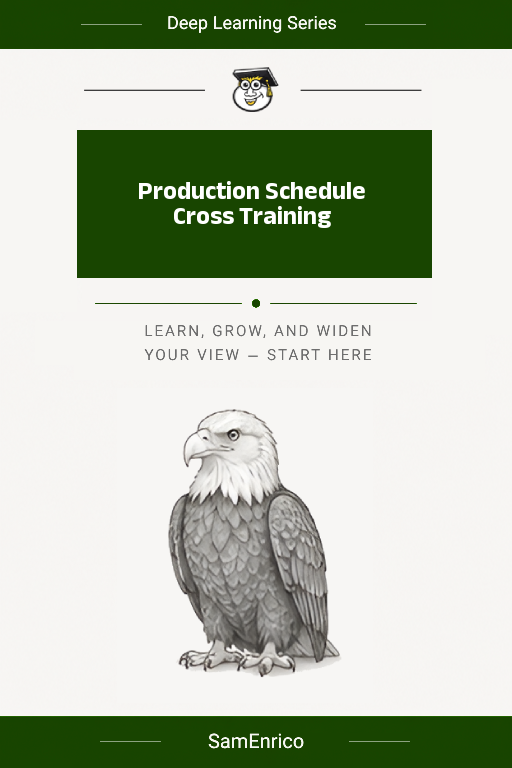
Non-FictionOperational Efficiency ManualCross Training
Production Schedule Cross Training
Schedule operators across multiple stations using
Schedule operators across multiple stations using cross-training to improve flexibility.
Formats
About this book
Free sample
Chapter 1: The Idle Operator Paradox--–- The Monday morning email arrived at 5:47 AM. Three call-offs. A bottleneck station down. The production scheduler, a twenty-year veteran named Diane, was already crying at her desk when I walked in. "The ERP says we're fully staffed," she said, pointing at her screen.
"But look at the floor."I looked. Station four—the CNC mill that every other station depended on—was dark. The operator had called in sick. And here was the problem Diane was crying about: no one else in the building knew how to run that machine. Not one person.
The mill would sit idle until the operator returned, which meant the next three stations downstream would run out of work by 10:00 AM, which meant the packing station would be empty by 1:00 PM, which meant the shipping dock would have nothing to load by 3:00 PM. One absence. One missing skill. A cascade of idle time that would cost the company $47,000 in lost output before the day was over.Diane wasn't crying because she was weak. She was crying because she was powerless.
Her schedule—meticulously crafted, optimized by software, approved by three layers of management—was a fantasy the moment the first call-off came in. And she knew it.This is the Idle Operator Paradox: most factories have enough people, but not enough of the right people at the right stations. The gap between headcount and skill coverage is where production schedules go to die. And until you understand that gap, you will keep building schedules that look perfect on a screen and fall apart on the floor.The ERP/MRP Gap: Why Software Lies to You Let me be precise about what is happening in that opening story. Enterprise Resource Planning (ERP) and Manufacturing Resource Planning (MRP) systems are extraordinary tools.
They track inventory, manage purchase orders, calculate material requirements, and generate production schedules that account for machine capacity, tooling availability, and material lead times. They can do all of that with impressive accuracy.But here is what almost every ERP and MRP system assumes: infinite labor availability. Specifically, these systems…
This is the end of the free sample. Get the eBook to keep going. Buy now
Contents
- Chapter 1
- Chapter 2
- Chapter 3
- Chapter 4
- Chapter 5
- Chapter 6
- Chapter 7
- Chapter 8
- Chapter 9
- Chapter 10
- Chapter 11
- Chapter 12
Details
- Author
- Bellamy Karissa
- Publisher
- SamEnrico
- Language
- English
- Genre
- Non-Fiction, Operational Efficiency Manual, Cross Training
- Released
- 2026-05-29
- Pages (approx.)
- 124
- Available as
- eBook, Audiobook

Read better in the ZLOADR app
Your eBooks on your phone or tablet. Sign in with your SamEnrico account and start reading.
More by Bellamy Karissa
 Mammogram Screening Guide for WomenBellamy Karissa$11.99
 Small Talk for Medical Waiting RoomsBellamy Karissa$11.99
 Email Signature OptimizationBellamy Karissa$11.99
 Pinterest VA Client Magnet MethodBellamy Karissa$11.99
 Remote Communication MetricsBellamy Karissa$11.99
 The Alchemist's Secret: The Medieval Quest for the Philosopher's Stone and the Birth of Mineral ScienceBellamy Karissa$11.99
 Glass Ceiling: The Unseen War of the First Female AstronautsBellamy Karissa$11.99
 Understanding Cochin Jewish DisorderBellamy Karissa$17.99
 How to Start a Hobby in LifecastingBellamy Karissa$11.99
 Background InvestigatorBellamy Karissa$11.99
 WeeTrade YC Application GuideBellamy Karissa$12.99
You may also like
 Hong Kong Handover 1997Dunn Johnnie$11.99
 Zumba For Postnatal Recovery CourseNeal Christian$11.99
 Zumba for BeginnersLadner Nikia$11.99
 YouTube Comment Mining GuideHumes Pandora$12.99
 Worry Box MeditationCarlin Rudy$11.99
 Workplace Stress MeditationNguyen Lynn$11.99
 Workplace Stress and Sleep RepairHawley Ivory$11.99
 Workplace Perfectionism CureDelaney Jeffry$11.99
 Workplace Injustice Anger GuideWallen Isabelle$11.99
 Work Addiction and Burnout LinkGreenwood Ester$11.99
 Women in Yoga and WellnessBeattie Galina$11.99
 Women in Stand Up ComedyChun Evangeline$11.99