
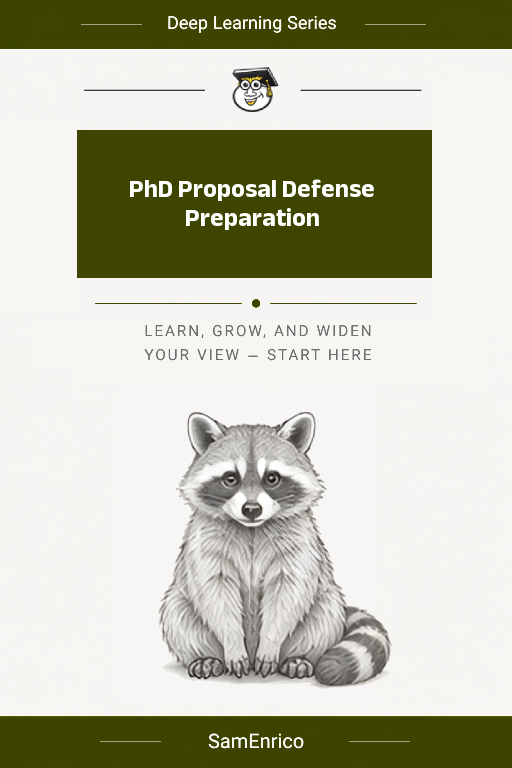
Non-FictionStudent's ShortcutDefense PrepPresentation Guide
PhD Proposal Defense Preparation eBook
Prepare for your proposal defense presentation wit
by Nealy Ronna
Prepare for your proposal defense presentation with slide design question anticipation and committee handling.
Formats
Free sample
Chapter 1: The Colleague Mindset--–- Every Ph D candidate remembers the moment. You have submitted your proposal. Your committee has signed off on the written document. A date appears on your calendar. And then, somewhere between the library and the parking lot, a cold realization settles into your chest: I have to stand in front of my committee and defend this.The fear is almost universal.
It does not discriminate by discipline, by university prestige, or by how many first-author publications you already have. Candidates who have presented at international conferences, who have taught their own courses, who have published peer-reviewed research—they all describe the same tightening in the throat when they imagine the proposal defense. Why? Because the defense feels different. It feels like a test you have not studied for, an exam with no study guide, a performance where the audience already knows the material better than you do.This chapter exists to dismantle that feeling.
Not by offering platitudes like "just be confident" or "you know your work better than anyone." Those statements, while well-intentioned, are not actually helpful because they ignore the structural reality of the defense. Your committee does know more than you in many respects. They have been professors longer than you have been a doctoral student. They have supervised more dissertations than you have read. Acknowledging this asymmetry is not the problem.
The problem is what you do with that acknowledgment.The single greatest predictor of a successful proposal defense is not the quality of your slides, not the elegance of your methods, and not even the significance of your research question. The greatest predictor is the mindset you carry into the room. Candidates who approach the defense as a test to be passed—a hurdle to clear, a ritual to endure—consistently perform worse than candidates who approach the same event as a scholarly conversation to be led. This is not a matter of personality or extroversion. It is a matter of framing.This chapter will guide you through a complete mental reset.
You will learn why the word "defense" misleads you, what it means to think like a colleague rather than a student, and how to prepare yourself psychologically for the single most important hour of your doctoral career. By the end of this chapter, you will not have eliminated your anxiety—some anxiety is adaptive and useful—but you will have transformed it. Instead of the fear of being exposed as a fraud, you will feel the focused anticipation of a professional about to do their job.The Myth of the Inquisition Let us begin with the word itself: defense. In ordinary English, to defend means to protect against attack. Armies defend territory.
Lawyers defend clients. Boxers defend titles. The word carries connotations of walls, shields, and parries. When a doctoral candidate hears "proposal defense," the unconscious association is a siege. You, alone, against a panel of experts who are trying to find the weak points in your armor and exploit them.This metaphor is catastrophically unhelpful.
It is also wrong.The proposal defense is not an adversarial proceeding. Your committee is not trying to fail you. They have already invested significant time in your development as a scholar. Your advisor, in particular, has staked their reputation on your success. When a student fails a proposal defense, it reflects poorly on the advisor as well.
The committee has every incentive to see you succeed, provided you have done the work and can demonstrate that you understand what you are doing.The German academic tradition uses a more accurate term: Disputation. In a disputation, a candidate presents a thesis and then engages in a structured scholarly dialogue with examiners. The goal is not to defeat the candidate but to test the robustness of the argument through rigorous questioning. The examiners are playing the role of thoughtful critics, not hostile attackers. They ask hard questions because hard questions are how knowledge advances, not because they want to watch you squirm.A successful defense, therefore, is not one where you answer every question perfectly.
A successful defense is one where you demonstrate that you can think like a scholar: that you can identify the limitations of your own work, that you can propose reasonable responses to those limitations, that you can distinguish between a fatal flaw and a manageable constraint, and that you can engage respectfully with criticism without becoming defensive or collapsing into self-doubt.This reframing is not just semantic. It changes your behavior. If you believe you are walking into an inquisition, you will prepare by memorizing answers, rehearsing scripts, and trying to predict every possible attack. You will be rigid, anxious, and brittle. If you believe you are walking into a scholarly conversation, you will prepare by deepening your understanding of your own work, identifying its genuine weak points, and thinking through how you would address those weak points in dialogue with intelligent critics.
You will be flexible, engaged, and resilient.From Test-Taker to Contributor Consider two hypothetical candidates approaching the same proposal defense.Candidate A thinks: The committee is going to ask me questions. I need to have the right answers. If I don't know something, I'll look stupid. I need to memorize my methods section and rehearse my justifications. This is the last big hurdle before candidacy, and then I can finally relax.Candidate B thinks: The committee is going to test my thinking.
I don't need to have every answer; I need to show them how I think through problems. If I don't know something, I can show them how a scholar would approach finding the answer. This is my first real chance to be treated as a junior colleague, and I want to demonstrate that I'm ready for that role.Notice the differences. Candidate A is focused on performance—on having the right answers at the right time. Candidate B is focused on competence—on demonstrating the underlying skills of scholarly thinking.
Candidate A sees the committee as judges. Candidate B sees them as experienced peers who are evaluating not the perfection of the proposal but the readiness of the candidate.The most important distinction, however, is what happens after an unexpected question. Candidate A, having memorized a finite set of anticipated questions, will be thrown off balance by anything outside that set. Candidate B, having prepared to think rather than to recite, will handle novelty with curiosity rather than panic.Becoming Candidate B requires a deliberate shift in identity. You must stop thinking of yourself as a student who is being tested and start thinking of yourself as a junior researcher who is presenting work for collegial feedback.
This is not arrogance; it is accuracy. By the time you defend your proposal, you have completed years of coursework, passed qualifying exams, conducted preliminary research, and written a document that contributes to the scholarly conversation in your field. You are not an imposter. You are a researcher with something to say.The "So What?" Mindset If you had to distill the entire proposal defense into a single question, it would be this: So what?Why does your study matter? What problem does it solve?
What gap does it fill? Who cares if you do this research? What changes if you are right? What do…
This is the end of the free sample. Get the eBook to keep going. Buy now
About this book
Details
- Author
- Nealy Ronna
- Publisher
- SamEnrico
- Language
- English
- Genre
- Non-Fiction, Student's Shortcut, Defense Prep, Presentation Guide
- Released
- 2026-06-01
- Pages (approx.)
- 138
- Available as
- eBook, Audiobook

Read better in the ZLOADR app
Your eBooks on your phone or tablet. Sign in with your SamEnrico account and start reading.
More by Nealy Ronna
 Debt Financing Structures DatabaseNealy Ronna$11.99
 Camera Defeat StrategyNealy Ronna$11.99
 LBO Tax Shield ModelingNealy Ronna$11.99
 FODMAP and Gut Microbiome GuideNealy Ronna$11.99
 Bariatric Surgery Revision GuideNealy Ronna$11.99
 The Abyss Beckons: The Deep-Sea Dive That Changed Science ForeverNealy Ronna$11.99
 Understanding Cataract Hutterite TypeNealy Ronna$17.99
 Business Credit Builder ChecklistNealy Ronna$12.99
 10 Ways to Use Chatang (Recipe Book)Nealy Ronna$11.99
You may also like
 Hong Kong Handover 1997Dunn Johnnie$11.99
 Zumba For Postnatal Recovery CourseNeal Christian$11.99
 Zumba for BeginnersLadner Nikia$11.99
 YouTube Comment Mining GuideHumes Pandora$12.99
 Worry Box MeditationCarlin Rudy$11.99
 Workplace Stress MeditationNguyen Lynn$11.99
 Workplace Stress and Sleep RepairHawley Ivory$11.99
 Workplace Perfectionism CureDelaney Jeffry$11.99
 Workplace Injustice Anger GuideWallen Isabelle$11.99
 Work Addiction and Burnout LinkGreenwood Ester$11.99
 Women in Yoga and WellnessBeattie Galina$11.99
 Women in Stand Up ComedyChun Evangeline$11.99