
Non-FictionCapital & Valuation RegisterTax
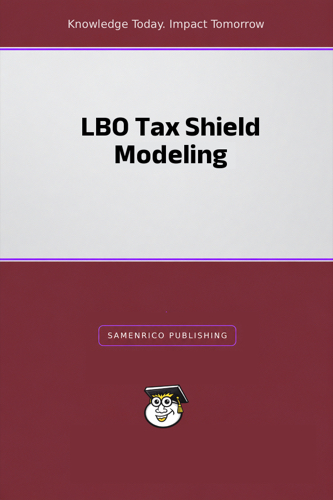
LBO Tax Shield Modeling
Teaches interest tax shield calculations and defer
by Nealy Ronna
Teaches interest tax shield calculations and deferred tax assets.
Formats
About this book
Free sample
Chapter 1: The Hidden Fuel--–- In 2017, two identical private equity firms submitted competing bids for a mid‑sized industrial manufacturing company based in the American Midwest. The target had stable EBITDA of $45 million, modest growth prospects, and a clean balance sheet with almost no existing debt. Firm A, a well‑known megafund with a reputation for operational excellence, offered $400 million – a 6.5x EBITDA multiple. Firm B, a smaller but technically savvy middle‑market fund, offered $405 million and won the deal. On paper, Firm A’s investment committee thought their rivals had overpaid by $5 million.
They were wrong. Six years later, Firm A’s next comparable deal delivered an IRR of 14%. Firm B’s “over‑priced” acquisition delivered 23%. The $5 million difference in entry price explained less than one‑third of the gap. The rest came from something Firm A had never properly modeled: the interest tax shield.This chapter reframes the traditional private equity return framework by introducing the interest tax shield not as a mere accounting detail but as the hidden fuel within the debt paydown engine.
Most practitioners cite three explicit engines of return: operational improvement (EBITDA growth), multiple expansion (exiting at a higher multiple than entry), and debt paydown (principal amortization). These three engines are real, measurable, and widely taught. Yet they are incomplete. Every dollar of interest expense reduces taxable income, which reduces cash taxes paid, which increases free cash flow to equity dollar‑for‑dollar at the marginal tax rate. Ignoring this effect is mathematically equivalent to ignoring 21‑35% of the value of debt, depending on the jurisdiction.
In a typical LBO with 60‑70% leverage, that is not a rounding error. It is the difference between a good deal and a great one – or, as in the case above, between a deal that fails the investment committee hurdle and one that becomes a fund‑making success.The purpose of this book is to teach you how to model the interest tax shield correctly, how to incorporate deferred tax assets from net operating losses, and how to avoid the common pitfalls that cause even experienced practitioners to leave value…
This is the end of the free sample. Get the eBook to keep going. Buy now
Contents
- Chapter 1
- Chapter 2
- Chapter 3
- Chapter 4
- Chapter 5
- Chapter 6
- Chapter 7
- Chapter 8
- Chapter 9
- Chapter 10
- Chapter 11
- Chapter 12
Details
- Author
- Nealy Ronna
- Publisher
- SamEnrico
- Language
- English
- Genre
- Non-Fiction, Capital & Valuation Register, Tax
- Released
- 2026-06-09
- Pages (approx.)
- 151
- Available as
- eBook, Audiobook

Read better in the ZLOADR app
Your eBooks on your phone or tablet. Sign in with your SamEnrico account and start reading.
More by Nealy Ronna
 Debt Financing Structures DatabaseNealy Ronna$11.99
 Camera Defeat StrategyNealy Ronna$11.99
 FODMAP and Gut Microbiome GuideNealy Ronna$11.99
 Bariatric Surgery Revision GuideNealy Ronna$11.99
 The Abyss Beckons: The Deep-Sea Dive That Changed Science ForeverNealy Ronna$11.99
 Understanding Cataract Hutterite TypeNealy Ronna$17.99
 PhD Proposal Defense PreparationNealy Ronna$12.99
 Business Credit Builder ChecklistNealy Ronna$12.99
 10 Ways to Use Chatang (Recipe Book)Nealy Ronna$11.99
You may also like
 Hong Kong Handover 1997Dunn Johnnie$11.99
 Zumba For Postnatal Recovery CourseNeal Christian$11.99
 Zumba for BeginnersLadner Nikia$11.99
 YouTube Comment Mining GuideHumes Pandora$12.99
 Worry Box MeditationCarlin Rudy$11.99
 Workplace Stress MeditationNguyen Lynn$11.99
 Workplace Stress and Sleep RepairHawley Ivory$11.99
 Workplace Perfectionism CureDelaney Jeffry$11.99
 Workplace Injustice Anger GuideWallen Isabelle$11.99
 Work Addiction and Burnout LinkGreenwood Ester$11.99
 Women in Yoga and WellnessBeattie Galina$11.99
 Women in Stand Up ComedyChun Evangeline$11.99