
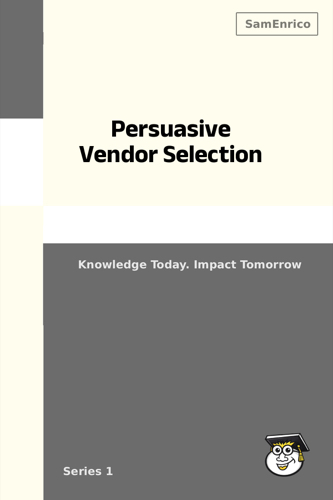
Non-FictionBusiness BriefVendor Management
Persuasive Vendor Selection eBook
Write recommendation memos that compare options an
Write recommendation memos that compare options and build consensus for your preferred supplier.
Formats
Free sample
Chapter 1: The Invisible Handshake--–- The email arrived at 11:47 PM on a Tuesday. Sarah, a procurement director with fourteen years of experience, had just closed her laptop when her phone buzzed. The subject line read: “Vendor Decision – Urgent.” Her CEO, copied along with three board members, had written two words: “Explain this.”Attached was the recommendation memo she had submitted two weeks earlier. It was twenty-three pages of impeccable analysis. She had run a weighted scorecard across six vendors.
She had documented total cost of ownership projections for five years. She had included legal review, security audit results, and a risk register with seventeen mitigation strategies. Her recommended vendor would save the company $3.7 million over the contract term. The data was ironclad.The CEO’s objection was not about the data. It was about the incumbent supplier—a vendor the CEO had personally introduced to the company a decade earlier.
The incumbent had not even made the shortlist. And Sarah had never mentioned that decision to the CEO before circulating the memo.She lost the contract. She lost her seat at the executive table. Six months later, she left the company.The tragedy was not that her analysis was wrong. It was that she believed analysis alone was enough.The Myth of the Rational Decision Every day, in thousands of organizations across the world, procurement professionals, IT managers, and operations directors make the same mistake Sarah made.
They assume that vendor selection is a mathematical exercise. They build scorecards. They calculate net present value. They create beautiful spreadsheets with color-coded cells and conditional formatting. And then they wonder why their recommendations die on a conference room table.Here is the truth that no spreadsheet will tell you: Vendor selection is never just about the vendor.
It is about the people choosing the vendor.The decision to award a contract is not a calculation. It is a social contract—an invisible handshake between the person recommending and the person approving. That handshake is built on trust, on political awareness, on timing, and on a deep understanding of what keeps each stakeholder awake at night. You can have the perfect vendor, the perfect price, and the perfect scorecard. If you do not understand the psychology of the decision-makers, you will lose to an inferior vendor every single time.This book exists because most procurement books stop exactly where the real work begins.
They teach you how to analyze. They do not teach you how to persuade.A Brief Note on Roles: Who This Book Is For Before we go further, a clarification is necessary. Throughout this book, we will address two distinct roles that often work together in vendor selection. Understanding which role you occupy—or whether you must perform both—will help you apply the chapters that follow.The Analyst/Buyer is the person who runs the RFP process, collects data, builds the scorecard, runs the sensitivity analysis, and writes the first draft of the recommendation memo. This person typically holds a title such as procurement manager, sourcing specialist, IT analyst, or operations lead.
If you are reading this book because you are responsible for figuring out which vendor is best, you are the Analyst.The Accountable Executive is the person who signs the contract, delivers the final recommendation to the board or leadership team, and bears responsibility if the vendor fails. This person typically holds a title such as Chief Financial Officer, Chief Information Officer, Vice President of Supply Chain, or Director of Operations. If you are reading this book because you are responsible for approving the decision and defending it upward, you are the Accountable Executive.Many readers will find themselves in both roles at different times—particularly in smaller organizations or flat structures. That is fine. The distinction exists to help you know who should do what when we discuss pre-conversations, memo writing, verbal briefings, and vendor debriefs.
When a chapter specifies that the Analyst performs a task, and you are the Accountable Executive, you may delegate it. When a chapter specifies that the Accountable Executive must deliver a message, and you are the Analyst, you must find your executive partner and ensure they fulfill that role.For the remainder of this chapter, we will assume you are an Analyst—because the psychology of vendor selection begins with the person doing the analysis. But the lessons apply equally to executives who want to understand why their teams’ recommendations so often fall short.The Three Invisible Forces That Ruin Perfect Analyses Sarah’s story is not an anomaly. It is a pattern. Across industries and continents, perfectly good vendor recommendations fail for reasons that have nothing to do with the quality of the analysis.
Three invisible forces are almost always at play.Force One: The Anchoring Bias of Relationships Human beings are not rational actors. We are relational animals. When a stakeholder has worked with a vendor for five years—when that vendor’s account manager remembers their birthday, when the vendor sponsored their industry conference, when the vendor helped them out of a jam at 2 AM—that stakeholder is anchored to that vendor in a way that no spreadsheet can overcome.This is not corruption. It is not even favoritism, in the malicious sense. It is simple human psychology.
We prefer what we know. We trust what has not yet betrayed us. And we resist change that feels like a betrayal of a relationship.The Analyst who ignores these emotional anchors does so at their peril. You can prove that a new vendor is 20 percent cheaper and 30 percent faster. The anchored stakeholder will hear those numbers and think, “But I don’t know if they will show up when something breaks.” That fear is not irrational.
It is the wisdom of experience, applied to the wrong data set.Force Two: The Invisible Veto of Mid-Level Stakeholders Most people assume that the only approval that matters is the signature at the top. The CEO signs. The board approves. Therefore, the Analyst assumes, the CEO is the only stakeholder who truly matters.This is wrong in a way that has derailed more vendor selections than any other single mistake.The most dangerous stakeholder is not the Accountable Executive. It is the mid-level director who has no formal veto power but possesses two more potent weapons: access and hindsight.
This person sits in meetings where your recommendation is discussed. They are asked for their opinion. They say things like, “I’ve worked with Vendor B before, and I had some concerns about their implementation process.” They do not say, “I will block this decision.” They do not need to. They simply plant seeds of doubt.When the vendor later has a problem—and every vendor eventually has a problem—that same mid-level stakeholder will say, “I had concerns about this from the beginning.” And suddenly, the failure belongs to you, not to the vendor.The Analyst who fails to map these invisible stakeholders is building a recommendation on a foundation of sand. You must know not only who signs the contract but also who whispers in the signer’s ear.Force Three: The Fear of the Post-Mortem Every executive who approves a vendor contract knows one thing with…
This is the end of the free sample. Get the eBook to keep going. Buy now
About this book
Details
- Author
- Edgar Ruthanne
- Publisher
- SamEnrico
- Language
- English
- Genre
- Non-Fiction, Business Brief, Vendor Management
- Released
- 2026-06-09
- Pages (approx.)
- 154
- Available as
- eBook, Audiobook

Read better in the ZLOADR app
Your eBooks on your phone or tablet. Sign in with your SamEnrico account and start reading.
More by Edgar Ruthanne
 The Assertiveness Journal MethodEdgar Ruthanne$11.99
 Lucknow Residency SiegeEdgar Ruthanne$11.99
 Pregnenolone Memory GuideEdgar Ruthanne$11.99
 Angola Independence WarEdgar Ruthanne$11.99
 Anxiety Driven Parent AngerEdgar Ruthanne$11.99
 Workplace Emotion GuideEdgar Ruthanne$11.99
 Representativeness Heuristic RisksEdgar Ruthanne$11.99
 Comfort Discomfort IndicatorsEdgar Ruthanne$11.99
 Specters in the Courtroom: The Forgotten Witchcraft Case That Divided a ColonyEdgar Ruthanne$11.99
 Scipio and Sophia: Love Letters from the Punic WarsEdgar Ruthanne$11.99
 The Alchemist of the Nile: The Lost Secrets of the Black PharaohsEdgar Ruthanne$11.99
 The Mineral Guide to ParachrysotileEdgar Ruthanne$11.99
You may also like
 Hong Kong Handover 1997Dunn Johnnie$11.99
 Zumba For Postnatal Recovery CourseNeal Christian$11.99
 Zumba for BeginnersLadner Nikia$11.99
 YouTube Comment Mining GuideHumes Pandora$12.99
 Worry Box MeditationCarlin Rudy$11.99
 Workplace Stress MeditationNguyen Lynn$11.99
 Workplace Stress and Sleep RepairHawley Ivory$11.99
 Workplace Perfectionism CureDelaney Jeffry$11.99
 Workplace Injustice Anger GuideWallen Isabelle$11.99
 Work Addiction and Burnout LinkGreenwood Ester$11.99
 Women in Yoga and WellnessBeattie Galina$11.99
 Women in Stand Up ComedyChun Evangeline$11.99