
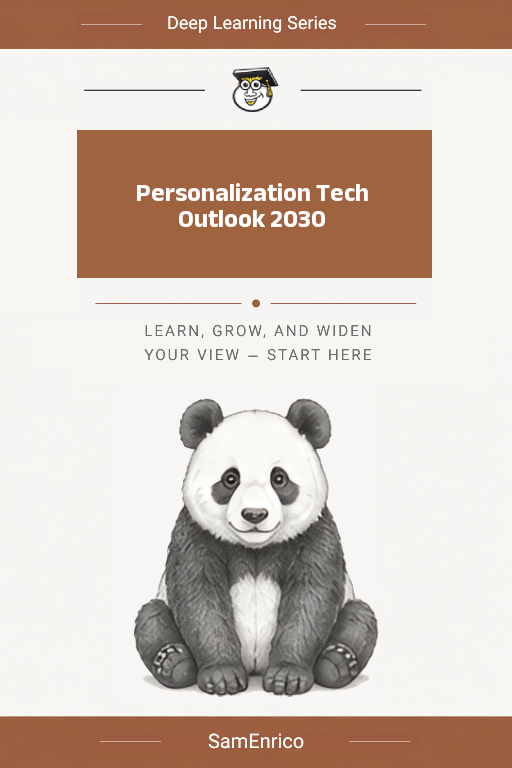
Non-FictionForecast & OutlookAI Retail
Personalization Tech Outlook 2030 eBook
Forecast AI-driven product recommendations, dynami
Forecast AI-driven product recommendations, dynamic pricing, and individualized merchandising adoption across online retail.
Formats
Free sample
Chapter 1: The $2 Trillion Blind Spot--In 2027, a major retailer will file for bankruptcy. The press releases will cite "supply chain challenges" and "changing consumer preferences." The analysts will nod knowingly and write about market headwinds. But the truth—the truth that no executive will utter in public—is that their personalization engine was too slow. Not broken. Not underfunded.
Too slow. Their cloud-based recommendation system took 800 milliseconds to return results. Their competitor's edge-native system took 200 milliseconds. And in that 600-millisecond gap, an entire company died.This book exists so that retailer is not you.The Personalization Paradox Let us begin with a contradiction that should keep every retail executive awake at night. Seventy-one percent of consumers now expect personalized experiences.
They want the website to remember their size, the app to suggest products they actually like, the email to arrive at the right time with the right offer. Yet simultaneously, over sixty percent of personalization investments deliver absolutely no positive return on investment. None. Zero. Millions of dollars spent on recommendation engines, segmentation tools, and customer data platforms—all producing nothing but disappointed stakeholders and skeptical boards.This is the Personalization Paradox.
And it is the single greatest strategic challenge facing online retail today.Why does this paradox exist? The answer is deceptively simple. Most companies are practicing the wrong kind of personalization. They are practicing static personalization—the kind that relies on pre-computed segments, batch-processed customer attributes, and rules-based decision trees. A customer visits the website.
The system checks their segment (e.g., "high-value women's apparel shopper"). It applies a rule (e.g., "show premium products first"). It serves a pre-built experience. This approach worked reasonably well in 2018. It fails catastrophically in 2025 and will be laughably obsolete by 2028.What consumers actually expect—what they mean when they say they want personalization—is dynamic personalization.
Real-time. Context-aware. Invisible. They want the system to know that they are browsing on a phone, in a hurry, looking for a birthday gift for a sister who likes minimalist jewelry, and they want that knowledge to translate into action in the same amount of time it takes to blink. Not in five seconds.
Not after a loading spinner. In less than three hundred milliseconds—the threshold at which the human brain stops perceiving "waiting" and starts perceiving "magic."The gap between static and dynamic personalization is not incremental. It is a chasm. Crossing it requires rethinking everything: the hardware you deploy on, the software architecture you build, the data you collect, the algorithms you train, and the organizational structure you create to manage it all.The $2 Trillion Prize Let us put a number on what is at stake. Analysts at Mc Kinsey, Bain, and Deloitte have converged on a staggering figure: the value at stake for retailers who successfully transition to dynamic, AI-driven personalization by 2030 is approximately two trillion dollars.
That is not a typo. Two trillion dollars.Consider the components of this prize. First, conversion lift. Retailers who implement real-time, generative recommendation engines see conversion rates increase by twenty to thirty percent compared to static systems. That is not incremental improvement; that is a category-defining advantage.
Second, average order value. When personalization extends to dynamic pricing and individualized merchandising, customers spend fifteen to twenty-five percent more per transaction—not because they are manipulated but because the system shows them relevant add-ons, complementary products, and timely upgrades that genuinely add value. Third, customer lifetime value. The most sophisticated personalization engines reduce churn by forty percent, simply by making every interaction feel tailored and thoughtful rather than generic and forgettable.Add these components together, multiply across global e-commerce, and the two trillion dollar figure becomes not just plausible but conservative.But here is the warning embedded in that number. The prize is available only to the winners.
This is not a rising-tide-lifts-all-boats scenario. Personalization is a winner-take-most market. The top ten percent of retailers—the ones who master dynamic personalization by 2027—will capture eighty percent of the value. The remaining ninety percent will fight over scraps. The gap will widen every quarter.
By 2030, the personalization haves and have-nots will not be competing in the same league.Why Legacy Systems Fail To understand why most personalization investments fail, we must look under the hood of the typical retail technology stack. The average large retailer operates with a patchwork of systems: an ERP for inventory, a CRM for customer data, a CMS for content, a marketing automation platform for campaigns, and a recommendation engine bolted on top. These systems were not designed to talk to each other. They certainly were not designed for real-time interaction.Consider what happens when a customer lands on a product page. The recommendation engine must query the CRM for customer history, the ERP for inventory availability, the pricing system for current offers, and the content system for images and descriptions.
In a legacy architecture, each query might take one hundred to two hundred milliseconds. By the time the results are assembled and rendered, the customer has been waiting for nearly a second. In online retail, one second of delay reduces conversion by seven percent. Two seconds reduces conversion by fifteen percent. Three seconds?
Nearly half your potential customers have already left.This is not a hypothetical. Amazon famously found that every one hundred milliseconds of latency cost them one percent of sales. Google found that an extra half-second in search page generation dropped traffic by twenty percent. The human attention span for digital experiences is measured in milliseconds, not seconds. If your personalization engine cannot respond faster than a human blink, you are not personalizing; you are irritating.But latency is only half the problem.
The other half is relevance. Legacy recommendation engines rely on collaborative filtering—the "people who bought X also bought Y" approach. This technique works well for commodity products with deep historical purchase data. It fails miserably for new products (no history), for niche products (thin data), and for complex use cases (dinner date jackets, not just waterproof jackets). Collaborative filtering cannot understand natural language.
It cannot interpret context. It certainly cannot generate novel recommendations that did not exist in the training data.The future belongs to generative AI—large language models and multimodal systems that understand what you mean, not just what you bought. But generative AI is computationally expensive. Running a large language model in the cloud introduces latency. Running it on a smartphone—which is where the customer actually is—requires a different hardware architecture entirely.
Which brings us to the silicon revolution.The Creepy Versus Convenient Line Before we dive into technical solutions, we must address the emotional barrier that defeats more personalization initiatives than any technical limitation: the creepy versus convenient line.Consumers want personalization. They also fear surveillance. They want convenience. They also want privacy. These are not contradictions; they are tensions that must be actively managed.
The difference between "helpful" and "creepy" is not the amount of data collected but the transparency of the collection and the speed of the value returned.Let us illustrate with two examples. A retailer tracks your location, notices you are near a store, and sends a push notification offering twenty percent off a product you browsed yesterday.…
This is the end of the free sample. Get the eBook to keep going. Buy now
About this book
Details
- Author
- Winfield Dani
- Publisher
- SamEnrico
- Language
- English
- Genre
- Non-Fiction, Forecast & Outlook, AI Retail
- Released
- 2026-06-01
- Pages (approx.)
- 149
- Available as
- eBook, Audiobook

Read better in the ZLOADR app
Your eBooks on your phone or tablet. Sign in with your SamEnrico account and start reading.
More by Winfield Dani
 AI Frame Interpolation for Slow MotionWinfield Dani$11.99
 Meth Dental Care NavigationWinfield Dani$11.99
 Team Meeting Presentation NervesWinfield Dani$11.99
 Kidnap Prevention GuideWinfield Dani$11.99
 The Co Parenting Stress GuideWinfield Dani$11.99
 Franklin's Frozen Grave: The Medical Mystery of the Lost ExpeditionWinfield Dani$11.99
 Echoes of the Argo: The Lost Colony That Never WasWinfield Dani$11.99
 Understanding Brachydactyly Type A7Winfield Dani$17.99
 How to Become a Dial-screw AssemblerWinfield Dani$11.99
 Field Services TechnicianWinfield Dani$11.99
You may also like
 Hong Kong Handover 1997Dunn Johnnie$11.99
 Zumba For Postnatal Recovery CourseNeal Christian$11.99
 Zumba for BeginnersLadner Nikia$11.99
 YouTube Comment Mining GuideHumes Pandora$12.99
 Worry Box MeditationCarlin Rudy$11.99
 Workplace Stress MeditationNguyen Lynn$11.99
 Workplace Stress and Sleep RepairHawley Ivory$11.99
 Workplace Perfectionism CureDelaney Jeffry$11.99
 Workplace Injustice Anger GuideWallen Isabelle$11.99
 Work Addiction and Burnout LinkGreenwood Ester$11.99
 Women in Yoga and WellnessBeattie Galina$11.99
 Women in Stand Up ComedyChun Evangeline$11.99