
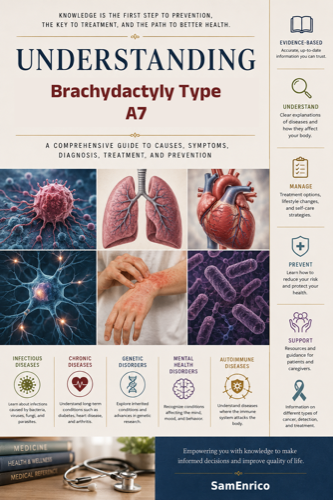
Non-FictionInformativeEducational
Understanding Brachydactyly Type A7
This disease publication, published by SamEnrico,
This disease publication, published by SamEnrico, covers Understanding Brachydactyly Type A7
Formats
About this book
Free sample
Chapter 1: A World of Short Digits...--–- In 1903, a young British physician named Dr. Archibald Garrod stood before the Royal Medical and Chirurgical Society in London and presented a series of case studies that would forever change how doctors thought about hand abnormalities. For centuries, physicians had observed that some families seemed to have unusually short fingers and toes, passing the trait from parent to child across generations. But no one had classified these differences. No one had asked whether the shortening of the middle finger in one family was the same condition as the shortening of the thumb in another.
And no one had recognized that these seemingly random variations followed predictable patterns of inheritance. Garrod changed that. His observations laid the groundwork for Julia Bell’s classification system decades later—a system that would ultimately encompass ten distinct forms of isolated brachydactyly. This chapter introduces that classification system, explains the terminology, and provides the essential background knowledge you need before diving into the specifics of Brachydactyly Type A7—the rarest form, described only once in medical literature, first identified by Meiselman and colleagues in April 1989 and nicknamed "Smorgasbord" for its mixture of features-1.What Is Brachydactyly? A Definition The word "brachydactyly" comes from two Greek roots: βραχύς (brachys), meaning "short," and δάκτυλος (daktylos), meaning "finger"-9.
Combined, they literally translate to "short finger." The term has been used in medical literature for over a century to describe disproportionately short fingers and toes caused by abnormal development of the phalanges (the small bones in the fingers and toes) or the metacarpals (the bones in the palm of the hand)-5. But this simple definition belies the extraordinary diversity of conditions that fall under the brachydactyly umbrella.Brachydactyly can occur as an isolated malformation—meaning the only abnormality is the shortening of the digits—or as part of a complex malformation syndrome that affects multiple body systems-3-7. This distinction is clinically crucial. When brachydactyly is isolated, the prognosis is generally excellent, and affected individuals lead normal, healthy lives without significant functional limitations. When brachydactyly appears as one feature of a syndromic condition, the prognosis depends…
This is the end of the free sample. Get the eBook to keep going. Buy now
Contents
- Chapter 1
- Chapter 2
- Chapter 3
- Chapter 4
- Chapter 5
- Chapter 6
- Chapter 7
- Chapter 8
- Chapter 9
- Chapter 10
- Chapter 11
- Chapter 12
Details
- Author
- Winfield Dani
- Publisher
- SamEnrico
- Language
- English
- Genre
- Non-Fiction, Informative, Educational
- Released
- 2026-06-03
- Pages (approx.)
- 132
- Available as
- eBook, Audiobook

Read better in the ZLOADR app
Your eBooks on your phone or tablet. Sign in with your SamEnrico account and start reading.
More by Winfield Dani
 AI Frame Interpolation for Slow MotionWinfield Dani$11.99
 Meth Dental Care NavigationWinfield Dani$11.99
 Team Meeting Presentation NervesWinfield Dani$11.99
 Kidnap Prevention GuideWinfield Dani$11.99
 The Co Parenting Stress GuideWinfield Dani$11.99
 Franklin's Frozen Grave: The Medical Mystery of the Lost ExpeditionWinfield Dani$11.99
 Echoes of the Argo: The Lost Colony That Never WasWinfield Dani$11.99
 How to Become a Dial-screw AssemblerWinfield Dani$11.99
 Personalization Tech Outlook 2030Winfield Dani$12.99
 Field Services TechnicianWinfield Dani$11.99
You may also like
 Hong Kong Handover 1997Dunn Johnnie$11.99
 Zumba For Postnatal Recovery CourseNeal Christian$11.99
 Zumba for BeginnersLadner Nikia$11.99
 YouTube Comment Mining GuideHumes Pandora$12.99
 Worry Box MeditationCarlin Rudy$11.99
 Workplace Stress MeditationNguyen Lynn$11.99
 Workplace Stress and Sleep RepairHawley Ivory$11.99
 Workplace Perfectionism CureDelaney Jeffry$11.99
 Workplace Injustice Anger GuideWallen Isabelle$11.99
 Work Addiction and Burnout LinkGreenwood Ester$11.99
 Women in Yoga and WellnessBeattie Galina$11.99
 Women in Stand Up ComedyChun Evangeline$11.99