
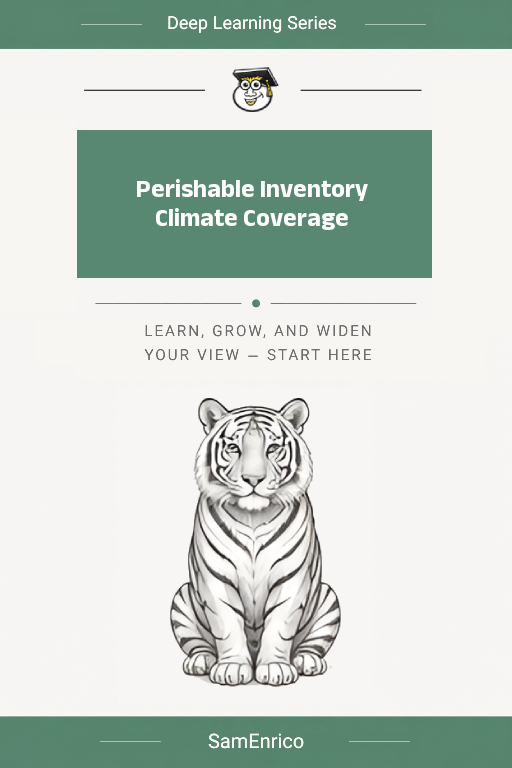
Non-FictionBusiness BriefPerishables
Perishable Inventory Climate Coverage eBook
Insure refrigerated goods, pharmaceuticals, and fo
by Toliver Sol
Insure refrigerated goods, pharmaceuticals, and food stock against temperature excursion losses.
Formats
Free sample
Chapter 1: The Fifty-Billion-Dollar Blindspot--–- On a humid Tuesday morning in July 2019, a facility manager named Elena Vasquez walked into a cold storage warehouse outside Memphis, Tennessee, and smelled nothing. That was the problem. Forty-seven minutes earlier, a routine grid fluctuation—what utility companies call a "brownout"—had caused three of the facility's sixteen ammonia compressors to cycle off. The backup generators fired as designed. The alarms triggered as designed.
But the compressors, upon restart, did not return to their previous set points. They defaulted to a factory reset of 7°C. For forty-seven minutes, while Elena drank her first coffee of the day, $23 million in influenza vaccines sat in a room that was, by design, supposed to be minus 20 degrees Celsius and was instead, by default, a cool spring day.–- The facility's temperature sensors continued to report normal readings because the sensors were located on the return air ducts, not inside the pallets. The vaccines, stacked floor to ceiling, retained their core temperature for approximately thirty-two minutes before the thermal gradient collapsed. By the time Elena's phone pinged with an automated alert—"Temperature Deviation: Zone 3"—the damage was done.
Not to the physical vials. The glass was intact. The labels were dry. The vaccines looked perfect. But the lipid nanoparticles encasing the messenger RNA inside those vials had begun to fuse together at 9°C, a process that is irreversible and invisible.
The vaccines were, to use the technical term from the manufacturer's stability data, "potency-compromised." To use the insurer's term, they were "not physically damaged." To use the legal term that would cost the facility $23 million, they were "inherently vice-ridden."–- The claim was denied within seventy-two hours. The denial letter, which would become Exhibit A in a three-year litigation, cited two exclusions. First, "inherent vice": the natural tendency of biologic products to degrade when removed from specified temperature ranges. Second, "delay": the time between the brownout and the spoilage was, the insurer argued, a delay in discovery, not a covered peril. The facility's insurance policy covered "sudden and accidental physical loss." Gradual temperature rise, even if caused by a sudden brownout, was not sudden.
The vaccines were not physically damaged. And the facility had failed to notify the insurer within four hours, as required by the fine print on page forty-seven of the policy.–- Elena Vasquez no longer works in cold storage. The facility declared bankruptcy eighteen months later. And twenty miles away, a grocery chain's distribution center lost $9 million in frozen vegetables the following winter when its backup generator ran out of diesel fuel after twelve hours, not the seventy-two hours the facility manager had assumed. In both cases, the responsible parties—the utility company, the generator maintenance contractor, the compressor manufacturer—were never sued.
The insurance policies had subrogation clauses, but the facilities had failed to preserve the evidence required to pursue third-party claims. The temperature loggers, where they existed, were either uncalibrated or had been overwritten. The bills of lading, where they existed, had been signed with handwritten notes: "seal broken," "container pre-cooling not verified." The coverage, where it existed, had been purchased on price alone, with no understanding of the gap between "all-risk" and "all-peril," between "physical damage" and "functional loss," between "I think we're covered" and "we are not covered."–- This book exists because those losses were preventable. Not just the spoilage—the spoilage is physics, and physics cannot be repealed—but the denial. The gap between a loss that happens and a claim that pays is not filled by hope.
It is filled by contracts, clauses, calibrations, and the cold, hard work of understanding what standard insurance policies actually say versus what every reasonable person assumes they mean. This chapter exposes the foundational mismatch between traditional insurance and perishable goods, a mismatch that costs the global cold chain an estimated $50 billion annually in uncovered losses. It deconstructs the "all-risk" illusion, establishes the two distinct types of perishability that break standard indemnity models, and prepares the reader for the technical, legal, and operational deep dives that follow in the remaining eleven chapters.The Coverage Gap: What Standard Policies Exclude and Why It Matters–- Standard property and cargo insurance policies were not designed for products that can be perfectly intact and utterly worthless at the same time. They were designed for steel beams, pallets of auto parts,集装箱 of finished furniture—goods that degrade slowly, predictably, and visibly. A steel beam that sits in a flooded warehouse for three days will rust.
The rust is visible. The loss is measurable. The cause is external (water). The same logic applied to a frozen tuna block that thaws and refreezes produces a different outcome: the tuna looks intact, but its cell walls have ruptured, and a sushi chef in Tokyo will reject it. The loss is invisible.
The cause is internal (the product's own biology interacting with temperature). And standard policies exclude that internal cause under a doctrine centuries old: inherent vice.–- Inherent vice is the natural tendency of a substance to deteriorate or lose value due to its own characteristics, independent of any external cause. Fresh produce respires—it breathes, generates heat, and consumes its own sugars. Biologics degrade stochastically—their potency declines continuously, not at a single expiration moment. Frozen goods experience ice recrystallization—even at stable temperatures, ice crystals slowly grow larger, damaging cell structures.
These are not defects in the product. They are the product. But insurance law treats them as uninsurable characteristics. The logic is ancient and, from an insurer's perspective, defensible: if a product would eventually spoil even under perfect conditions, then any external event that accelerates that spoilage is merely hastening an inevitable outcome. The insurer owes nothing for the inevitable.–- The practical effect of the inherent vice exclusion is devastating and frequently misunderstood.
Consider a container of strawberries shipped from Mexico to Canada. The strawberries have a refrigerated shelf life of fourteen days under ideal conditions—steady 2°C, high humidity, no physical damage. The shipment experiences a twelve-hour temperature excursion to 10°C due to a compressor failure on day three. The strawberries arrive on day five and spoil on day eight, six days earlier than expected. The insurer denies the claim, arguing that the strawberries would have spoiled by day fourteen anyway, and the twelve-hour excursion merely moved the spoilage forward.
The shipper argues that without the excursion, the strawberries would have reached retail shelves on day six and sold by day twelve. Who is correct? In most jurisdictions, the insurer prevails because the shipper cannot prove that the strawberries would not have spoiled earlier due to inherent vice—uneven ripening, hidden bruising, variability in respiration rates.–- The delay exclusion compounds the problem. Standard policies exclude loss caused by "delay," regardless of the cause of the delay. A storm at sea (covered) causes the ship to divert to a different port (delay).
The delay causes the refrigerated cargo to exceed its safe holding time (spoilage). The insurer argues: the storm was covered, but the spoilage was caused by the delay (excluded), not by the storm. This is not a loophole. It is intentional policy language dating back to the nineteenth century, when underwriters…
This is the end of the free sample. Get the eBook to keep going. Buy now
About this book
Details
- Author
- Toliver Sol
- Publisher
- SamEnrico
- Language
- English
- Genre
- Non-Fiction, Business Brief, Perishables
- Released
- 2026-06-01
- Pages (approx.)
- 141
- Available as
- eBook, Audiobook

Read better in the ZLOADR app
Your eBooks on your phone or tablet. Sign in with your SamEnrico account and start reading.
More by Toliver Sol
 Rectal Medication GuideToliver Sol$11.99
 Humming Vagus Nerve ResetToliver Sol$11.99
 The Remote Leadership GuideToliver Sol$11.99
 Destiny 2 Weekly Reset GrindToliver Sol$11.99
 The Walls of Xian: China's Eternal FortressToliver Sol$11.99
 Operations InternshipToliver Sol$11.99
 How to Produce Interior CaulkToliver Sol$11.99
 10 Ways to Use Alize Liqueur (Recipe Book)Toliver Sol$11.99
You may also like
 Hong Kong Handover 1997Dunn Johnnie$11.99
 Zumba For Postnatal Recovery CourseNeal Christian$11.99
 Zumba for BeginnersLadner Nikia$11.99
 YouTube Comment Mining GuideHumes Pandora$12.99
 Worry Box MeditationCarlin Rudy$11.99
 Workplace Stress MeditationNguyen Lynn$11.99
 Workplace Stress and Sleep RepairHawley Ivory$11.99
 Workplace Perfectionism CureDelaney Jeffry$11.99
 Workplace Injustice Anger GuideWallen Isabelle$11.99
 Work Addiction and Burnout LinkGreenwood Ester$11.99
 Women in Yoga and WellnessBeattie Galina$11.99
 Women in Stand Up ComedyChun Evangeline$11.99