
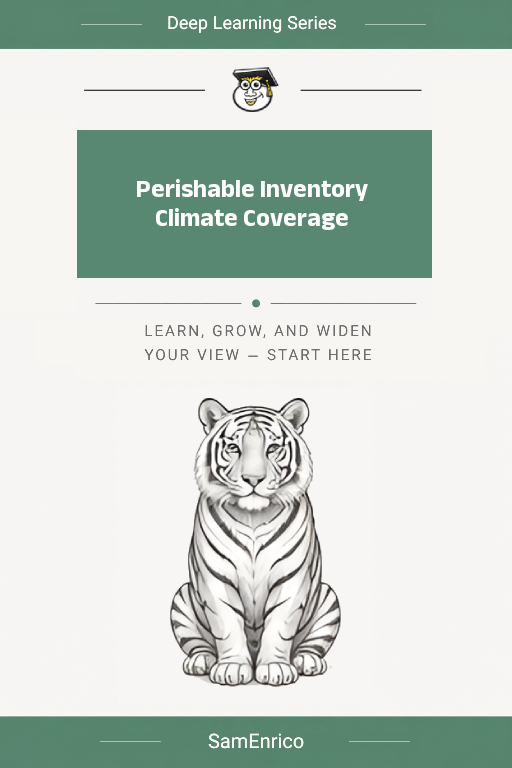
Non-FictionBusiness BriefPerishables
Perishable Inventory Climate Coverage
Insure refrigerated goods, pharmaceuticals, and fo
by Toliver Sol
Insure refrigerated goods, pharmaceuticals, and food stock against temperature excursion losses.
Formats
About this book
Free sample
Chapter 1: The Fifty-Billion-Dollar Blindspot--–- On a humid Tuesday morning in July 2019, a facility manager named Elena Vasquez walked into a cold storage warehouse outside Memphis, Tennessee, and smelled nothing. That was the problem. Forty-seven minutes earlier, a routine grid fluctuation—what utility companies call a "brownout"—had caused three of the facility's sixteen ammonia compressors to cycle off. The backup generators fired as designed. The alarms triggered as designed.
But the compressors, upon restart, did not return to their previous set points. They defaulted to a factory reset of 7°C. For forty-seven minutes, while Elena drank her first coffee of the day, $23 million in influenza vaccines sat in a room that was, by design, supposed to be minus 20 degrees Celsius and was instead, by default, a cool spring day.–- The facility's temperature sensors continued to report normal readings because the sensors were located on the return air ducts, not inside the pallets. The vaccines, stacked floor to ceiling, retained their core temperature for approximately thirty-two minutes before the thermal gradient collapsed. By the time Elena's phone pinged with an automated alert—"Temperature Deviation: Zone 3"—the damage was done.
Not to the physical vials. The glass was intact. The labels were dry. The vaccines looked perfect. But the lipid nanoparticles encasing the messenger RNA inside those vials had begun to fuse together at 9°C, a process that is irreversible and invisible.
The vaccines were, to use the technical term from the manufacturer's stability data, "potency-compromised." To use the insurer's term, they were "not physically damaged." To use the legal term that would cost the facility $23 million, they were "inherently vice-ridden."–- The claim was denied within seventy-two hours. The denial letter, which would become Exhibit A in a three-year litigation, cited two exclusions. First, "inherent vice": the natural tendency of biologic products to degrade when removed from specified temperature ranges. Second, "delay": the time between the brownout and the spoilage was, the insurer argued, a delay in discovery, not a covered peril. The facility's insurance policy covered "sudden and accidental physical loss." Gradual temperature rise, even if caused by…
This is the end of the free sample. Get the eBook to keep going. Buy now
Contents
- Chapter 1
- Chapter 2
- Chapter 3
- Chapter 4
- Chapter 5
- Chapter 6
- Chapter 7
- Chapter 8
- Chapter 9
- Chapter 10
- Chapter 11
- Chapter 12
Details
- Author
- Toliver Sol
- Publisher
- SamEnrico
- Language
- English
- Genre
- Non-Fiction, Business Brief, Perishables
- Released
- 2026-06-01
- Pages (approx.)
- 141
- Available as
- eBook, Audiobook

Read better in the ZLOADR app
Your eBooks on your phone or tablet. Sign in with your SamEnrico account and start reading.
More by Toliver Sol
 Rectal Medication GuideToliver Sol$11.99
 Humming Vagus Nerve ResetToliver Sol$11.99
 The Remote Leadership GuideToliver Sol$11.99
 Destiny 2 Weekly Reset GrindToliver Sol$11.99
 The Walls of Xian: China's Eternal FortressToliver Sol$11.99
 Operations InternshipToliver Sol$11.99
 How to Produce Interior CaulkToliver Sol$11.99
 10 Ways to Use Alize Liqueur (Recipe Book)Toliver Sol$11.99
You may also like
 Hong Kong Handover 1997Dunn Johnnie$11.99
 Zumba For Postnatal Recovery CourseNeal Christian$11.99
 Zumba for BeginnersLadner Nikia$11.99
 YouTube Comment Mining GuideHumes Pandora$12.99
 Worry Box MeditationCarlin Rudy$11.99
 Workplace Stress MeditationNguyen Lynn$11.99
 Workplace Stress and Sleep RepairHawley Ivory$11.99
 Workplace Perfectionism CureDelaney Jeffry$11.99
 Workplace Injustice Anger GuideWallen Isabelle$11.99
 Work Addiction and Burnout LinkGreenwood Ester$11.99
 Women in Yoga and WellnessBeattie Galina$11.99
 Women in Stand Up ComedyChun Evangeline$11.99