
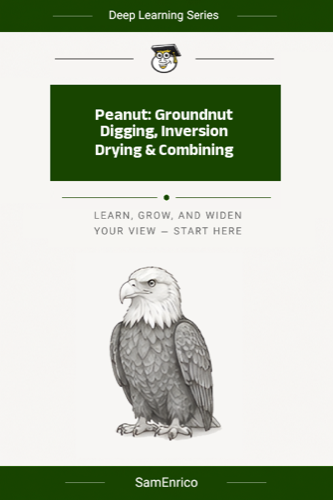
Peanut: Groundnut Digging, Inversion Drying & Combining eBook
This harvesting publication, published by SamEnric
by Clapp Anisa
This harvesting publication, published by SamEnrico, covers Peanut: Groundnut Digging, Inversion Drying & Combining
Formats
Free sample
Chapter 1: The Buried Fortune...-- Every peanut farmer begins harvest with a simple belief: the crop is in the ground, the digger is hitched, and the combine is waiting. But beneath every acre of healthy-looking vines lies a hidden fortune that can vanish before a single pod reaches the wagon. The difference between a profitable harvest and a catastrophic loss is not luck, weather, or even the quality of your equipment. It is the ability to read what the plant is telling you before you turn a single blade of soil. This chapter is about that critical window of decision-making: the days and hours before the digger enters the field.
Get this wrong, and nothing else matters. Get it right, and you have already won half the battle.The common belief among growers is that harvest begins when the digger engages. That is a costly myth. Harvest actually begins weeks earlier, when the first pods reach physiological maturity. The decisions made in that pre-digging period determine everything that follows: how many pods will stay attached to the plant, how easily they will separate from the soil, how uniformly they will dry, and ultimately how much money will be deposited into your operating account.
This chapter covers the three pillars of pre-harvest success: understanding the peg zone, mastering the hull-scrape method for digging date determination, and using yield mapping as a planning tool rather than a live adjustment mechanism. By the end of this chapter, you will be able to walk any peanut field and know with confidence whether it is ready to dig, needs another week, or has already begun to lose value.The Peg Zone: Where Fortune Hangs by a Thread The peanut plant is a biological marvel precisely because it does something almost no other major crop does: it flowers above ground and fruits below ground. After pollination, the fertilized ovary (the peg or gynophore) elongates and grows downward into the soil, where it swells into the pod that eventually becomes your income. The point where the peg attaches to the pod is the single most vulnerable structural element in the entire harvest system. Think of it as a chain link.
If that link holds, the pod reaches the combine tank. If it breaks, the pod stays in the field, and your profit stays in the dirt.Peg strength is not constant. It changes throughout the growing season and, critically, changes rapidly as the plant approaches and passes maturity. Early in pod development, pegs are green, fleshy, and elastic. They can be stretched and twisted without breaking.
As the pod matures, the peg begins to senesce, turning brown and woody. At optimal maturity, the peg is strong enough to hold the pod during digging and inversion but brittle enough to release the pod when the combine applies threshing force. This is the sweet spot. Dig too early, and the peg is still green and elastic. It will stretch rather than break, causing the pod to remain attached to the vine through the combine.
That pod will be carried out the back of the machine and lost. Dig too late, and the peg has become so dry and brittle that it snaps at the slightest disturbance. Pods will rain onto the soil before the digger even arrives, a loss category called shedding that can easily reach 10 to 15 percent of the crop in just a few days of delayed harvest.The practical implication is simple but unforgiving: you cannot determine peg strength by looking at the vines. The pegs are underground. You have to dig up sample plants and examine them manually.
This should be done weekly starting about 120 days after planting for most Runner and Virginia varieties, and slightly earlier for Spanish types. Pull at least five representative plants from different areas of the field, being careful not to shake off pods. Turn the plant upside down and examine the pegs where they enter the pods. Are they green and supple? The plant is not ready.
Are they brown and cracking? You are already losing yield. Are they tan to light brown, firm but not brittle? That is your target zone. Additionally, feel the resistance when you pull a pod from the peg.
A clean, sharp separation with slight resistance is ideal. A pod that falls off when you breathe on it means you have waited too long. A pod that requires aggressive twisting to remove means you are digging too early.The Hull-Scrape Method: Finding the Black Layer Peg strength tells you about the attachment mechanism, but it does not tell you about the kernel inside. A pod can be firmly attached but contain shriveled, immature kernels with low oil content and poor flavor. Conversely, a pod can be loosely attached but contain fully mature, high-value kernels that are ready for harvest.
You need a method to assess kernel maturity directly, and the industry standard is the hull-scrape method. It is fast, cheap, accurate, and requires nothing more than a pocketknife and a few minutes of time.The method works because peanut hulls change color predictably as the kernels inside mature. Immature hulls are white to pale yellow. As maturity progresses, the hull interior develops orange, brown, and eventually black pigmentation. The black layer, as it is called, is the abscission zone forming between the pod and the peg, and it correlates strongly with maximum oil accumulation and flavor development.
To perform the test, select a representative sample of pods from across the field, at least 50 to 100 pods. Using a sharp knife, carefully scrape the inside surface of the hull, exposing the flesh beneath the outer skin. Compare the color to a standard maturity profile, which should be provided in the appendix of this book or available from your local extension office.A common shorthand used by experienced growers is the 80-20 rule: when 80 percent of pods in the sample show orange to brown hull interiors and 20 percent show black layer formation, the field is entering the optimal harvest window. When 50 percent or more show black layer, you are at peak maturity and should begin digging immediately. When 80 percent or more show black layer, you are losing yield to shedding every day the digger stays in the shed.
Do not rely on a single sample. Take samples from at least five locations per field, including low, medium, and high-yield zones. Record the results on a log sheet. Compare samples week to week. The rate of maturity change accelerates as the plant ages, so increase sampling frequency from weekly to every three to four days once you see the first orange hull interiors.Temperature and moisture stress can alter the hull-scrape timeline.
In hot, dry conditions, hulls may darken prematurely while kernels remain immature. In cool, wet conditions, hulls may remain pale even after kernels have reached full maturity. This is why the hull-scrape method should be used in conjunction with peg strength testing and, if available, kernel moisture measurement. A mature kernel will typically have 30 to 35 percent moisture at digging time, though this varies by variety and growing conditions. Commercial peanut moisture meters can be used on freshly dug pods, but be aware that the shells…
This is the end of the free sample. Get the eBook to keep going. Buy now
About this book
Details
- Author
- Clapp Anisa
- Publisher
- SamEnrico
- Language
- English
- Genre
- Non-Fiction, Informative, Educational
- Released
- 2026-06-02
- Pages (approx.)
- 122
- Available as
- eBook, Audiobook

Read better in the ZLOADR app
Your eBooks on your phone or tablet. Sign in with your SamEnrico account and start reading.
More by Clapp Anisa
 Fortune Telling Anger CycleClapp Anisa$11.99
 Peer Feedback ConversationsClapp Anisa$11.99
 Fear of Failure in MarriageClapp Anisa$11.99
 Toxic Relationship Boundary GuideClapp Anisa$11.99
 The Mother's Child TraffickingClapp Anisa$11.99
 Water Weight MisleadingClapp Anisa$11.99
 HIIT for Weight LossClapp Anisa$11.99
 Debt Stress Recovery GuideClapp Anisa$11.99
 The Calculus of the Nile: How Egypt's Mathematicians Shaped the WorldClapp Anisa$11.99
 The Last Pharaoh's Secret: Cleopatra's Vanished FleetClapp Anisa$11.99
 How to Produce Produce CleanerClapp Anisa$11.99
 How to Produce Electric Skillet and Wok AccessoriesClapp Anisa$11.99