
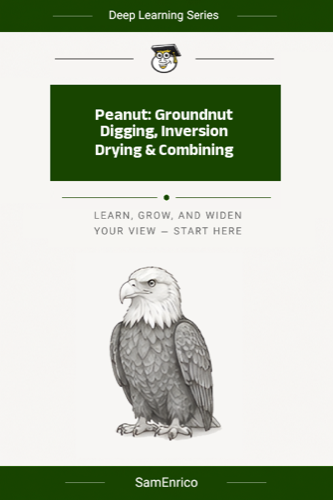
Peanut: Groundnut Digging, Inversion Drying & Combining
This harvesting publication, published by SamEnric
by Clapp Anisa
This harvesting publication, published by SamEnrico, covers Peanut: Groundnut Digging, Inversion Drying & Combining
Formats
About this book
Free sample
Chapter 1: The Buried Fortune...-- Every peanut farmer begins harvest with a simple belief: the crop is in the ground, the digger is hitched, and the combine is waiting. But beneath every acre of healthy-looking vines lies a hidden fortune that can vanish before a single pod reaches the wagon. The difference between a profitable harvest and a catastrophic loss is not luck, weather, or even the quality of your equipment. It is the ability to read what the plant is telling you before you turn a single blade of soil. This chapter is about that critical window of decision-making: the days and hours before the digger enters the field.
Get this wrong, and nothing else matters. Get it right, and you have already won half the battle.The common belief among growers is that harvest begins when the digger engages. That is a costly myth. Harvest actually begins weeks earlier, when the first pods reach physiological maturity. The decisions made in that pre-digging period determine everything that follows: how many pods will stay attached to the plant, how easily they will separate from the soil, how uniformly they will dry, and ultimately how much money will be deposited into your operating account.
This chapter covers the three pillars of pre-harvest success: understanding the peg zone, mastering the hull-scrape method for digging date determination, and using yield mapping as a planning tool rather than a live adjustment mechanism. By the end of this chapter, you will be able to walk any peanut field and know with confidence whether it is ready to dig, needs another week, or has already begun to lose value.The Peg Zone: Where Fortune Hangs by a Thread The peanut plant is a biological marvel precisely because it does something almost no other major crop does: it flowers above ground and fruits below ground. After pollination, the fertilized ovary (the peg or gynophore) elongates and grows downward into the soil, where it swells into the pod that eventually becomes your income. The point where the peg attaches to the pod is the single most vulnerable structural element…
This is the end of the free sample. Get the eBook to keep going. Buy now
Contents
- Chapter 1
- Chapter 2
- Chapter 3
- Chapter 4
- Chapter 5
- Chapter 6
- Chapter 7
- Chapter 8
- Chapter 9
- Chapter 10
- Chapter 11
- Chapter 12
Details
- Author
- Clapp Anisa
- Publisher
- SamEnrico
- Language
- English
- Genre
- Non-Fiction, Informative, Educational
- Released
- 2026-06-02
- Pages (approx.)
- 122
- Available as
- eBook, Audiobook

Read better in the ZLOADR app
Your eBooks on your phone or tablet. Sign in with your SamEnrico account and start reading.
More by Clapp Anisa
 Fortune Telling Anger CycleClapp Anisa$11.99
 Peer Feedback ConversationsClapp Anisa$11.99
 Fear of Failure in MarriageClapp Anisa$11.99
 Toxic Relationship Boundary GuideClapp Anisa$11.99
 The Mother's Child TraffickingClapp Anisa$11.99
 Water Weight MisleadingClapp Anisa$11.99
 HIIT for Weight LossClapp Anisa$11.99
 Debt Stress Recovery GuideClapp Anisa$11.99
 The Calculus of the Nile: How Egypt's Mathematicians Shaped the WorldClapp Anisa$11.99
 The Last Pharaoh's Secret: Cleopatra's Vanished FleetClapp Anisa$11.99
 How to Produce Produce CleanerClapp Anisa$11.99
 How to Produce Electric Skillet and Wok AccessoriesClapp Anisa$11.99