
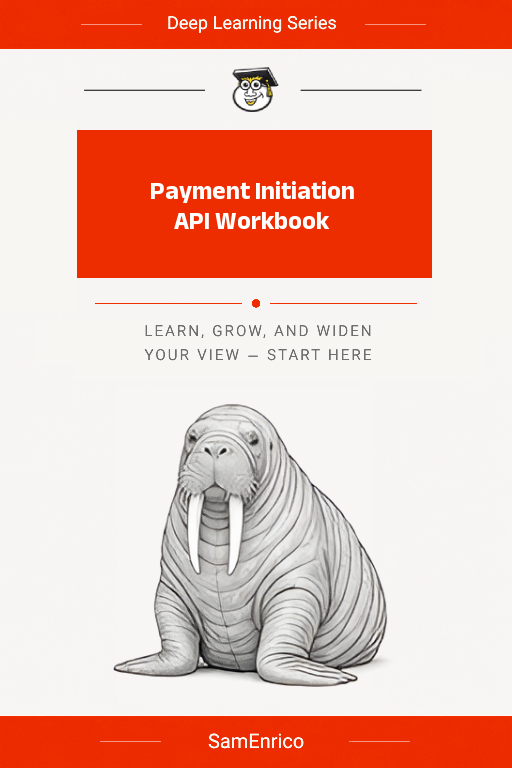
Payment Initiation API Workbook eBook
Initiate single and bulk payments directly from cu
by Lyles Temple
Initiate single and bulk payments directly from customer accounts without cards.
Formats
Free sample
Chapter 1: The 3% Tax--Every time a customer taps their card, swipes their phone, or types sixteen digits into a checkout form, they are paying a tax. Not a government tax—no, that one is unavoidable. This tax is levied by a private cartel of four companies that sit between merchants and their money, extracting roughly three percent of every transaction for doing very little that requires three percent of anything.If you run a business that processes one million dollars annually through card payments, you are paying approximately thirty thousand dollars per year in interchange fees, assessment fees, and markup. If you process ten million, you are paying three hundred thousand. If you process one hundred million, you are paying three million dollars—enough to hire an entire engineering team, launch a new product line, or buy a decent house in most American cities.This book exists because that tax is now optional.For the first time in the fifty-year history of electronic payments, there is a legally mandated, technically viable, and commercially proven alternative to card networks.
It is called Payment Initiation Services, or PIS. It allows you to pull money directly from a customer's bank account without a card, without a wallet, and without paying three percent. The cost is typically a flat fee of twenty to fifty cents per transaction, or as low as 0.3 percent for high-volume processors. That is not a typo. You can reduce your payment processing costs by eighty to ninety percent, overnight, with no change to your customer's experience beyond a single redirect to their banking app.The catch, of course, is that you have to build it yourself.
Or rather, you have to learn how to build it yourself, which is what this workbook is for.Why This Chapter Exists Before you write a single line of code, before you register for a sandbox environment, before you even decide whether PIS is right for your business, you need to understand what you are replacing, what you are building, and why the financial industry spent five years and billions of dollars creating the infrastructure that makes this possible.This chapter establishes the strategic and economic rationale for shifting from card-based payments to account-to-account payments via Payment Initiation Services. It contrasts the traditional card scheme model—with its multiple intermediaries and interchange fees—against the direct debtor-to-creditor flow of Open Banking. You will learn the four core advantages that make PIS disruptive: cost, speed, security, and data richness. You will meet the key players in the ecosystem: the banks, the third-party providers, and the customer. And you will complete a hands-on setup that prepares you for every coding exercise in the remaining eleven chapters.Let us begin with a story about a sandwich shop.The Sandwich Shop That Lost Twenty Thousand Dollars In 2019, a small chain of sandwich shops in Manchester, England, called "Bread & Co" decided to accept card payments for the first time.
They had been cash-only since opening in 2012, but customers kept asking to pay with cards. The owner, a practical woman named Sarah, signed up with a popular payment processor. The sales representative told her the fees were "competitive" and "standard for the industry." Sarah did the math: the processor would take 2.9 percent plus twenty pence per transaction.Bread & Co did about four hundred thousand pounds in annual revenue. Their average transaction was eight pounds. The math worked out to roughly eleven thousand pounds per year in fees.
Sarah considered this the cost of doing business.What Sarah did not know was that the actual cost of moving money from a customer's bank account to her bank account was approximately one penny. Everything above that was profit for intermediaries.Four years later, in 2023, Bread & Co switched to a Payment Initiation Service. Their cost per transaction dropped to twenty pence flat—no percentage. On the same four hundred thousand pounds in revenue, they paid roughly two thousand five hundred pounds in fees. They saved eight thousand five hundred pounds per year.
That was enough to hire a part-time employee, upgrade their ovens, or, as Sarah put it, "stop feeling like I was being robbed every time a customer bought a sandwich."The sandwich shop story is not unique. It is happening thousands of times per day across Europe, where PIS is mature, and starting to happen across the rest of the world, where Open Banking regulations are spreading. If you are reading this book, you are likely in one of two camps: you are a developer tasked with integrating PIS for your employer or client, or you are a business owner who has realized that card fees are consuming a meaningful portion of your margin. In either case, the path forward is the same. You need to understand how Payment Initiation works, why banks agreed to build it, and how to talk to the APIs they exposed.The Hidden Architecture of Card Payments To understand why Payment Initiation is revolutionary, you must first understand how card payments actually work under the hood.
Most merchants never see the full chain. They see a checkout form, a "payment successful" message, and a deposit in their bank account two days later. Between those two events, a Rube Goldberg machine of intermediaries extracts value at every step.Here is what happens when a customer pays with a Visa card.The customer enters their card details on your website. Your payment gateway encrypts those details and sends them to your acquirer—the bank that processes card transactions on your behalf. The acquirer forwards the transaction to the card network (Visa, Mastercard, or, rarely, American Express or Discover).
The card network routes the transaction to the issuing bank—the bank that gave the customer their card. The issuing bank checks whether the customer has sufficient funds or credit, deducts the amount, and sends an approval back through the chain. The approval travels from issuer to network to acquirer to gateway to your website. You show a "success" message. Two days later, the acquirer deposits the funds into your bank account, minus the interchange fees, assessment fees, and markup.Every single entity in this chain takes a cut.
The issuing bank takes interchange fees (typically 1.5 to 2.5 percent). The card network takes assessment fees (typically 0.1 to 0.15 percent). The acquirer takes a markup (typically 0.3 to 0.5 percent). The gateway takes a per-transaction fee (typically five to ten pence). The total is almost always between 2.5 and 3.5 percent, with a fixed per-transaction fee on top.For a ten-pound transaction, you pay roughly thirty pence in percentage fees plus ten pence fixed, totaling forty pence.
For a one-hundred-pound transaction, you pay roughly three pounds.Now consider what these intermediaries actually do. The issuing bank checks the customer's balance and holds the funds. The card network routes the message. The acquirer deposits the funds. The gateway encrypts the data.
None of these functions requires 2.9 percent. The actual cost of processing a payment, measured by the raw computing and banking resources consumed, is less than one penny for any transaction under one thousand pounds. The rest is economic rent extracted from the fact that merchants have no alternative.Until now.The Direct Path: How Payment Initiation Works Payment Initiation…
This is the end of the free sample. Get the eBook to keep going. Buy now
About this book
Details
- Author
- Lyles Temple
- Publisher
- SamEnrico
- Language
- English
- Genre
- Non-Fiction, Business Brief, Payment Initiation
- Released
- 2026-05-30
- Pages (approx.)
- 149
- Available as
- eBook, Audiobook

Read better in the ZLOADR app
Your eBooks on your phone or tablet. Sign in with your SamEnrico account and start reading.
More by Lyles Temple
 Celebrity Lookalike TrickLyles Temple$11.99
 Social Anxiety Relationship GuideLyles Temple$11.99
 Duolingo Streak Anxiety HelpLyles Temple$11.99
 Morning Nap StrategyLyles Temple$11.99
 The Blood Drive CoordinatorLyles Temple$11.99
 Price War AvoidanceLyles Temple$11.99
 OKRs for Business TeamsLyles Temple$11.99
 Overcome Online Checkout RushLyles Temple$11.99
 The Poisoned Formula: How a Corporate Spy Betrayed Latin America's Pharmaceutical GiantsLyles Temple$11.99
 The Moonlit Vow of the Nine-Tailed FoxLyles Temple$11.99
 How to Produce Joint PrimerLyles Temple$11.99
 Service Providers Guide to Internet ServiceLyles Temple$11.99