
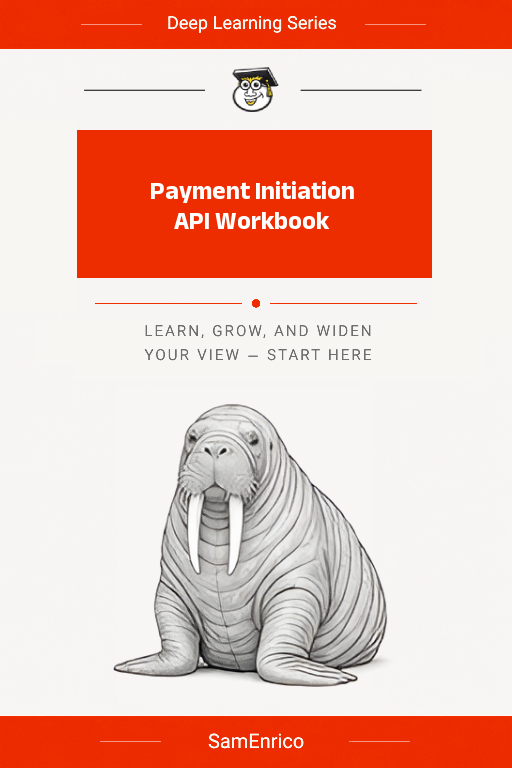
Payment Initiation API Workbook Audiobook
Initiate single and bulk payments directly from cu
by Lyles Temple
Initiate single and bulk payments directly from customer accounts without cards.
Formats
Free sample
Chapter 1: The 3% Tax--Every time a customer taps their card, swipes their phone, or types sixteen digits into a checkout form, they are paying a tax. Not a government tax—no, that one is unavoidable. This tax is levied by a private cartel of four companies that sit between merchants and their money, extracting roughly three percent of every transaction for doing very little that requires three percent of anything.If you run a business that processes one million dollars annually through card payments, you are paying approximately thirty thousand dollars per year in interchange fees, assessment fees, and markup. If you process ten million, you are paying three hundred thousand. If you process one hundred million, you are paying three million dollars—enough to hire an entire engineering team, launch a new product line, or buy a decent house in most American cities.This book exists because that tax is now optional.For the first time in the fifty-year history of electronic payments, there is a legally mandated, technically viable, and commercially proven alternative to card networks.
It is called Payment Initiation Services, or PIS. It allows you to pull money directly from a customer's bank account without a card, without a wallet, and without paying three percent. The cost is typically a flat fee of twenty to fifty cents per transaction, or as low as 0.3 percent for high-volume processors. That is not a typo. You can reduce your payment processing costs by eighty to ninety percent, overnight, with no change to your customer's experience beyond a single redirect to their banking app.The catch, of course, is that you have to build it yourself.
Or rather, you have to learn how to build it yourself, which is what this workbook is for.Why This Chapter Exists Before you write a single line of code, before you register for a sandbox environment, before you even decide whether PIS is right for your business, you need to understand what you are replacing, what you are building, and why the financial industry spent five years and billions of dollars creating the infrastructure that makes this possible.This chapter establishes the strategic and economic rationale for shifting from card-based payments to account-to-account payments via Payment Initiation Services. It contrasts the traditional card scheme model—with its multiple intermediaries and interchange fees—against the direct debtor-to-creditor flow of Open Banking. You will learn the four core advantages that…
This is the end of the free sample. Get the Audiobook to keep going. Buy now
About this book
Details
- Author
- Lyles Temple
- Publisher
- SamEnrico
- Language
- English
- Genre
- Non-Fiction, Business Brief, Payment Initiation
- Released
- 2026-05-30
- Pages (approx.)
- 149
- Available as
- eBook, Audiobook

Listen in the VoxFlicks app
Audiobooks and audio dramas wherever you go. Sign in with your SamEnrico account and press play.
More by Lyles Temple
 Celebrity Lookalike TrickLyles Temple$11.99
 Social Anxiety Relationship GuideLyles Temple$11.99
 Duolingo Streak Anxiety HelpLyles Temple$11.99
 Morning Nap StrategyLyles Temple$11.99
 The Blood Drive CoordinatorLyles Temple$11.99
 Price War AvoidanceLyles Temple$11.99
 OKRs for Business TeamsLyles Temple$11.99
 Overcome Online Checkout RushLyles Temple$11.99
 The Poisoned Formula: How a Corporate Spy Betrayed Latin America's Pharmaceutical GiantsLyles Temple$11.99
 The Moonlit Vow of the Nine-Tailed FoxLyles Temple$11.99
 How to Produce Joint PrimerLyles Temple$11.99
 Service Providers Guide to Internet ServiceLyles Temple$11.99