
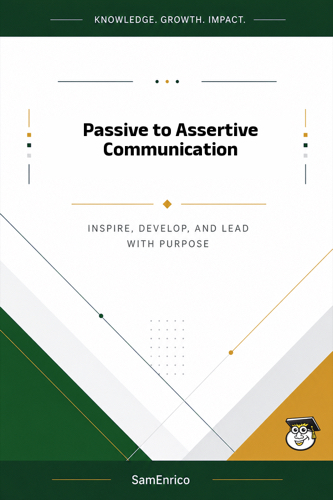
Passive to Assertive Communication Audiobook
Gradually replace silent suffering and people plea
Gradually replace silent suffering and people pleasing with confident speech.
Formats
Free sample
Here is an in-depth, chapter-by-chapter summary for the book The Voice of Integrity: Breaking the Silence of People-Pleasing, following the outline provided.Each chapter summary includes:Core Thesis (the central argument)Key Concepts (new frameworks introduced)Practical Exercises (what the reader actually does)Chapter Takeaway (the one-sentence lesson to remember)Part I: The Archaeology of Silence (Why We Stay Quiet)Chapter 1: The High Cost of Being "Nice"Core Thesis:Passivity is not a harmless personality quirk or a virtue. It is an expensive survival strategy that accrues interest over time. This chapter reframes "niceness" from a moral good to a transactional behavior with real psychological and relational costs.Key Concepts:The Hidden Invoice: A metaphor for the unspoken tally of small sacrifices, swallowed words, and deferred preferences. Every time you say "yes" when you mean "no," you add a line item to this invoice.Passive Debt: The accumulation of resentment, exhaustion, and invisible labor that builds up in relationships where one person consistently suppresses their needs. This debt eventually destroys intimacy, because the passive person begins secretly "keeping score" while the other person remains unaware.The Three Ledgers:Time Ledger: Hours lost to activities you didn't want to do.Energy Ledger: The fatigue from constant hypervigilance (monitoring others' moods).Resentment Ledger: The growing bitterness that leaks out as sarcasm, withdrawal, or psychosomatic illness.The "Nice vs.
Good" Distinction:Nice is performative, transactional, and fear-based ("If I am nice, you won't abandon/attack me").Good is values-based, chosen, and sustainable ("I act kindly because it aligns with who I want to be").Practical Exercises:The Hidden Invoice Worksheet: Readers log three specific incidents from the past week where they said "yes" resentfully, calculating the time spent, energy lost, and resentment points accrued.The Cost-Benefit Reversal: For each incident, readers ask: "What would have been the actual cost of saying 'no'? What was the actual cost of saying 'yes'?" (Often, the imagined cost of "no" is far lower than the real cost of "yes.")Chapter Takeaway:You cannot afford to be "nice" indefinitely—the passive debt will bankrupt your relationships and your sense of self.Chapter 2: The "Fawning" Instinct Core Thesis:Chronic people-pleasing is not a sign of excessive empathy; it is the fourth "F" in the trauma response (Fight, Flight, Freeze, Fawn). It is a learned survival strategy designed to neutralize a perceived threat by becoming indispensable, agreeable, or invisible.Key Concepts:The Fawn Response: First described by trauma therapist Pete Walker. When…
This is the end of the free sample. Get the Audiobook to keep going. Buy now
About this book
Details
- Author
- Snider Celena
- Publisher
- SamEnrico
- Language
- English
- Genre
- Non-Fiction, Self-Help, Personal Growth
- Released
- 2026-06-11
- Pages (approx.)
- 147
- Available as
- eBook, Audiobook

Listen in the VoxFlicks app
Audiobooks and audio dramas wherever you go. Sign in with your SamEnrico account and press play.
More by Snider Celena
 The Even Better If GuideSnider Celena$11.99
 Hollywood Child Star Survival GuideSnider Celena$11.99
 Flow State Interruption Shield GuideSnider Celena$11.99
 Media Manipulation CaseSnider Celena$11.99
 Walmart TruckingSnider Celena$11.99
 The Freelance Pay Rate GuideSnider Celena$11.99
 Teen Self Esteem and MindfulnessSnider Celena$11.99
 GST Registration India Step by Step ManualSnider Celena$11.99
 The Great Pizza War: How Domino's and Pizza Hut Fought for Global DominationSnider Celena$11.99
 The Day the Earth Roared: Krakatoa's Forgotten AftermathSnider Celena$11.99
 Understanding AnorchidismSnider Celena$17.99
 The Complete Guide to the No S DietSnider Celena$11.99
You may also like
 Redefining Ambition for ResilienceSisson Diedre$11.99
 Anger as Relationship DataAlbertson Catrice$11.99
 Alcoholism and Personality Change Recovery GuideCollyer Bobbie$11.99
 Assertiveness for Passive PersonalitiesKnox Charlyn$11.99
 The First Year of SobrietyShively Viva$11.99
 The Self Talk Transformation GuideSisson Vertie$11.99
 Passive to Assertive TrainingSheffield Bonny$11.99
 Finding Life Purpose WorkbookHobson Inga$11.99