
Non-FictionSelf-HelpAgreement Persuasion
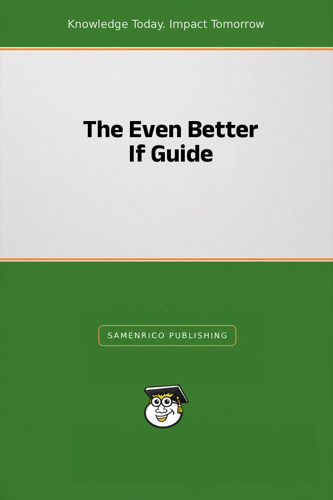
The Even Better If Guide
Agrees first then suggests improvement.
Agrees first then suggests improvement.
Formats
About this book
Free sample
Chapter 1: The Validation Priority Rule--A few years ago, I watched a senior product manager named Sarah lose control of a meeting she was supposed to lead. She had prepared slides, data, and a clear recommendation. Thirty seconds in, a junior designer interrupted and said, “This whole approach is wrong.” Sarah’s face tightened. She crossed her arms and said, “Actually, I’ve been working on this for three weeks.” The room went silent. The junior designer doubled down.
Within five minutes, the meeting was a wreck—defensiveness, blame, and zero progress. Later, Sarah told me, “I was just defending my work. Why did that go so badly?”I told her something that changed how she communicated forever: “You started with ‘actually.’ That’s a ‘no’ in disguise. And you never once validated what the designer said—even the part that was true.”Sarah had broken the first rule of the Even Better If framework. She had failed to validate before improving.
Worse, she had no way of knowing what to validate. Was she supposed to agree with “this whole approach is wrong”? That would be a lie. Was she supposed to validate the designer’s emotion? His intent?
His factual claim? The designer had thrown a grenade into the room, and Sarah had no prioritization system for picking up the right piece of it.This chapter provides that system. It is called the Validation Priority Rule, and it is the single most important tool in the Even Better If framework. Before you can say “even better if,” you must know what to validate first. Get this wrong, and EBI fails.
Get it right, and even the harshest criticism becomes a doorway to collaboration.The Problem with “Agreement”Let me clarify something immediately. This book previously used the word “agreement” to cover too much territory. Readers and editors rightly pointed out that agreeing with someone’s emotion (“I agree you feel angry”) is not the same as agreeing with their fact (“I agree the report was late”) or their intent (“I agree you want faster results”). Using one word for all three created confusion.So…
This is the end of the free sample. Get the eBook to keep going. Buy now
Contents
- Chapter 1
- Chapter 2
- Chapter 3
- Chapter 4
- Chapter 5
- Chapter 6
- Chapter 7
- Chapter 8
- Chapter 9
- Chapter 10
- Chapter 11
- Chapter 12
Details
- Author
- Snider Celena
- Publisher
- SamEnrico
- Language
- English
- Genre
- Non-Fiction, Self-Help, Agreement Persuasion
- Released
- 2026-06-09
- Pages (approx.)
- 137
- Available as
- eBook, Audiobook

Read better in the ZLOADR app
Your eBooks on your phone or tablet. Sign in with your SamEnrico account and start reading.
More by Snider Celena
 Passive to Assertive CommunicationSnider Celena$11.99
 Hollywood Child Star Survival GuideSnider Celena$11.99
 Flow State Interruption Shield GuideSnider Celena$11.99
 Media Manipulation CaseSnider Celena$11.99
 Walmart TruckingSnider Celena$11.99
 The Freelance Pay Rate GuideSnider Celena$11.99
 Teen Self Esteem and MindfulnessSnider Celena$11.99
 GST Registration India Step by Step ManualSnider Celena$11.99
 The Great Pizza War: How Domino's and Pizza Hut Fought for Global DominationSnider Celena$11.99
 The Day the Earth Roared: Krakatoa's Forgotten AftermathSnider Celena$11.99
 Understanding AnorchidismSnider Celena$17.99
 The Complete Guide to the No S DietSnider Celena$11.99
You may also like
 Hong Kong Handover 1997Dunn Johnnie$11.99
 Zumba For Postnatal Recovery CourseNeal Christian$11.99
 Zumba for BeginnersLadner Nikia$11.99
 YouTube Comment Mining GuideHumes Pandora$12.99
 Worry Box MeditationCarlin Rudy$11.99
 Workplace Stress MeditationNguyen Lynn$11.99
 Workplace Stress and Sleep RepairHawley Ivory$11.99
 Workplace Perfectionism CureDelaney Jeffry$11.99
 Workplace Injustice Anger GuideWallen Isabelle$11.99
 Work Addiction and Burnout LinkGreenwood Ester$11.99
 Women in Yoga and WellnessBeattie Galina$11.99
 Women in Stand Up ComedyChun Evangeline$11.99