
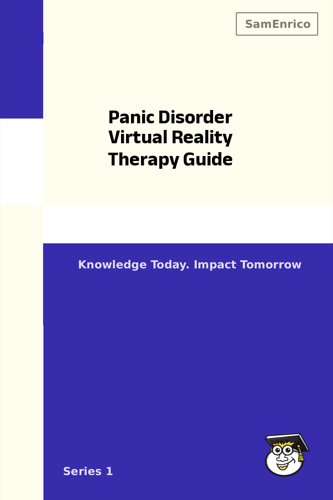
Non-FictionHealth & WellnessDigital Therapy
Panic Disorder Virtual Reality Therapy Guide eBook
Use VR exposure to practice panic management in sa
Use VR exposure to practice panic management in safe digital environments.
Formats
Free sample
Chapter 1: The False Alarm...--–- You are reading this because a part of you—maybe the part that wakes you at 3:00 AM with a pounding chest and the certain knowledge that this time, this time, something is truly wrong—believes that your body has betrayed you. That belief is the first thing we need to examine, not because it is false in the way a lie is false, but because it is false in the way a smoke alarm is false when it screams about burnt toast. The alarm is doing exactly what it was designed to do. The problem is not the alarm. The problem is what the alarm is detecting—or, more precisely, what it thinks it is detecting.Let me tell you about a patient I will call David.
(All names and identifying details throughout this book have been changed, but the clinical truth remains intact.) David was a 34-year-old architect who built skyscrapers for a living. He could calculate load-bearing stresses in his head. He could stand on a 40th-floor steel beam without a tremor. But twice a week, sometimes more, he would find himself sitting in his parked car outside a grocery store, unable to open the door. His hands would sweat.
His heart would pound so hard he could see his shirt moving. His vision would narrow to a tunnel. And he would think, I am dying. This is it. Right here in the parking lot of a Stop & Shop.
He had been to the emergency room seven times in the previous year. Seven times they had run EKGs, drawn blood, taken chest X-rays. Seven times they had told him the same thing: Your heart is fine. Your lungs are fine. You are having a panic attack.
And seven times David had walked out thinking, But they missed something. They didn't see it. Next time, they will see.David is not unusual. He is not broken in some unique or exotic way. He is, in fact, perfectly predictable—because the mechanism that produces his panic attacks is the same mechanism that produces panic attacks in millions of people across every culture, every income level, every profession.
It is not a character flaw. It is not a sign of weakness. It is a false alarm in the most literal sense of those two words: an alarm that triggers when there is no fire.This chapter will teach you three things. First, you will learn exactly what happens inside your brain and body during a panic attack—not the vague, pop-psychology version, but the real neurobiological sequence. Second, you will learn why your brain keeps triggering these false alarms even though you know nothing is dangerous.
And third, you will learn the single most important principle that underlies everything else in this book: the difference between avoidance and approach, and why one shrinks your world while the other rewires your brain.By the end of this chapter, you will no longer see panic as a mysterious enemy that attacks without warning. You will see it as a predictable, understandable, and—this is the crucial word—trainable response. And that shift in perspective is the foundation upon which every VR exercise in this book will be built.The Architecture of a False Alarm To understand why panic attacks happen, you need to understand a small, almond-shaped structure deep inside your brain called the amygdala. The amygdala does not think. It does not reason.
It does not care about your credit score, your relationship problems, or whether you remembered to send that email. The amygdala has exactly one job: threat detection. It is the smoke alarm of your nervous system.Approximately 40 milliseconds—that is forty thousandths of a second—after your senses detect something potentially dangerous, the amygdala activates your sympathetic nervous system. Your adrenal glands release epinephrine (adrenaline). Your heart rate accelerates.
Your breathing becomes rapid and shallow. Blood rushes away from your digestive system and toward your large muscles. Your pupils dilate. Your non-essential systems (like digestion and immune response) temporarily shut down. This is the fight-or-flight response, and it is one of the most elegant survival mechanisms ever evolved.Here is the problem: the amygdala is fast, but it is not accurate.
It evolved in an environment where the most common threats were predators, cliffs, and hostile tribes. In that environment, a false alarm (running away from a rustling bush that turned out to be wind) was cheap. A missed alarm (not running away from a rustling bush that turned out to be a lion) was fatal. So evolution selected for amygdalas that erred on the side of screaming first and asking questions later.Your amygdala does not know that you are sitting in a climate-controlled living room reading a book. It does not know that the "threat" it just detected was a skipped heartbeat (which is almost always benign) or a slight dizzy sensation (which is almost always harmless) or a feeling of shortness of breath (which is almost always anxiety, not illness).
All your amygdala knows is that it detected something that looks, in some primitive pattern-matching way, like danger. And so it screams.The key insight—and I want you to write this down somewhere you will see it often—is this: A panic attack is not evidence that something is wrong with your body. It is evidence that your amygdala is doing exactly what it evolved to do. The problem is not the alarm. The problem is that the alarm is being triggered by the wrong signals.This is what clinicians call the False Alarm Theory of panic disorder.
It was first formally described by psychologist David Barlow in the 1980s, and it has been confirmed by hundreds of subsequent studies. People with panic disorder do not have "too much" anxiety. They have normal anxiety responses that are being triggered at the wrong times—by internal bodily sensations rather than by external threats.The Two Fears That Trap You Here is where panic disorder becomes genuinely cruel. Most fears have a clear object: you are afraid of heights, so you avoid tall buildings. You are afraid of spiders, so you avoid basements.
The fear is unpleasant, but it is contained. Panic disorder does not work that way. Panic disorder creates not one fear but two.The first fear is external fear—fear of specific situations or places. This is the fear that makes David unable to enter the grocery store. It is the fear that makes you avoid the highway, the elevator, the airplane, the crowded restaurant.
On its own, this fear is manageable. You could, in theory, simply avoid those situations forever.But then comes the second fear, and this is the one that destroys lives. The second fear is internal fear—fear of the physical sensations themselves. You are not afraid of the grocery store. You are afraid of the dizziness you might feel in the grocery store.
You are not afraid of the highway. You are afraid of the racing heart you might experience on the highway. You are not afraid of the elevator. You are afraid of the feeling of being trapped and suffocating that the…
This is the end of the free sample. Get the eBook to keep going. Buy now
About this book
Details
- Author
- Iverson Karin
- Publisher
- SamEnrico
- Language
- English
- Genre
- Non-Fiction, Health & Wellness, Digital Therapy
- Released
- 2026-06-06
- Pages (approx.)
- 157
- Available as
- eBook, Audiobook

Read better in the ZLOADR app
Your eBooks on your phone or tablet. Sign in with your SamEnrico account and start reading.
More by Iverson Karin
 HGH and Hair Loss ConnectionIverson Karin$11.99
 Crisis Communication Presentation NervesIverson Karin$11.99Crisis Communication Presentation NervesIverson Karin$11.99
 Parental Anger Micro Habits GuideIverson Karin$11.99
 Self Hypnosis for AbundanceIverson Karin$11.99
 The 444 Days: The Forgotten Hostage Crisis That Shocked the WorldIverson Karin$11.99
 Letters Across the Wire: Love in the Battle of BritainIverson Karin$11.99
 Understanding Branchial Arch Syndrome X LinkedIverson Karin$17.99
 Immigration ParalegalIverson Karin$11.99
 Remote Global Bootcamp GuideIverson Karin$12.99
 Ecommerce Returns Policy OutlookIverson Karin$12.99
 How to Become a Sawyer IiIverson Karin$11.99
You may also like
 Hong Kong Handover 1997Dunn Johnnie$11.99
 Zumba For Postnatal Recovery CourseNeal Christian$11.99
 Zumba for BeginnersLadner Nikia$11.99
 YouTube Comment Mining GuideHumes Pandora$12.99
 Worry Box MeditationCarlin Rudy$11.99
 Workplace Stress MeditationNguyen Lynn$11.99
 Workplace Stress and Sleep RepairHawley Ivory$11.99
 Workplace Perfectionism CureDelaney Jeffry$11.99
 Workplace Injustice Anger GuideWallen Isabelle$11.99
 Work Addiction and Burnout LinkGreenwood Ester$11.99
 Women in Yoga and WellnessBeattie Galina$11.99
 Women in Stand Up ComedyChun Evangeline$11.99