
Non-FictionInformativeEducational
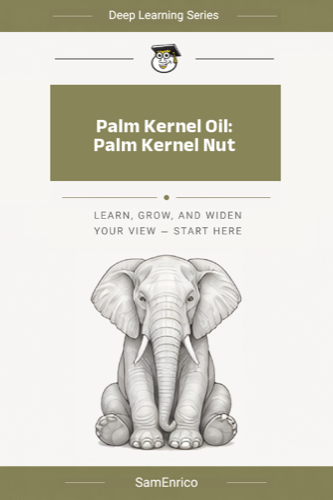
Palm Kernel Oil: Palm Kernel Nut eBook
This harvesting publication, published by SamEnric
by Milam Bula
This harvesting publication, published by SamEnrico, covers Palm Kernel Oil: Palm Kernel Nut
Formats
Free sample
Chapter 1: Two Oils, One Fruit--–- The first time I held a palm kernel in my hand, I had no idea what it was. The fruit that surrounded it—a glossy, reddish-orange oval the size of a small olive—looked like any other tropical drupe. I squeezed it, expecting juice or soft flesh. Instead, my fingernail struck something that felt like stone. The field manager beside me laughed.
“That’s what you’re really after,” he said, pointing to the invisible seed inside. “The pulp is for volume. The kernel is for value.” That moment of confusion is where this book begins—and where most of the world still lives. We see palm oil everywhere: in our packaged foods, our biodiesel, our politics. But we almost never see the kernel, the hard white seed that hides inside the fruit, waiting to become the foam in our shampoo, the cream in our soap, the melt in our chocolate.
This chapter is an act of separation. It will teach you to see one fruit as two completely different oils—and why that distinction matters more than you think.The Anatomy of a Single Fruit To understand palm kernel oil, you must first unlearn what you think you know about palm oil. They come from the same tree, the same bunch, even the same individual fruit. But from that point forward, their stories diverge completely.The oil palm, Elaeis guineensis, produces bunches that weigh between ten and forty kilograms each. A single bunch contains anywhere from one thousand to three thousand individual fruits.
Each fruit is a botanical marvel of compartmentalization. The outer skin, or exocarp, is smooth and waxy, ranging in color from deep purple to orange-red as it ripens. Beneath that lies the mesocarp—the fleshy, fibrous layer that gives us crude palm oil (CPO). When you hear about the environmental controversies of palm oil, this is the layer under discussion. CPO is red because it is rich in carotenoids (the same compounds that make carrots and tomatoes red), and it flows freely at tropical temperatures.
It is the workhorse fat of the global food industry, found in everything from margarine to instant noodles.But buried inside that fleshy mesocarp is something entirely different. A hard, woody shell, called the endocarp, protects the fruit’s single seed. That seed is the palm kernel. Unlike the soft, oily mesocarp, the kernel is solid, white, and dense. It contains an oil that shares almost none of the chemical properties of CPO.
The kernel’s oil is lauric, not palmitic. It is solid at room temperature, not liquid. It is odorless and nearly colorless when refined, not red and pungent. And while 70 percent of CPO ends up in food, 70 percent of palm kernel oil (PKO) ends up in industrial and cosmetic products. One tree, one fruit, two completely different economic destinies.Why This Distinction Has Been Hidden The confusion between palm oil and palm kernel oil is not an accident.
It is the result of decades of reporting, advocacy, and supply chain opacity that treated the entire palm fruit as a single commodity. When environmental groups campaign against palm oil, they almost never distinguish between CPO and PKO. When journalists write about deforestation in Indonesia and Malaysia, they use the generic phrase “palm oil production” to describe an industry that actually produces two distinct products with different supply chains, different buyers, and different sustainability profiles.This lumping together has real consequences. Smallholder farmers who could earn premium prices for high-quality kernels often do not know that a separate market exists. Mill operators who could double their revenue by optimizing kernel recovery instead treat kernels as an afterthought.
Consumers who want to make ethical choices read labels that say “palm oil” when the ingredient is actually PKO—a fat that has never been linked to the worst deforestation drivers because it comes from the seed, not the flesh, and because the kernel’s high value creates economic incentives for intensification rather than expansion.The goal of this chapter—and this entire book—is to separate what has been confused. By the time you finish reading, you will never again mistake CPO for PKO. You will understand why the kernel deserves its own supply chain, its own quality metrics, and its own chapter in the story of sustainable agriculture.Chemical Divorce: Lauric Versus Palmitic The most fundamental difference between palm oil and palm kernel oil is not where they come from but what they are made of. Fats and oils are composed of triglycerides—molecules made of a glycerol backbone attached to three fatty acid chains. The length of those chains and the presence or absence of double bonds determine every property of the oil: its melting point, its shelf life, its reactivity, and its value in different industries.Crude palm oil is dominated by palmitic acid (C16:0), a sixteen-carbon saturated fatty acid that makes up approximately 44 percent of its total fatty acid profile.
It also contains significant amounts of oleic acid (C18:1, a monounsaturated fat) and linoleic acid (C18:2, a polyunsaturated fat). This combination gives CPO a balanced melting profile and makes it useful for frying, baking, and as a structural fat in processed foods. It is a generalist oil, suitable for many applications but not exceptional at any single one.Palm kernel oil could not be more different. Its dominant fatty acid is lauric acid (C12:0), a twelve-carbon saturated fat that constitutes approximately 48 percent of its total profile. Lauric acid is a medium-chain triglyceride (MCT) precursor, which means it is metabolized differently than long-chain fats.
It is also the reason PKO is the preferred feedstock for the oleochemical industry. When lauric acid is split from the glycerol backbone and processed, it becomes sodium lauryl sulfate (SLS), sodium laureth sulfate (SLES), lauryl alcohol, and a dozen other surfactants that give shampoo its foam, toothpaste its bubbles, and laundry detergent its cleaning power.The difference in chain length—twelve carbons for lauric versus sixteen for palmitic—may seem small, but it changes everything. Lauric oils are rare. Only coconut oil and palm kernel oil contain them in significant quantities. This scarcity is why PKO trades at a premium to CPO, sometimes by hundreds of dollars per ton.
It is also why the kernel is not a byproduct but a co-product—a point we will return to throughout this book.A side‑by‑side comparison makes the contrast clear. PKO is 80 to 85 percent saturated fat, with lauric acid at roughly 48 percent, myristic at 16 percent, and palmitic at 8 percent. CPO is roughly 50 percent saturated, 40 percent monounsaturated, and 10 percent polyunsaturated, with palmitic at 44 percent, oleic at 39 percent, and linoleic at 10 percent. These numbers are not academic trivia. They determine everything from how the oil behaves in a frying pan to how much it costs on the Rotterdam spot market.The Harvest Timing Trade‑Off Because the kernel is buried inside a hard shell, its maturation follows a different schedule than the fleshy mesocarp.
This physiological fact has profound implications for anyone who harvests oil palm bunches.The mesocarp begins accumulating oil early in the fruit’s development, roughly sixteen weeks after anthesis (flowering). By twenty weeks, the mesocarp is already rich…
This is the end of the free sample. Get the eBook to keep going. Buy now
About this book
Details
- Author
- Milam Bula
- Publisher
- SamEnrico
- Language
- English
- Genre
- Non-Fiction, Informative, Educational
- Released
- 2026-06-02
- Pages (approx.)
- 141
- Available as
- eBook, Audiobook

Read better in the ZLOADR app
Your eBooks on your phone or tablet. Sign in with your SamEnrico account and start reading.
More by Milam Bula
 High School Study GuideMilam Bula$11.99
 Shift Work and Digestive DisordersMilam Bula$11.99
 Fear of Failure in CreativesMilam Bula$11.99
 Exit Interview ConversationsMilam Bula$11.99
 Weight Loss Calorie CreepMilam Bula$11.99
 The Mother's Faked DeathMilam Bula$11.99
 CPR for National ParksMilam Bula$11.99
 Odysseus Unbound: The Cunning King’s Last LessonMilam Bula$11.99
 The Cosmic Visionaries of Meroë: Astronomers of the NileMilam Bula$11.99
 How to Produce Printer, Copier and Fax Machine Circuit BoardsMilam Bula$11.99
 Export Financing for Shea & CoffeeMilam Bula$12.99
 Alibaba Sample Order vs Amazon Test Buy WorkbookMilam Bula$12.99
You may also like
 Hong Kong Handover 1997Dunn Johnnie$11.99
 Zumba For Postnatal Recovery CourseNeal Christian$11.99
 Zumba for BeginnersLadner Nikia$11.99
 YouTube Comment Mining GuideHumes Pandora$12.99
 Worry Box MeditationCarlin Rudy$11.99
 Workplace Stress MeditationNguyen Lynn$11.99
 Workplace Stress and Sleep RepairHawley Ivory$11.99
 Workplace Perfectionism CureDelaney Jeffry$11.99
 Workplace Injustice Anger GuideWallen Isabelle$11.99
 Work Addiction and Burnout LinkGreenwood Ester$11.99
 Women in Yoga and WellnessBeattie Galina$11.99
 Women in Stand Up ComedyChun Evangeline$11.99