
Non-FictionSelf-HelpCreative Psychology
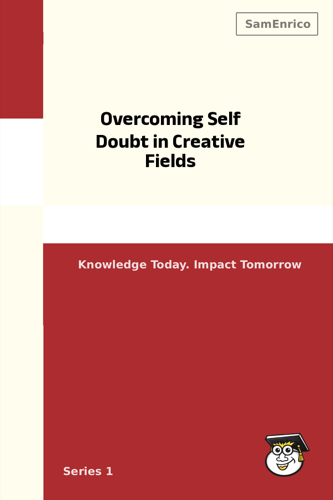
Overcoming Self Doubt in Creative Fields eBook
Helps artists, writers, and musicians trust their
Helps artists, writers, and musicians trust their creative worth.
Formats
Free sample
Chapter 1: The Gatekeeper's Lie--The first time I almost quit making art, I wasn't failing. I was winning.I had just finished my first paid commission as a freelance writer—a small piece for a local magazine, nothing glamorous. The editor sent a polite email: "Thanks for this. A few revision notes attached." Three hundred words of feedback. None of it mean.
All of it reasonable. And I sat at my kitchen table and felt my chest tighten like I'd been caught stealing.My inner voice, which had been quiet during the actual work, suddenly roared to life: You don't know what you're doing. They made a mistake hiring you. Everyone can see you're faking it.I didn't send the revisions. I closed my laptop and spent three days avoiding the document, convincing myself I'd been lucky once and would never work again.
The feedback wasn't the problem. The problem was that I had succeeded—even a little—and my brain had interpreted success as a threat.That was the moment I realized something that would take me another decade to fully understand: self-doubt is not the enemy of creative work. It is the toll booth you must pass through to get to the other side.If you picked up this book, you already know the feeling. Maybe you're a painter who can't start the next canvas because the last one was "good enough" and now the bar is higher. Maybe you're a musician who finishes a song, loves it for exactly six hours, then wakes up convinced it's garbage.
Maybe you're a writer who has three abandoned novels in a drawer and a fourth one you're afraid to open.You have been told, probably a hundred times, that the solution is confidence. "Believe in yourself." "Trust your voice." "Fake it till you make it."This book is going to argue the opposite.Confidence is a trap. It comes and goes like weather. If you wait to create until you feel confident, you will die with your best work undone. The goal is not to become confident.
The goal is to become effective—able to act whether you feel confident or not. And the first step toward effectiveness is understanding the force that has been stopping you.Its name is Resistance.The Force That Calls Itself You Most people who struggle with creative self-doubt believe they have a unique problem. They think their inner critic is louder than other people's, or their procrastination is more stubborn, or their impostor syndrome is somehow more real.Here is the liberating truth: you are not broken. You are not uniquely flawed. You are experiencing a universal psychological force that every creative person—from Nobel laureates to garage bands—has faced since humans first painted on cave walls.This force has many names.
Procrastination. Perfectionism. Distraction. Self-sabotage. The inner critic.
Impostor syndrome. But these are not separate problems. They are costumes that a single force wears to hide its true nature.We call it Resistance.Resistance is the name we give to any internal force that delays or prevents creative work. It feels external, like a critic sitting next to you or a weight on your chest. But it is not external.
It is generated by your own brain—specifically, by ancient neurological systems that evolved to protect you from physical danger and social rejection, not from blank pages.Here is what Resistance sounds like in your head:"Who do you think you are?""You should probably check email first.""This has already been done better.""You don't have the right training.""Wait until you feel ready.""What if it's bad?""What if it's good—and then you have to do it again?"Notice something important about these sentences. They are not logical arguments. They are not accurate assessments of your skills or your situation. They are fear wearing the mask of reason.And here is the most important thing to understand about Resistance: it grows strongest right before a breakthrough.The more important the work is to your soul, the louder the doubt. The closer you get to finishing something real, the more Resistance will scream that you should stop, check email, reorganize your desk, watch one more tutorial, read one more book, wait until Monday, wait until after the holidays, wait until you feel ready.Waiting until you feel ready is the most elegant trap Resistance has ever designed.
Because "ready" never comes.The Two Kinds of Doubt (Only One Is Real)Before we go further, we need to make a distinction that will save you years of suffering. Not all doubt is Resistance. Some doubt is logistical. Some doubt is existential. Learning to tell them apart is the single most important skill this book will teach you.Logistical Doubt: The Useful Kind Logistical doubt asks questions like:"Do I have the skills to pull this off?""Do I need better materials?""Should I take a class on this technique?""Is this the right medium for what I'm trying to say?"Logistical doubt is answerable.
It points to specific, concrete gaps between where you are and where you want to be. You can address logistical doubt with practice, study, better tools, or a different approach. It is not pleasant—no one likes realizing they have more to learn—but it is productive. Logistical doubt leads to action. It says, "You need to learn X," and then you go learn X.Logistical doubt is not the enemy.
It is your quality control system.Existential Doubt: The Resistance Disguise Existential doubt asks questions like:"Do I have the right to exist as a creative person?""Who am I to do this work?""What if I'm fundamentally untalented?""What if everyone finds out I've been faking?"Existential doubt is unanswerable. No amount of practice, study, or external validation will ever resolve it. You could win a Pulitzer, sell out a stadium, or hang your work in the Louvre, and existential doubt would simply raise the bar and ask, "Yes, but what about next time?"Here is the secret that most self-help books won't tell you: you cannot eliminate existential doubt. It is a permanent feature of the creative mind. The goal is not to kill it.
The goal is to recognize it, name it, and act despite it.Logistical doubt asks, "Do I have the skills?" That's a real question. Answer it.Existential doubt asks, "Do I have the right?" That's Resistance. Ignore it and work anyway.Why Success Triggers Worse Doubt Than Failure The paragraph you are about to read may be the most important in this chapter.Resistance is not afraid of your failure. It is terrified of your success.Think about that. When you fail, Resistance wins.
You stop creating. You retreat to safety. You never risk again. Failure is Resistance's dream outcome. But when you succeed—when you finish something, share it, get recognition, feel the satisfaction of a completed work—Resistance goes into emergency mode.
Because success proves that you can do it. And if you can do it once, you might do it again. And again. And then Resistance loses all its power.This is why so many creatives self-sabotage right…
This is the end of the free sample. Get the eBook to keep going. Buy now
About this book
Details
- Author
- Heckman Karissa
- Publisher
- SamEnrico
- Language
- English
- Genre
- Non-Fiction, Self-Help, Creative Psychology
- Released
- 2026-06-08
- Pages (approx.)
- 128
- Available as
- eBook, Audiobook

Read better in the ZLOADR app
Your eBooks on your phone or tablet. Sign in with your SamEnrico account and start reading.
More by Heckman Karissa
 Loving Kindness for BreakupsHeckman Karissa$11.99
 High Net Worth Wellness HabitsHeckman Karissa$11.99
 Cameroon Union des PopulationsHeckman Karissa$11.99
 The Equifax Breach ExposedHeckman Karissa$11.99
 The Symphony of the Stars: How Apollo 8’s Christmas Broadcast United the WorldHeckman Karissa$11.99
 Technical Writing Workflow AIHeckman Karissa$12.99
 Procter Gamble GuideHeckman Karissa$12.99
 Understanding Moore–Smith–weaver SyndromeHeckman Karissa$17.99
 How to Become a Cloth-printing InspectorHeckman Karissa$11.99
 HR RecruiterHeckman Karissa$11.99
You may also like
 Hong Kong Handover 1997Dunn Johnnie$11.99
 Zumba For Postnatal Recovery CourseNeal Christian$11.99
 Zumba for BeginnersLadner Nikia$11.99
 YouTube Comment Mining GuideHumes Pandora$12.99
 Worry Box MeditationCarlin Rudy$11.99
 Workplace Stress MeditationNguyen Lynn$11.99
 Workplace Stress and Sleep RepairHawley Ivory$11.99
 Workplace Perfectionism CureDelaney Jeffry$11.99
 Workplace Injustice Anger GuideWallen Isabelle$11.99
 Work Addiction and Burnout LinkGreenwood Ester$11.99
 Women in Yoga and WellnessBeattie Galina$11.99
 Women in Stand Up ComedyChun Evangeline$11.99