
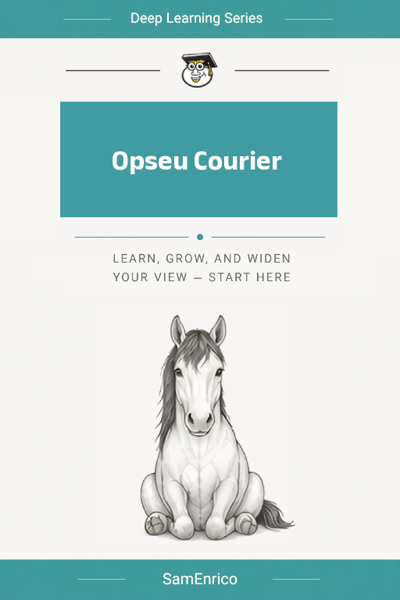
Non-FictionInformativeEducational
Opseu Courier eBook
A Coursebook on Opseu Courier
A Coursebook on Opseu Courier
Formats
Free sample
Chapter 1: The Dispatch Fallacy...--The first thing you need to unlearn is that a courier moves packages.This sounds like heresy. After all, you picked up this book because you want to understand how things get from one place to another without leaving a trace. You imagine dead drops at midnight, encrypted handshakes, the quiet thrill of moving something valuable through a world that wants to stop you. And yes, all of that appears in later chapters. But if you begin with the package, you have already lost.The OPSEU courier does not move packages.
The OPSEU courier moves trust.Packages are just the visible symptom. They are the cargo, the container, the physical or digital atom that happens to be sitting inside the transaction. But what you are actually transporting — what you are being paid to safeguard — is the relationship between a sender who cannot reveal themselves and a recipient who cannot acknowledge the delivery. The package is a proxy. The dispatch is the contract that makes that proxy legitimate.This distinction matters because almost every mistake a new courier makes comes from focusing on the object instead of the obligation.
You worry about whether the dead drop is dry enough, whether the encryption is strong enough, whether the handshake will verify in time. These are real concerns. But they are secondary to the question that defines the OPSEU system: Who is allowed to trust whom, and for how long?Before you make your first run, before you accept your first dispatch token, you need to understand what OPSEU actually is. Not the romantic version — the lonely operator against the system — but the boring, rigorous, sometimes paranoid architecture that has kept the network alive while conventional courier services have been hacked, subpoenaed, and co-opted.The Two Kinds of Dispatches Every OPSEU dispatch falls into one of two categories. If you confuse them, you will fail.
The protocols are not interchangeable, the risks are not the same, and the consequences of mixing them range from embarrassment to imprisonment.Digital Dispatches are encrypted data tokens. They contain routing instructions, payload manifests, proof-of-work requirements, and sometimes the payload itself if the payload is information. A digital dispatch never touches physical space. It moves from node to node through the network, living entirely as bits. Its vulnerabilities are cryptographic: key compromise, traffic analysis, timing attacks.
Its advantages are speed and deniability. You can forward a digital dispatch through fourteen countries in four seconds, and when it arrives, no one can prove you ever touched it.Physical Dispatches are atomic objects. A hard drive. A document. A prototype.
A package small enough to fit in a backpack or large enough to require a vehicle. Physical dispatches move through real space, which means they are subject to real-world constraints: weight, weather, border controls, police checkpoints, nosy neighbors, curious dogs, and the inevitable decay of all material things. Their vulnerabilities are tactical: interception, surveillance, forensic analysis. Their advantage is that they carry value that cannot be copied. You cannot man-in-the-middle a physical object.
You cannot intercept it and leave the original behind.Most new couriers want to handle physical dispatches. They are romantic. They feel like spy novels. The reality is that physical dispatches are slower, more dangerous, and less profitable per unit of risk than digital dispatches. You take a physical run because the payload cannot be digitized — because it is a thing, not a representation of a thing — or because the sender specifically requires deniability that only physical handoff can provide.The OPSEU network itself, however, runs almost entirely on digital dispatches.
The trust metrics, the handshake protocols, the routing tables, the escrow confirmations — all of these are digital. They move through the same decentralized architecture as the payloads they protect. Which brings us to the first concept you must internalize: the node.Nodes, Edges, and the Absence of a Center There is no central OPSEU server. There is no headquarters, no CEO, no database you can subpoena to reveal every courier who has ever worked a run. The network is composed entirely of nodes — individual couriers running client software on their own devices — and edges — the encrypted connections between them.When you join OPSEU, you become a node.
Your device (a laptop, a phone, a dedicated single-board computer running only the OPSEU client) holds three things:A private key that proves your identity to other nodes without revealing your name.A partial routing table listing nodes you have successfully handshaken with in the past, along with trust scores for each.A queue of pending dispatches that have been routed toward you.That is it. You do not hold the whole network's data. You cannot see every courier or every dispatch. You see only your immediate neighbors — the nodes you have authenticated with directly — and a small halo of nodes two or three hops away. This is not a limitation.
It is the entire security model.The term for this architecture is gossip-protocol trust web. It is not a blockchain. There is no global ledger, no proof-of-work consensus, no mining. Those systems are useful for public networks where anyone can join without permission. OPSEU is not that.
OPSEU is a permissioned network with decentralized validation. You join through existing members (Chapter 10 covers the recruitment process in detail), and once you are in, you prove your trustworthiness through successful runs.Your trust score is not stored anywhere except in the private routing tables of nodes you have interacted with. If you complete a run successfully, the nodes you worked with increment your score. If you fail — if you lose a package, if you deviate from protocol, if you are arrested and the network suspects you have talked — those nodes decrement your score and propagate that decrement to their neighbors. Over time, a failing courier becomes invisible.
Their node is still technically online, but no one routes dispatches to them. They have been gossiped out of existence.This is both the strength and the weakness of the system. There is no central kill switch, but there is also no central appeal. If enough nodes decide you are untrustworthy, you are gone. No court, no review board, no second chance.Static vs.
Dynamic Delivery Vectors Every dispatch needs a destination. In conventional logistics, the destination is an address: 123 Main Street, Apartment 4B. In OPSEU, the destination is a delivery vector — a cryptographic description of where and how the dispatch should be handed off.Static vectors are fixed locations. A specific geocache coordinate. A dead drop behind a particular loose brick.
A public locker in a train station. The vector does not change between the time the dispatch is created and the time it is delivered. Static vectors are simple, reliable, and dangerous. If a static vector is compromised — if someone discovers the loose brick — every dispatch routed there is exposed. Static vectors are best for low-value, time-insensitive deliveries where the courier can afford to verify the drop location immediately before use.Dynamic vectors update in real time.
The destination might be "the third bench from the left in Bryant Park, but only between 2:00 and 2:15 AM on nights when the fountain is off." The dispatch token…
This is the end of the free sample. Get the eBook to keep going. Buy now
About this book
Details
- Author
- Seward Laronda
- Publisher
- SamEnrico
- Language
- English
- Genre
- Non-Fiction, Informative, Educational
- Released
- 2026-05-08
- Pages (approx.)
- 144
- Available as
- eBook, Audiobook

Read better in the ZLOADR app
Your eBooks on your phone or tablet. Sign in with your SamEnrico account and start reading.
More by Seward Laronda
 The Expectation Reset GuideSeward Laronda$11.99
 Smoking and ED GuideSeward Laronda$11.99
 MDD Subtypes ExplainedSeward Laronda$11.99
 The Working Memory for Chess GuideSeward Laronda$11.99
 Emergency Placement NightsSeward Laronda$11.99
 The Lost Tapes of the Apollo 11 Mission: Unearthed Secrets from the MoonSeward Laronda$11.99
 The Breeder's Guide to Randall Lineback CattleSeward Laronda$11.99
 .eu vs .com ComparisonSeward Laronda$12.99
 CTO Interview Questions GuideSeward Laronda$12.99
 How to Become a Log PeelerSeward Laronda$11.99
You may also like
 Hong Kong Handover 1997Dunn Johnnie$11.99
 Zumba For Postnatal Recovery CourseNeal Christian$11.99
 Zumba for BeginnersLadner Nikia$11.99
 YouTube Comment Mining GuideHumes Pandora$12.99
 Worry Box MeditationCarlin Rudy$11.99
 Workplace Stress MeditationNguyen Lynn$11.99
 Workplace Stress and Sleep RepairHawley Ivory$11.99
 Workplace Perfectionism CureDelaney Jeffry$11.99
 Workplace Injustice Anger GuideWallen Isabelle$11.99
 Work Addiction and Burnout LinkGreenwood Ester$11.99
 Women in Yoga and WellnessBeattie Galina$11.99
 Women in Stand Up ComedyChun Evangeline$11.99