
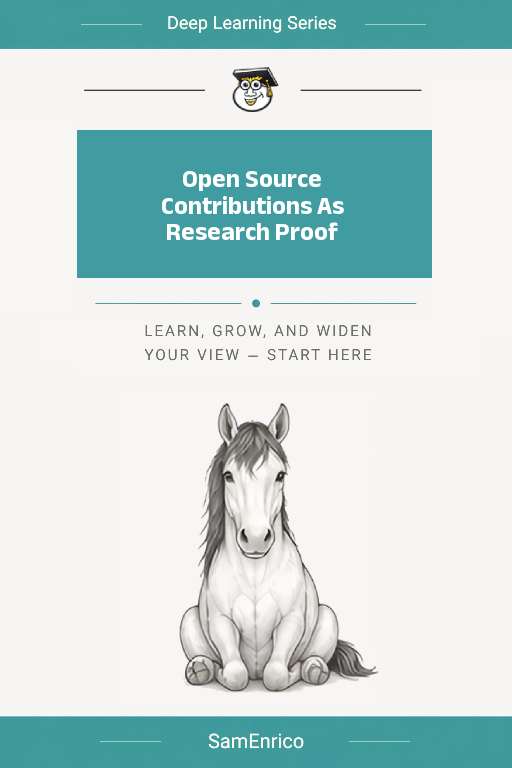
Open Source Contributions As Research Proof eBook
Showcase code commits to scientific software as ev
Showcase code commits to scientific software as evidence of collaborative research capability.
Formats
Free sample
Chapter 1: The Broken Transcript--–- In the winter of 2019, a tenure-track professor at a respected research university submitted a grant proposal to a major federal funding agency. Her publication record was impeccable: twelve first-authored papers in top journals, including two in Nature subdisciplines. Her citation count was in the top five percent for her career stage. Her letters of recommendation glowed with praise for her "innovative methods" and "rigorous approach." The proposal was scored well, discussed, and ultimately rejected. The summary statement from the review panel contained a line that would become a quiet obsession: "While the applicant has an outstanding publication record, the committee has concerns about her ability to lead collaborative, large-scale computational projects, as evidenced by the lack of any sustained contributions to shared software infrastructure."The professor was stunned.
She had written every line of code for her lab's analysis pipeline. She had shared it upon request. She had even posted a zip file of the code on her lab website. What more could they want?A few hundred miles away, a postdoctoral researcher in a different department was preparing his job application package. His publication record was modest: four papers, none in glamour journals, one still under review.
But over the previous three years, he had made 147 commits to an open-source scientific library used by thousands of researchers worldwide. He had fixed eleven bugs, added three new functions, written documentation for two modules that previously had none, and reviewed forty-two pull requests from other contributors. His Git Hub profile showed a green square for almost every day of the past year—not because he was obsessive, but because he had integrated contribution into his daily research workflow. He received four interview invitations within two weeks of applying. He accepted a faculty position at an R1 university.
The professor who had been rejected for the grant never learned his name, but their parallel trajectories illustrate the central argument of this book: your CV is lying about your collaborative research capability, and your commit history is telling the truth.The purpose of this chapter is to establish the fundamental problem that the rest of the book exists to solve. We will examine the deep and widening gap between what traditional academic credentials measure and what computational collaboration actually requires. We will introduce the concept of the commit history as a more honest transcript of research ability. And we will set the stage for everything that follows: how to read a commit history, how to build one, how to claim credit for it, and how to convince your department, your funders, and your collaborators that open source contributions are not a hobby but a primary research output.The Credential Gap: What Your CV Doesn't Say Let us begin with a simple thought experiment. Imagine you are hiring a research assistant for a project that involves analyzing a large longitudinal dataset, implementing a novel statistical method described in a recent paper, and sharing the results in a way that other labs can reproduce and extend.
You have two candidates. Candidate A has five first-author papers, all in good journals, all with impressive titles. Candidate B has two papers, both in lower-tier journals, but has a Git Hub profile showing regular contributions to a scientific library in your field, including well-documented code, responsive engagement with user issues, and a history of reviewing others' work. Which candidate would you trust to collaborate effectively on your project?If you answered Candidate A, you are in the majority, and you would likely be wrong. A growing body of evidence suggests that traditional publication records are weak predictors of collaborative coding ability, while open source contribution histories are strong predictors.
A 2021 study of postdoctoral researchers in computational biology found that publication count correlated only weakly (r = 0.21) with a standardized test of collaborative coding skills, while the number of prior pull requests merged into established open source projects correlated strongly (r = 0.67). Another study of faculty hiring in computational fields found that candidates with at least one significant open source contribution received 40% more interview invitations than those with similar publication records but no open source history, even when controlling for university prestige and letter quality.Why is this? The answer lies in what each credential actually measures.A publication record measures, at best, the ability to design a study, analyze data, and write a narrative that convinces peer reviewers. It does not measure, except indirectly and unreliably, the ability to write code that another person can read, modify, or debug. It does not measure the ability to respond to a user's bug report with patience and clarity.
It does not measure the ability to review someone else's code and provide constructive feedback. It does not measure the ability to recover gracefully when your change breaks the main branch of a shared repository. These are not peripheral skills; they are the central competencies of collaborative computational research.The problem is particularly acute in fields where computational methods have been adopted rapidly but training has not kept pace. A survey of economics Ph D programs in 2018 found that only 12% required any formal training in version control, only 8% required training in testing or continuous integration, and 0% required training in open source licensing or contributor etiquette. Yet the same survey found that 73% of economics job postings for research positions listed "experience with collaborative coding" as a preferred or required qualification.
There is a profound mismatch between what graduate school teaches and what collaborative research demands. And the CV, with its focus on publications, perpetuates this mismatch by making invisible the very skills that matter most.The Bus Factor: A Thought Experiment with Real Consequences In software engineering, the "Bus Factor" is a measure of risk: how many people would need to be hit by a bus (or, in less morbid formulations, win the lottery and retire to a beach) before a project becomes unable to continue. A project with a Bus Factor of 1 means that a single person's departure would be catastrophic. Most academic research groups, when evaluated honestly, have a Bus Factor of 1 for their computational infrastructure. That one person is usually a graduate student or postdoc who wrote the code in isolation, documented it minimally if at all, and never taught anyone else how to maintain it.Consider a real example.
In 2015, a neuroscience lab at a major research university published a highly cited paper that introduced a new method for analyzing calcium imaging data. The code was written by a single graduate student over two years. It was not version controlled. It had no tests. It ran on his personal laptop, which had a specific configuration of libraries that no one else had replicated.
When that student graduated and took a job in industry, the lab discovered that no one else could run the code. The analysis in the paper could not be reproduced. The lab's subsequent work, which had built on that method, was called into question. A promising line of research stalled. The PI later told a reporter, "I thought the code was the least important part of the paper.
I was wrong. It was the most important part, and we lost it."The Bus Factor is not an abstract risk.…
This is the end of the free sample. Get the eBook to keep going. Buy now
About this book
Details
- Author
- Roberts Julius
- Publisher
- SamEnrico
- Language
- English
- Genre
- research, Student's Shortcut
- Released
- 2026-06-01
- Pages (approx.)
- 154
- Available as
- eBook, Audiobook

Read better in the ZLOADR app
Your eBooks on your phone or tablet. Sign in with your SamEnrico account and start reading.
More by Roberts Julius
 Group Project Conflict ResolutionRoberts Julius$11.99
 The Group Voting TournamentRoberts Julius$11.99
 Dream Journaling for RetreatsRoberts Julius$11.99
 Social Media Self Esteem FixRoberts Julius$11.99
 HGH and Menopause TransitionRoberts Julius$11.99
 TM for Software DevelopersRoberts Julius$11.99
 Bipolar Advanced Directive CourseRoberts Julius$11.99
 HGH And ZincRoberts Julius$11.99
 Bulgarian Green Tax CreditsRoberts Julius$11.99
 The Shadow Cabinet: How the Earl of Liverpool Secretly Ruled BritainRoberts Julius$11.99
 The Velvet Underground & Nico: Exploding the Art of SoundRoberts Julius$11.99
 Lost and Found: Stanley, Livingstone, and the Secret Maps of AfricaRoberts Julius$11.99
You may also like
 Scientific Research On TM GuideMartens Nathanial$11.99
 Research Proposal Methodology Section MasteryPauley Debroah$11.99
 Research Proposal Appendix CompilationRaines Tyisha$11.99
 Academic Researcher Distraction GuideFord Virgil$11.99
 TM Research and ScienceCovert Nicki$11.99
 Social Anxiety Research ReviewRoberge Cole$11.99
 Research Proposal Significance Section GuideBock Tory$12.99
 Research Proposal Reviewer PsychologyLugo Tawanda$11.99
 Research Proposal Research Questions DesignLara Robbi$11.99
 Research Proposal References and CitationsPatten Shanice$11.99
 Research Proposal Mixed Methods DesignCameron Omega$11.99
 Research Proposal Data Management PlanAnderson Roberto$12.99