
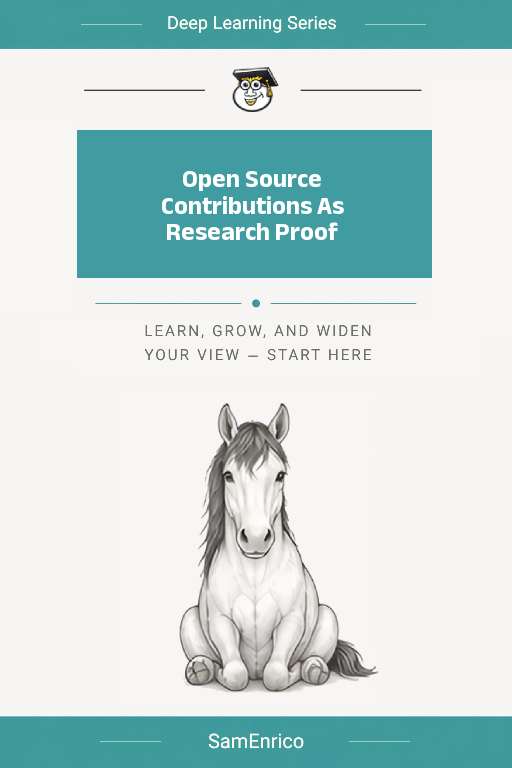
Open Source Contributions As Research Proof Audiobook
Showcase code commits to scientific software as ev
Showcase code commits to scientific software as evidence of collaborative research capability.
Formats
Free sample
Chapter 1: The Broken Transcript--–- In the winter of 2019, a tenure-track professor at a respected research university submitted a grant proposal to a major federal funding agency. Her publication record was impeccable: twelve first-authored papers in top journals, including two in Nature subdisciplines. Her citation count was in the top five percent for her career stage. Her letters of recommendation glowed with praise for her "innovative methods" and "rigorous approach." The proposal was scored well, discussed, and ultimately rejected. The summary statement from the review panel contained a line that would become a quiet obsession: "While the applicant has an outstanding publication record, the committee has concerns about her ability to lead collaborative, large-scale computational projects, as evidenced by the lack of any sustained contributions to shared software infrastructure."The professor was stunned.
She had written every line of code for her lab's analysis pipeline. She had shared it upon request. She had even posted a zip file of the code on her lab website. What more could they want?A few hundred miles away, a postdoctoral researcher in a different department was preparing his job application package. His publication record was modest: four papers, none in glamour journals, one still under review.
But over the previous three years, he had made 147 commits to an open-source scientific library used by thousands of researchers worldwide. He had fixed eleven bugs, added three new functions, written documentation for two modules that previously had none, and reviewed forty-two pull requests from other contributors. His Git Hub profile showed a green square for almost every day of the past year—not because he was obsessive, but because he had integrated contribution into his daily research workflow. He received four interview invitations within two weeks of applying. He accepted a faculty position at an R1 university.
The professor who had been rejected for the grant never learned his name, but their parallel trajectories illustrate the central argument of this book: your CV is lying about your collaborative research capability, and your commit history is telling the truth.The purpose of this chapter is to establish the fundamental problem that the rest of the book exists to solve. We will examine the deep and widening gap between what traditional academic credentials measure and what computational collaboration actually requires. We will introduce the concept of the commit history as a more honest transcript of research ability. And we…
This is the end of the free sample. Get the Audiobook to keep going. Buy now
About this book
Details
- Author
- Roberts Julius
- Publisher
- SamEnrico
- Language
- English
- Genre
- research, Student's Shortcut
- Released
- 2026-06-01
- Pages (approx.)
- 154
- Available as
- eBook, Audiobook

Listen in the VoxFlicks app
Audiobooks and audio dramas wherever you go. Sign in with your SamEnrico account and press play.
More by Roberts Julius
 Group Project Conflict ResolutionRoberts Julius$11.99
 The Group Voting TournamentRoberts Julius$11.99
 Dream Journaling for RetreatsRoberts Julius$11.99
 Social Media Self Esteem FixRoberts Julius$11.99
 HGH and Menopause TransitionRoberts Julius$11.99
 TM for Software DevelopersRoberts Julius$11.99
 Bipolar Advanced Directive CourseRoberts Julius$11.99
 HGH And ZincRoberts Julius$11.99
 Bulgarian Green Tax CreditsRoberts Julius$11.99
 The Shadow Cabinet: How the Earl of Liverpool Secretly Ruled BritainRoberts Julius$11.99
 The Velvet Underground & Nico: Exploding the Art of SoundRoberts Julius$11.99
 Lost and Found: Stanley, Livingstone, and the Secret Maps of AfricaRoberts Julius$11.99
You may also like
 Scientific Research On TM GuideMartens Nathanial$11.99
 Research Proposal Methodology Section MasteryPauley Debroah$11.99
 Research Proposal Appendix CompilationRaines Tyisha$11.99
 Academic Researcher Distraction GuideFord Virgil$11.99
 TM Research and ScienceCovert Nicki$11.99
 Social Anxiety Research ReviewRoberge Cole$11.99
 Research Proposal Significance Section GuideBock Tory$12.99
 Research Proposal Reviewer PsychologyLugo Tawanda$11.99
 Research Proposal Research Questions DesignLara Robbi$11.99
 Research Proposal References and CitationsPatten Shanice$11.99
 Research Proposal Mixed Methods DesignCameron Omega$11.99
 Research Proposal Data Management PlanAnderson Roberto$12.99