
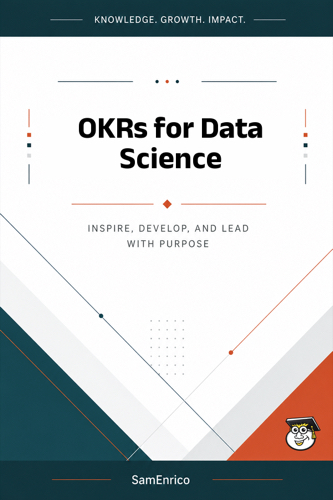
OKRs for Data Science eBook
Sets model accuracy and insight goals.
by Marino Leora
Sets model accuracy and insight goals.
Formats
Free sample
Chapter 1: The Certainty Trap--–- Maryam stared at the quarterly OKRs her VP had just circulated. "Increase customer retention by 15% using the new churn model." It looked reasonable. It looked ambitious. It looked exactly like every other OKR she had seen in her ten years as a data scientist.But something gnawed at her. The model she was being asked to build would predict which customers were likely to leave.
She could build that. She could even make it accurate. But the OKR assumed something that no one had said out loud: that a more accurate prediction would automatically lead to higher retention.What if the sales team ignored the predictions? What if the interventions cost more than the retained revenue? What if the data was so noisy that 70% accuracy was the theoretical maximum, and the VP expected 95%?Maryam had learned, through painful experience, that traditional OKRs were designed for确定性—for shipping features, launching marketing campaigns, and building software.
But data science was different. Data science was probabilistic. It was exploratory. And often, the most valuable thing a data scientist could do was prove that a widely held belief was wrong.The VP's OKR didn't accommodate that. It didn't accommodate failure, learning, or uncertainty.
And that, Maryam knew, was a recipe for disaster.This chapter is about why generic OKRs fail for data science, why the gap between "activity" and "impact" is wider in DS than in any other function, and how a specialized framework can save your team from the Certainty Trap.The Dirty Secret of Most Data Science Teams Let us begin with an uncomfortable truth: most data science teams are failing to deliver measurable business value. Not because they lack talent. Not because they lack data. But because they are measured the wrong way.Consider the evidence. Studies consistently show that 60-80% of machine learning models never make it to production.
Of those that do, a significant fraction are used briefly and then abandoned. And yet, when you ask a data science team how their quarter went, they will often say "great" because they built three models, increased accuracy on a test set by 5%, and delivered four insightful dashboards.Notice what happened there. They measured activity (building, increasing, delivering). They did not measure outcome (revenue, retention, decision quality).This is not the fault of data scientists. They are responding to the incentives placed before them.
If a VP asks for "three models this quarter," that is what the team will produce. Quality, adoption, and impact become secondary concerns because they are not explicitly rewarded.The problem is that generic OKR frameworks—the kind popularized by Measure What Matters and adopted by thousands of companies—were designed for deterministic, repeatable work. They work beautifully for engineering teams shipping features with clear specifications. They work for sales teams with quota targets. They work for marketing teams with campaign deadlines.But data science is different in three fundamental ways.Why Data Science Breaks Generic OKRs First, data science is probabilistic.
When you build a software feature, you know with near certainty that if you write the code correctly, it will function as intended. The output is deterministic. In data science, you are predicting the future, inferring causal relationships from noisy data, or clustering messy human behavior. You might do everything right and still get a model that barely beats a simple heuristic. The universe is noisy, and your OKRs must account for that noise.Second, data science is exploratory.
Much of the work is not about building something but about finding out something. You might spend two weeks testing a hypothesis only to discover that there is no signal in the data. That is not a failure. That is valuable learning that prevents the company from investing millions in a doomed initiative. But under a traditional OKR framework, that quarter would be marked "red" because you delivered no model, no dashboard, no output.Third, the value chain in data science is longer and more fragile than in other disciplines.
A software engineer writes code, deploys it, and the user immediately experiences the feature. A data scientist builds a model, but then the model must be integrated into a workflow, adopted by humans, and acted upon before any value is realized. There are at least five handoffs between the Jupyter notebook and the business outcome. Any one of those handoffs can break the value chain.These three differences—probabilistic, exploratory, fragile value chain—mean that generic OKRs do not merely fail to help; they actively harm data science teams by creating perverse incentives.The Certainty Trap: How Well-Intentioned OKRs Kill Innovation The Certainty Trap is a simple but devastating phenomenon. When you require data science teams to commit to specific, measurable outcomes in advance, they will naturally gravitate toward work that is predictable, low-risk, and guaranteed to produce a positive result.
They will avoid work that is uncertain, exploratory, or likely to disprove a hypothesis.This sounds rational. Why would a data scientist take on a project that has a 40% chance of failing to produce a usable model when they could instead work on a simple aggregation dashboard that is guaranteed to succeed?The answer is that the high-risk, high-uncertainty projects are often the most valuable. The question that keeps the CEO up at night—"Why are our best customers leaving?"—is hard. It might not have an answer. It might require six weeks of exploratory analysis that reveals nothing actionable.
But if it does yield an answer, the value could be enormous.Under a generic OKR system, that question will never be asked. The team will instead work on low-value, guaranteed tasks, and the company will slowly ossify, solving easy problems while the hard, valuable ones remain untouched.I have seen this happen at multiple companies. A retail company wanted to predict which products would go out of stock. The data science team knew that accurate prediction would require integrating point-of-sale, supply chain, and weather data across three different legacy systems. It was a hard problem with uncertain payoff.
Instead, they built a simple reorder recommendation system that took two weeks and was used by exactly zero store managers. The OKRs were green. The business value was zero.Discovery vs. Delivery: Two Modes of Data Science Work To escape the Certainty Trap, we must recognize that data science operates in two fundamentally different modes: Discovery and Delivery.Discovery work is exploratory. Its goal is to answer questions, test hypotheses, or find signals in noise.
Success in Discovery means learning something new, even if that learning is that a hypothesis is false. Discovery work is probabilistic and high-variance. You might strike gold, or you might find nothing.Examples of Discovery work:"Does changing the email subject line improve open rates?" (causal inference)"Are there natural customer segments we haven't identified?" (clustering)"What features are most predictive of churn?" (feature discovery)Delivery work is operational. Its goal is to build a model, deploy a pipeline, or automate a decision. Success in Delivery means shipping something that works reliably.
Delivery work is more deterministic and lower-variance. You should be able to predict with reasonable confidence whether you can complete it.Examples of Delivery work:"Deploy…
This is the end of the free sample. Get the eBook to keep going. Buy now
About this book
Details
- Author
- Marino Leora
- Publisher
- SamEnrico
- Language
- English
- Genre
- Non-Fiction, Self-Help, Data
- Released
- 2026-06-10
- Pages (approx.)
- 144
- Available as
- eBook, Audiobook

Read better in the ZLOADR app
Your eBooks on your phone or tablet. Sign in with your SamEnrico account and start reading.
More by Marino Leora
 Inpatient vs Outpatient Stimulant RehabMarino Leora$11.99
 Dog Walk Mindfulness GuideMarino Leora$11.99
 Sibling LGBTQ ReconciliationMarino Leora$11.99
 Digital Dream Journal AppMarino Leora$11.99
 Storage Unit Cost Benefit AnalysisMarino Leora$11.99
 Conflict De escalation GuideMarino Leora$11.99
 Compulsive Spending And EnvyMarino Leora$11.99
 The Glitch That Stole ChristmasMarino Leora$11.99
 The Beirut Bank Heist: The Victorian-Era Fraud That Shook the LevantMarino Leora$11.99
 How to Produce Used ShoesMarino Leora$11.99
 Cooperative Savings MobilizationMarino Leora$12.99
 Invoice Factoring ExportsMarino Leora$12.99
You may also like
 Hong Kong Handover 1997Dunn Johnnie$11.99
 Zumba For Postnatal Recovery CourseNeal Christian$11.99
 Zumba for BeginnersLadner Nikia$11.99
 YouTube Comment Mining GuideHumes Pandora$12.99
 Worry Box MeditationCarlin Rudy$11.99
 Workplace Stress MeditationNguyen Lynn$11.99
 Workplace Stress and Sleep RepairHawley Ivory$11.99
 Workplace Perfectionism CureDelaney Jeffry$11.99
 Workplace Injustice Anger GuideWallen Isabelle$11.99
 Work Addiction and Burnout LinkGreenwood Ester$11.99
 Women in Yoga and WellnessBeattie Galina$11.99
 Women in Stand Up ComedyChun Evangeline$11.99