
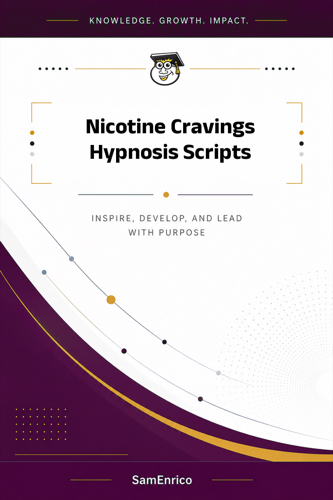
Non-FictionHealth & WellnessHypnotherapy
Nicotine Cravings Hypnosis Scripts eBook
Self administered hypnotic audio tracks to rewire
by Roby Cecila
Self administered hypnotic audio tracks to rewire subconscious urges to smoke or vape.
Formats
Free sample
Chapter 1: The Machine You Cannot See...--–- You are reading this because you have tried to quit before. Not once. Probably not twice. You have lost count. And each time, you made promises to yourself that you absolutely meant in the moment.
You threw away the pack. You smashed the vape under your heel. You announced to someone—a partner, a friend, your own reflection—that this time was different. And then, hours or days or weeks later, your hand reached. Not because you are weak.
Not because you lack character. Not because you secretly want to keep poisoning yourself. Your hand reached because you were trying to fight a machine you cannot see.The conscious mind operates on logic. It reads books like this one. It makes spreadsheets of money saved.
It calculates years added to a lifespan. It is rational, linear, and utterly convinced that it is in charge. But the conscious mind is not the driver of your behavior. It is the passenger. It has opinions.
It has hopes. It has desperate, sincere intentions. But it does not have the wheel.The subconscious mind has the wheel. And the subconscious mind does not speak English. It does not read spreadsheets.
It does not care about your lifespan. The subconscious mind speaks in sensations, images, emotions, and ancient survival programs. It learned, somewhere along the way, that nicotine is a tool for survival. Not a pleasure. Not a habit.
A survival tool. This is not metaphor. This is the neurobiology of addiction, translated into the language of hypnotic change.Every time you smoked or vaped during a moment of stress, your subconscious recorded a neural pathway that said: Nicotine + stress = relief. Every time you reached for a cigarette during a social moment of awkwardness, your subconscious recorded: Nicotine + social anxiety = safety. Every time you vaped while driving or working or waiting for coffee, your subconscious recorded: Nicotine + boredom = stimulation.
These are not conscious choices anymore. They are programs. They run automatically, below the level of awareness, faster than thought.This is why willpower fails. Willpower is the conscious mind trying to override a program that runs ten times faster than conscious thought. It is like trying to stop a speeding car by standing in front of it and reciting the safety manual.
You might believe in the manual. You might have highlighted the best passages. But the car does not care about your beliefs. The car follows its programming. And the programming says: Reach.
Inhale. Relax. Repeat.The good news—the extraordinary, life-altering news—is that programs can be rewritten. Not by fighting them. Not by hating them.
Not by white-knuckling through withdrawal while cursing your own weakness. Programs are rewritten by accessing the same system that wrote them in the first place: the subconscious mind. And the most effective tool ever developed for accessing the subconscious is hypnosis.This book is not about teaching you to "believe" in hypnosis. Hypnosis is not a belief system. It is a neurological state—a natural, everyday state that you already enter multiple times per day.
When you lose yourself in a movie and forget you are sitting in a room, that is hypnosis. When you drive a familiar route and arrive home with no memory of the last ten minutes, that is hypnosis. When you daydream and fail to hear someone say your name, that is hypnosis. It is a state of focused attention in which the critical factor—the conscious filter that rejects unfamiliar suggestions—temporarily steps aside. And in that state, the subconscious mind is open to revision.The chapters that follow contain twelve self-administered hypnotic scripts.
Each script is a specific tool for a specific job. Some target the physical sensation of withdrawal. Some target the hand-to-mouth muscle memory. Some target emotional triggers, social fears, or the deep identity shift from "someone who is quitting" to "someone who does not smoke or vape." You will not use all of them equally. You will find your own pathway.
But before you press play on a single script, you must understand the machine you are trying to rewire.The Fundamental Mistake Almost Everyone Makes Most smoking and vaping cessation programs make the same catastrophic error. They assume that the addiction is the enemy. They tell you to fight it. To resist it. To white-knuckle through it.
To prove your strength by enduring it. This approach fails because it activates the very system you are trying to change.When you treat a craving as an enemy, your subconscious mind treats your resistance as a threat. And when the subconscious perceives a threat, it reaches for its most trusted survival tools. For you, one of those tools is nicotine. You are not fighting the addiction when you resist a craving.
You are feeding it. You are proving to your subconscious that this is, indeed, a battle. And the subconscious always reaches for its weapons in a battle.This book is built on a radically different model. The model has three pillars, and you must understand all three before the scripts will work at full power.Pillar One: The Addiction Is a Misguided Protector The part of you that wants to smoke or vape is not your enemy. It is not a demon.
It is not a moral failure. It is a part of your own mind that learned, at some point, that nicotine provided something you needed. Maybe it provided a break when no one else would give you permission to pause. Maybe it provided calm when your nervous system was overwhelmed. Maybe it provided a sense of belonging when you felt excluded.
The form of the protection is poison. The intention behind the protection is survival. You cannot kill a part of yourself without collateral damage. But you can reassign it. You can thank it for its service and show it a healthier way to meet the same need.Pillar Two: The Craving Is Not the Enemy—Resistance Is A craving is a wave.
It rises, it peaks, and it falls. The entire cycle lasts three to five minutes if you do not interfere. But when you resist—when you clench your fists, grit your teeth, and tell yourself "I will not smoke"—you extend the wave. You turn a three-minute sensation into a thirty-minute ordeal. The resistance is not strength.
The resistance is the problem. The solution is not to fight the wave. The solution is to surf it. To ride it without acting on it. To watch it rise, observe it with curiosity, and feel it fall.
The craving does not need to be destroyed. It needs to be outlasted. And you can outlast anything for six minutes.Pillar Three: Identity Change Is the Finish Line As long as you think of yourself as "a smoker who is trying to quit," you will struggle. The word "quitting" implies loss. It implies deprivation.
It implies that you are giving up something valuable. The subconscious mind does not voluntarily give up valuable things. It defends them. The only way to end the struggle is to stop identifying as someone who is quitting and start identifying as someone who does…
This is the end of the free sample. Get the eBook to keep going. Buy now
About this book
Details
- Author
- Roby Cecila
- Publisher
- SamEnrico
- Language
- English
- Genre
- Non-Fiction, Health & Wellness, Hypnotherapy
- Released
- 2026-06-08
- Pages (approx.)
- 129
- Available as
- eBook, Audiobook

Read better in the ZLOADR app
Your eBooks on your phone or tablet. Sign in with your SamEnrico account and start reading.
More by Roby Cecila
 HGH Children Short StatureRoby Cecila$11.99
 Caregiver Employee Stress GuideRoby Cecila$11.99
 Italian Green Incentives GuideRoby Cecila$11.99
 The Teen Confidence WorkbookRoby Cecila$11.99
 Addressing Addiction in FamilyRoby Cecila$11.99
 Antwerp Heist Children's BookRoby Cecila$11.99
 HGH Testing And DiagnosisRoby Cecila$11.99
 TM for Student AthletesRoby Cecila$11.99
 Silent Siege: The 1977 Entebbe Hijackers Who VanishedRoby Cecila$11.99
 The Tsar's Falcon: A Russian Imperial AdventureRoby Cecila$11.99
 The Last Cabin at Camp Crystal LakeRoby Cecila$11.99
 Blockchain Security FundamentalsRoby Cecila$11.99
You may also like
 Hong Kong Handover 1997Dunn Johnnie$11.99
 Zumba For Postnatal Recovery CourseNeal Christian$11.99
 Zumba for BeginnersLadner Nikia$11.99
 YouTube Comment Mining GuideHumes Pandora$12.99
 Worry Box MeditationCarlin Rudy$11.99
 Workplace Stress MeditationNguyen Lynn$11.99
 Workplace Stress and Sleep RepairHawley Ivory$11.99
 Workplace Perfectionism CureDelaney Jeffry$11.99
 Workplace Injustice Anger GuideWallen Isabelle$11.99
 Work Addiction and Burnout LinkGreenwood Ester$11.99
 Women in Yoga and WellnessBeattie Galina$11.99
 Women in Stand Up ComedyChun Evangeline$11.99