
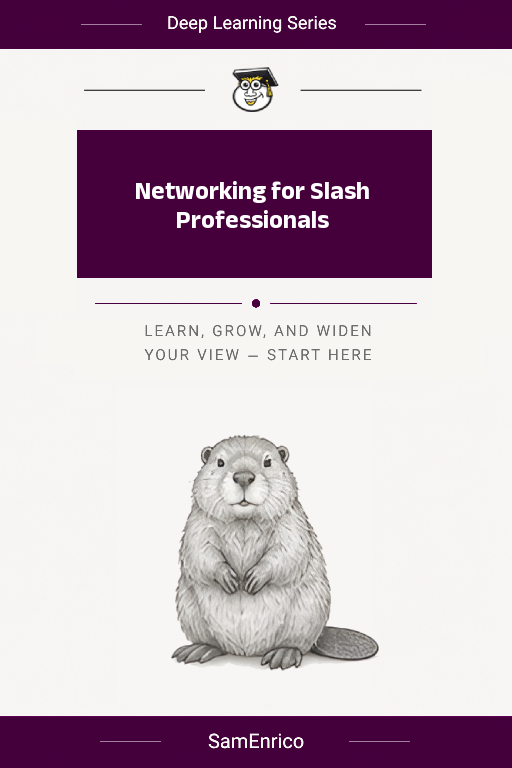
Non-FictionNon-Obvious CareerNetworking
Networking for Slash Professionals eBook
Build relationships across different industries to
by Britt Lelah
Build relationships across different industries to uncover part-time role opportunities.
Formats
Free sample
Chapter 1: The No-Ask Rule--Before I tell you what the No-Ask Rule is, let me tell you why I invented it.I was sitting in a coffee shop on a Tuesday morning—the kind of overpriced café where the lattes cost nine dollars and everyone is either on a laptop or pretending to read a book they will not finish. My own laptop was open to three email drafts, each one more desperate than the last. The first draft was to a former colleague: “Just following up on my follow-up…” The second was to a connection I had met at a networking event six months ago: “I know it’s been a while, but I was wondering if you might have a few minutes to chat about potential opportunities…” The third, the most honest and the most pathetic, was to no one in particular: a blank screen with a blinking cursor that seemed to mock me.I had been a slash professional for four years at that point. Writer, marketing consultant, part-time social media manager for a local bakery that paid me in croissants half the time. I had three careers, none of which were producing enough income to cover my rent.
And I was exhausted. Not from the work itself—I loved the work—but from the constant, grinding pressure of asking. Asking for coffee. Asking for advice. Asking for introductions.
Asking for jobs. Asking, asking, asking.Every book I had read on networking told me the same thing. Reach out to people. Build your network. Make connections.
Send the follow-up email. Always be closing. What they did not tell me was how humiliating it felt to be the person who always needed something. I was the supplicant. The beggar.
The one who showed up to every conversation with empty hands and an open mouth.That Tuesday morning, I hit a wall.I closed my laptop, walked out of the coffee shop without buying anything (a small act of rebellion), and called my friend Elena. Elena is a bartender and a part-time florist—a true slash professional in every sense. She works three jobs and somehow never seems stressed about any of them. When I told her about my email drafts, she laughed.“You’re doing it wrong,” she said.“Thanks. Very helpful.”“No, listen.
When I meet someone new, I never ask them for anything. Not the first time, not the second time, not even the third time. I just talk to them. I ask them questions. I learn about their life.
And then, if I think of something that might help them—an article, an introduction, a tool, whatever—I send it. No strings attached.”“That sounds nice,” I said, “but how do you get work?”“The work comes to me,” she said. “People remember me because I’m not asking them for anything. When they finally need what I do, they think of me first. Not because I begged them, but because I was useful.”That conversation changed everything.Over the next several months, I tested Elena’s approach.
I stopped asking. Completely. I went to networking events and asked questions instead of pitching myself. I sent emails that contained zero requests. I offered small bits of value—a template, a resource, a connection—without any expectation of return.
And something strange happened. People started reaching out to me. Not every time, not even most of the time. But enough. Enough that my calendar filled.
Enough that I stopped feeling like a beggar and started feeling like a peer.That was the birth of the No-Ask Rule.What Is the No-Ask Rule?The No-Ask Rule is simple, but it is not easy.Here it is in one sentence: Never contact someone expecting an immediate return on your time.That is it. That is the entire rule. But let me unpack what it actually means, because the implications are deeper than they first appear.When I say “never contact someone expecting an immediate return,” I am talking about the emotional expectation that you bring to the interaction. It is the difference between sending a message because you genuinely want to learn something and sending a message because you need a job. It is the difference between offering help because you have something valuable to share and offering help because you want that person to owe you a favor.Most networking advice tells you to do the opposite.
It tells you to be strategic. To have an “ask” ready. To always be closing. To treat every conversation as a sales opportunity. And that advice works—if you want to feel like a used car salesman.
If you want to wake up at 3am wondering why no one returns your emails. If you want to build a network of people who tolerate you rather than people who champion you.The No-Ask Rule is a rejection of that entire philosophy.It is based on a simple observation: people are drowning in requests. Your inbox is full of people who want something. Your Linked In DMs are full of strangers who want to “pick your brain.” Your calendar is full of meetings that someone else asked for. The last thing anyone needs is another ask.But here is the counterintuitive truth: when you stop asking, you become remarkable.
You become the person who shows up with empty hands and a curious mind. You become the person who offers value before extracting it. You become the person that other people want to help—not because you asked, but because you were different.The Three Types of Outreach (And Why Only One Works)To understand the No-Ask Rule fully, you need to understand the three types of outreach that most professionals use. I call them the Ask, the Veiled Ask, and the No-Ask.The Ask.This is the most common and the most ineffective. It looks like this:“Hi Sarah, I’m a big fan of your work.
Would you have 15 minutes for a quick call next week? I’d love to ask for your advice on my job search.”Sarah has received this exact message two hundred times. She will delete it in three seconds. The problem is not that Sarah is mean or busy (though she is both). The problem is that you are offering her nothing.
You are asking her to give you her time, her attention, and her expertise, and you are offering nothing in return except the vague promise of gratitude.The Veiled Ask.This is slightly more sophisticated but equally ineffective. It looks like this:“Hi Sarah, I’ve been following your career for years and I’m really impressed by your approach to X. I’d love to buy you coffee sometime and learn more about how you think about Y. No pressure at all, just would be great to connect.”This is still an ask. The coffee is a prop.
The “no pressure” is a lie. Sarah knows that you want something, and she knows that the coffee will inevitably lead to a request for advice, an introduction, or a job. She will delete this message too, though she might feel slightly less annoyed than she…
This is the end of the free sample. Get the eBook to keep going. Buy now
About this book
Details
- Author
- Britt Lelah
- Publisher
- SamEnrico
- Language
- English
- Genre
- Non-Fiction, Non-Obvious Career, Networking
- Released
- 2026-05-29
- Pages (approx.)
- 142
- Available as
- eBook, Audiobook

Read better in the ZLOADR app
Your eBooks on your phone or tablet. Sign in with your SamEnrico account and start reading.
More by Britt Lelah
 Pilot Shift Sleep GuideBritt Lelah$11.99
 Failure Celebration GuideBritt Lelah$11.99
 Senior Photo Album MemoryBritt Lelah$11.99
 Teresas Foundations JourneyBritt Lelah$11.99
 Design Thinking for Risk ManagementBritt Lelah$11.99
 NVC for Religious GroupsBritt Lelah$11.99
 Working Parent Time ManagementBritt Lelah$11.99
 Elizabeth Progress Tours StrategyBritt Lelah$11.99
 The Harmonious Wisdom of the Griots: Africa's Ancient Thinkers and Their Timeless TeachingsBritt Lelah$11.99
 The Bone Collector of Lima: A 19th-Century Escape and the Birth of Forensic EntomologyBritt Lelah$11.99
 How to Produce IngotsBritt Lelah$11.99
 Accommodation Cost Comparison WorkbookBritt Lelah$12.99
You may also like
 Hong Kong Handover 1997Dunn Johnnie$11.99
 Zumba For Postnatal Recovery CourseNeal Christian$11.99
 Zumba for BeginnersLadner Nikia$11.99
 YouTube Comment Mining GuideHumes Pandora$12.99
 Worry Box MeditationCarlin Rudy$11.99
 Workplace Stress MeditationNguyen Lynn$11.99
 Workplace Stress and Sleep RepairHawley Ivory$11.99
 Workplace Perfectionism CureDelaney Jeffry$11.99
 Workplace Injustice Anger GuideWallen Isabelle$11.99
 Work Addiction and Burnout LinkGreenwood Ester$11.99
 Women in Yoga and WellnessBeattie Galina$11.99
 Women in Stand Up ComedyChun Evangeline$11.99