
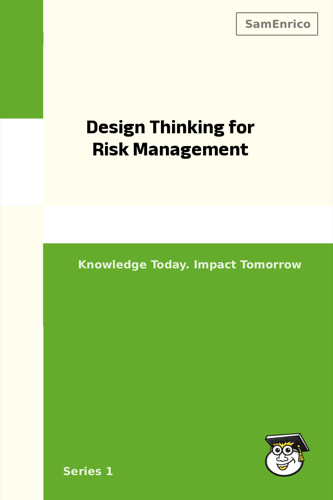
Design Thinking for Risk Management
Identify and mitigate risks by understanding human
by Britt Lelah
Identify and mitigate risks by understanding human factors and behaviors.
Formats
About this book
Free sample
Chapter 1: The Broken Human Myth--–- In the control room of a nuclear power plant, three operators stared at a flashing red panel. An alarm screamed. Their procedure manual, updated just six months earlier after a near-miss in a similar facility, contained exactly 847 steps for this specific alarm pattern. They had trained on this scenario for forty hours. Yet in the seventeen seconds before they took action, two of them reached for different switches, the third froze entirely, and the alarm continued to flash.
The post-incident investigation would later conclude, as these investigations always did, that the cause was “human error.” The operators were retrained. The procedure was expanded to 912 steps. And three months later, the same pattern repeated itself in a different control room, with different operators, producing a different failure.This is the story of modern risk management. It is a story written in the language of blame, retrofitted onto the aftermath of failure, and repeated so often that no one questions its fundamental premise. That premise is simple, seductive, and catastrophically wrong: that humans are the weakest link in any system, that their errors are the primary cause of failure, and that the solution is to constrain, monitor, and punish them into compliance.
Call this the Broken Human Myth.This book is built on a different premise. After two decades of research across aviation, medicine, finance, nuclear power, and maritime shipping, a quiet revolution has been underway. It began in the work of Sidney Dekker, James Reason, and Erik Hollnagel, who asked a question that seems almost heretical: What if human error is not a cause of failure but a symptom of deeper design flaws? What if the same adaptability that occasionally produces mistakes is also the only reason systems succeed at all? And what if the entire apparatus of traditional risk management—the checklists, the root cause analyses, the punitive investigations—has been aimed at the wrong target?This chapter dismantles the Broken Human Myth.
It introduces three concepts that will serve as the foundational lens for every subsequent chapter in this book: Reactance, Proximity to…
This is the end of the free sample. Get the eBook to keep going. Buy now
Contents
- Chapter 1
- Chapter 2
- Chapter 3
- Chapter 4
- Chapter 5
- Chapter 6
- Chapter 7
- Chapter 8
- Chapter 9
- Chapter 10
- Chapter 11
- Chapter 12
Details
- Author
- Britt Lelah
- Publisher
- SamEnrico
- Language
- English
- Genre
- Non-Fiction, Self-Help
- Released
- 2026-06-08
- Pages (approx.)
- 144
- Available as
- eBook, Audiobook

Read better in the ZLOADR app
Your eBooks on your phone or tablet. Sign in with your SamEnrico account and start reading.
More by Britt Lelah
 Pilot Shift Sleep GuideBritt Lelah$11.99
 Failure Celebration GuideBritt Lelah$11.99
 Senior Photo Album MemoryBritt Lelah$11.99
 Teresas Foundations JourneyBritt Lelah$11.99
 NVC for Religious GroupsBritt Lelah$11.99
 Working Parent Time ManagementBritt Lelah$11.99
 Elizabeth Progress Tours StrategyBritt Lelah$11.99
 The Harmonious Wisdom of the Griots: Africa's Ancient Thinkers and Their Timeless TeachingsBritt Lelah$11.99
 The Bone Collector of Lima: A 19th-Century Escape and the Birth of Forensic EntomologyBritt Lelah$11.99
 How to Produce IngotsBritt Lelah$11.99
 Accommodation Cost Comparison WorkbookBritt Lelah$12.99
 Networking for Slash ProfessionalsBritt Lelah$12.99
You may also like
 Hong Kong Handover 1997Dunn Johnnie$11.99
 Zumba For Postnatal Recovery CourseNeal Christian$11.99
 Zumba for BeginnersLadner Nikia$11.99
 YouTube Comment Mining GuideHumes Pandora$12.99
 Worry Box MeditationCarlin Rudy$11.99
 Workplace Stress MeditationNguyen Lynn$11.99
 Workplace Stress and Sleep RepairHawley Ivory$11.99
 Workplace Perfectionism CureDelaney Jeffry$11.99
 Workplace Injustice Anger GuideWallen Isabelle$11.99
 Work Addiction and Burnout LinkGreenwood Ester$11.99
 Women in Yoga and WellnessBeattie Galina$11.99
 Women in Stand Up ComedyChun Evangeline$11.99