
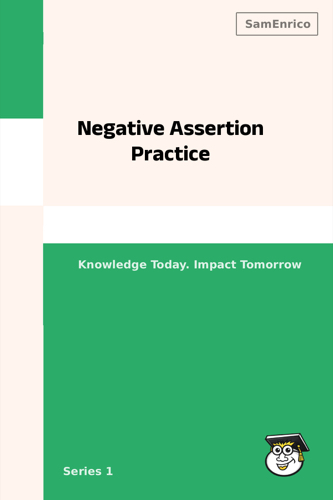
Negative Assertion Practice eBook
Acknowledge your mistakes without over-apologizing
Acknowledge your mistakes without over-apologizing or losing self-worth.
Formats
Free sample
Chapter 1: The Four Masks...--–- Every apology you have ever uttered falls into one of four patterns. You are about to discover which one has been running your life.You say “sorry” before asking your partner to pass the salt. You say “sorry” when a colleague bumps into you in the hallway. You say “sorry” for having a headache, for needing a day off, for asking a question in a meeting, for crying, for not crying, for caring too much, and for caring too little. The word has become so automatic that you no longer hear yourself say it.
But other people do. And more importantly, your nervous system does.The first step toward mastering negative assertion is not learning what to say. It is learning what you have been saying without knowing it. Every over-apologizer, every deflector, every self-punisher, and every silent avoider is wearing a mask. The mask is not a lie.
It is a strategy—an adaptation that once protected you from something painful. But adaptations outlive their usefulness. And the mask that kept you safe as a child, or in a past relationship, or in a work environment where you had no power, is now keeping you small.This chapter introduces the Four Apology Archetypes. By the end, you will know exactly which mask you have been wearing, why you put it on, and what it will take to take it off.The Architecture of an Unseen Strategy Before we meet the four archetypes, we need to understand what they are and what they are not.An archetype is not a diagnosis. You will not find these categories in the DSM, and no therapist is going to label you with them.
They are descriptive, not prescriptive—patterns of behavior that emerge from specific core beliefs. Most people are not pure examples of a single archetype. You may be an Over-Apologizer at work and a Silent Avoider at home. You may be a Self-Punisher with your partner and a Deflector with your parents. The goal of identifying your archetype is not to put yourself in a box.
It is to recognize the box you have been living in so that you can step out of it.Each archetype is defined by three things: a characteristic behavior (what you actually do and say), a core belief (the hidden conviction that drives the behavior), and a primary fear (what you are trying to avoid by apologizing). The behaviors are visible. The beliefs and fears are not. Most over-apologizers have never articulated the belief that runs their apology habit. They just feel the urge to say “sorry” and obey it.The chapter includes a self-assessment quiz.
Before you read the descriptions of the four archetypes, take out a piece of paper or open a note on your phone. You will answer twelve questions, and based on your answers, you will identify your primary and secondary archetypes. The quiz is not designed to be scored in a binary way. It is designed to show you where your weight is distributed.The Self-Assessment Quiz For each statement, rate yourself from 1 (strongly disagree) to 5 (strongly agree).I apologize even when I am not sure what I did wrong.When someone criticizes me, my first instinct is to point out what they did wrong too.After I apologize, I often add something like “I’m so stupid” or “I’m the worst.”When I make a mistake, I prefer to say nothing and hope no one notices.I say “sorry” for asking questions in meetings or classes.My apologies usually include the word “but” followed by an explanation.I have apologized by saying “You deserve better than me” or something similar.I often wait so long to apologize that the moment passes entirely.I apologize for having needs—like needing help, needing rest, or needing space.When I say “I’m sorry,” I am usually also secretly angry that I have to say it.I have apologized for existing in someone’s way, even when they could have walked around me.I have told myself “If I just stay quiet, this will blow over.”Now look at your answers. The statements are grouped by archetype.Over-Apologizer: Statements 1, 5, 9, 11.
Add your scores. Total possible: 20. If you scored 12 or higher, the Over-Apologizer is at least a secondary pattern for you. If you scored 16 or higher, it is likely your primary pattern.Deflector: Statements 2, 6, 10. (Note: three statements, not four, because Deflectors tend to be less purely defined.) Add your scores.
Total possible: 15. If you scored 9 or higher, the Deflector pattern is significant.Self-Punisher: Statements 3, 7. (Two statements, because self-punishment is a concentrated pattern.) Add your scores. Total possible: 10. If you scored 6 or higher, the Self-Punisher is active in you.Silent Avoider: Statements 4, 8, 12.
Add your scores. Total possible: 15. If you scored 9 or higher, the Silent Avoider pattern is significant.Most people will have one high score and one or two medium scores. That is normal. The key is to identify which archetype you lead with—the one that emerges first under stress, before you have time to think.Archetype One: The Over-Apologizer“Sorry for existing.”The Over-Apologizer is the most recognizable of the four archetypes, in part because our culture has trained certain groups (especially women, marginalized people, and anyone socialized to be agreeable) to perform this role.
The Over-Apologizer apologizes for basic needs: “Sorry, could I ask a question?” “Sorry to bother you, but I need to leave early today.” “Sorry, I know this is a lot, but I’m really struggling.”The Over-Apologizer apologizes for preferences: “I’m sorry, I actually don’t like sushi. Is that okay?” “Sorry, I’d prefer to stay in tonight if that’s alright with you.” “I know this is annoying, but I’d rather not see that movie.”And most painfully, the Over-Apologizer apologizes for mere presence. They say “sorry” when they enter a room. They say “sorry” when they laugh too loud. They say “sorry” when they cry, when they are angry, when they are excited—as if any strong emotion is an imposition on others.The Core Belief The Over-Apologizer operates from a single, devastating conviction: My existence is an inconvenience.
This belief is rarely conscious. If you asked an Over-Apologizer directly, “Do you believe your existence is an inconvenience?” they would likely say no. But their behavior says yes. Every reflexive “sorry” is a vote for that belief. When you apologize before asking for a glass of water, you are acting as if your thirst is a burden.
When you apologize for having a different opinion, you are acting as if your perspective is unwelcome by default.The Primary Fear The fear beneath the Over-Apologizer’s behavior is fear of rejection through imposition. They believe that if they take up space, ask for what they need, or express a genuine preference, the other person will leave. Not will be annoyed—will leave. The Over-Apologizer’s childhood often included conditional love: you were acceptable as long as you were convenient. As an adult, they continue to perform convenience as a survival strategy.What the Over-Apologizer Looks Like in Action In a meeting: “Sorry to interrupt, but I just have a quick question.…
This is the end of the free sample. Get the eBook to keep going. Buy now
About this book
Details
- Author
- Flanders Miss
- Publisher
- SamEnrico
- Language
- English
- Genre
- Non-Fiction, Self-Help, Accountability
- Released
- 2026-06-09
- Pages (approx.)
- 143
- Available as
- eBook, Audiobook

Read better in the ZLOADR app
Your eBooks on your phone or tablet. Sign in with your SamEnrico account and start reading.
More by Flanders Miss
 Migraine and Cervicogenic HeadacheFlanders Miss$11.99
 Eisenhower For Remote WorkersFlanders Miss$11.99
 Fear Recognition MethodsFlanders Miss$11.99
 Betaine Liver Health GuideFlanders Miss$11.99
 The 10 Second Pause MethodFlanders Miss$11.99
 Meal Delivery for SeniorsFlanders Miss$11.99
 Team Building NonverbalsFlanders Miss$11.99
 Sunk Cost Fallacy AvoidanceFlanders Miss$11.99
 Starlight Serpents: The Lost Mission of Pioneer 10Flanders Miss$11.99
 Quantum Rhapsody: The Enigma of Schrödinger’s CatFlanders Miss$11.99
 Subprime Shadows: The Collateral Damage of Lehman's FallFlanders Miss$11.99
 Relationship Mental Health AdvisorFlanders Miss$12.99
You may also like
 Virtual Coworking SessionsFarrar Lili$11.99
 Negative Assertiveness TrainingJustus Mammie$11.99
 Burnout Prevention Accountability GuideNumbers Hiedi$11.99
 Negative Assertiveness SkillsCosta Migdalia$11.99
 Morning Accountability Partner GuidePrado Jaleesa$11.99
 The Spending Accountability PartnerWolford Cecille$11.99
 Sobriety Accountability SystemsHanks Les$11.99
 Focus Accountability Partner System CourseDyson Roselyn$11.99
 Accountability For ProcrastinatorsGiroux Selina$11.99
 Workplace Accountability PartnerDotson Lesley$11.99
 The Accountability Conversation GuideShull Cassy$11.99
 Shopping Addiction Accountability Partner GuideBryan Danny$11.99