
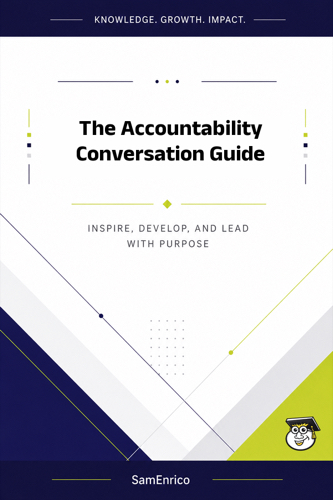
The Accountability Conversation Guide
Holding others responsible for missed commitments
by Shull Cassy
Holding others responsible for missed commitments without shaming or blaming.
Formats
About this book
Free sample
Chapter 1: The Blame Trap--Every leader has experienced the paradox. You need someone to take responsibility for a missed deadline, a broken promise, or a dropped ball. So you call them in. You state the facts. You explain the impact.
You ask for an explanation. And instead of owning the mistake, they deflect. They make excuses. They blame someone else. They get defensive.
They shut down. Or worse, they attack you back.You walk away frustrated, wondering why accountability is so hard to get.The answer is uncomfortable but simple: You triggered their threat response.This chapter reveals the hidden psychology behind the blame trap—why shaming and blaming actually reduce the likelihood of changed behavior, how your well-intentioned attempt to hold someone accountable can backfire instantly, and what to do instead. By the end of this chapter, you will understand why the loudest demand for accountability often produces the least, and you will learn the foundational distinction that makes every subsequent chapter in this book possible: the difference between natural outcomes and punitive hostility.The Neuroscience of Defensiveness Let us begin with a simple experiment. Imagine you are sitting at your desk, working on a project. Your manager walks in and says, "You missed the deadline yesterday.
Why didn't you get it done?"Notice what happens inside your body. Does your chest tighten? Does your stomach clench? Do you feel a sudden urge to explain, justify, or defend yourself?Now imagine a different scenario. Your manager walks in and says, "I noticed the report wasn't submitted by 3 PM yesterday, which was different from what we agreed on.
What got in the way?"Does that feel different? Most people report a noticeable drop in physical tension between these two openings.The reason is not merely about word choice, though that matters. The reason is about what happens inside the human brain when it perceives a threat.Research in social neuroscience has demonstrated that social threats—rejection, criticism, blame, humiliation—activate the same neural pathways as physical pain. The anterior cingulate cortex, the region that registers physical injury, lights up when someone feels blamed or shamed. Your…
This is the end of the free sample. Get the eBook to keep going. Buy now
Contents
- Chapter 1
- Chapter 2
- Chapter 3
- Chapter 4
- Chapter 5
- Chapter 6
- Chapter 7
- Chapter 8
- Chapter 9
- Chapter 10
- Chapter 11
- Chapter 12
Details
- Author
- Shull Cassy
- Publisher
- SamEnrico
- Language
- English
- Genre
- Non-Fiction, Self-Help, Accountability
- Released
- 2026-06-09
- Pages (approx.)
- 155
- Available as
- eBook, Audiobook

Read better in the ZLOADR app
Your eBooks on your phone or tablet. Sign in with your SamEnrico account and start reading.
More by Shull Cassy
 Meeting Attendance Opt Out GuideShull Cassy$11.99
 Newborn Parent Sleep StrategyShull Cassy$11.99
 The PCOS Symptom Management GuideShull Cassy$11.99
 Burnout Nutrition Recovery GuideShull Cassy$11.99
 The Poisoner and the Doctor: The Trial of Graham Young and His Deadly ExperimentsShull Cassy$11.99
 Lionel Messi vs Cristiano RonaldoShull Cassy$11.99
 Understanding Xeroderma PigmentosumShull Cassy$17.99
 How to Start a Basement Lights Made of Glass Business (Beginners Guide)Shull Cassy$11.99
 UserZoom Testing GuideShull Cassy$12.99
You may also like
 Virtual Coworking SessionsFarrar Lili$11.99
 Negative Assertiveness TrainingJustus Mammie$11.99
 Burnout Prevention Accountability GuideNumbers Hiedi$11.99
 Negative Assertiveness SkillsCosta Migdalia$11.99
 Morning Accountability Partner GuidePrado Jaleesa$11.99
 The Spending Accountability PartnerWolford Cecille$11.99
 Sobriety Accountability SystemsHanks Les$11.99
 Focus Accountability Partner System CourseDyson Roselyn$11.99
 Accountability For ProcrastinatorsGiroux Selina$11.99
 Workplace Accountability PartnerDotson Lesley$11.99
 Shopping Addiction Accountability Partner GuideBryan Danny$11.99
 Listener Accountability PartnerParra Debi$11.99