
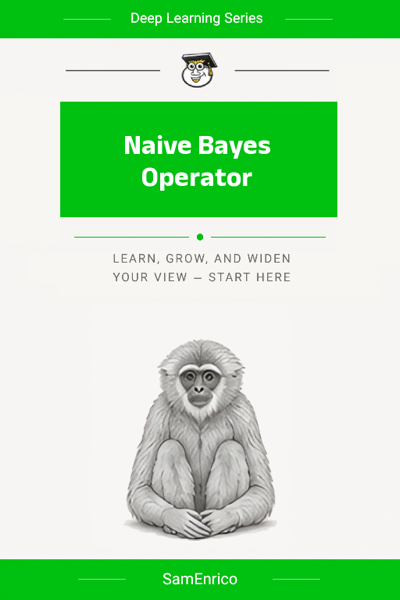
Non-FictionInformativeEducational
Naive Bayes Operator eBook
A Coursebook on Naive Bayes Operator
by Dix Corazon
A Coursebook on Naive Bayes Operator
Formats
Free sample
Chapter 1: The Probability Mindset...--–- Every time you check your phone’s weather app and see “70% chance of rain,” you are acting as a probabilistic operator. You decide whether to carry an umbrella based not on certainty, but on a belief quantified as a number between zero and one. That mundane act—updating your behavior based on a conditional probability—is the exact same reasoning pattern that powers one of the most elegant, fastest, and surprisingly effective machine learning algorithms ever invented: the Naive Bayes classifier.Most data scientists approach Naive Bayes as a black box. They import it from a library, feed it data, and accept the predictions without ever understanding the probabilistic engine humming beneath the surface. This book exists to transform you from a passive user into an active Naive Bayes Operator—someone who doesn’t just run code, but who operates, diagnoses, tunes, and deploys probabilistic models with surgical precision.Before you write a single line of Python, before you call fit() or predict(), you must internalize one fundamental truth: All classification is probabilistic reasoning.
Every time you assign a label to an input, you are expressing a conditional probability: P(Class | Features). That is the heartbeat of this entire discipline.The Operator’s Creed: Why Probability Is Not Just Math Let us begin with a provocative statement: Deterministic thinking is a dangerous illusion in data science. No real-world prediction is ever certain. A medical test can be wrong. An email that looks exactly like spam might be a legitimate newsletter you actually want.
A credit card transaction that matches fraud patterns perfectly could be your own unusual purchase while traveling.The Naive Bayes Operator embraces uncertainty. Instead of pretending to be certain, you will learn to quantify uncertainty, report it honestly, and make decisions that balance risks and rewards. That is the Operator’s Creed: “I will not predict. I will assign probabilities, and I will let the decision-maker choose the threshold.”This chapter builds the foundation upon which everything else in this book rests. You will learn:What probability really means (and why most people misunderstand it)How to derive Bayes’ Theorem from first principles The critical distinction between probability and likelihood The “naive” assumption and why it is simultaneously ridiculous and powerful How to manually calculate posterior probabilities with nothing but a spreadsheet By the end of this chapter, you will have performed a complete probabilistic classification by hand.
You will never look at a predict_proba() output the same way again.What Is Probability, Really?Before we can use probability as a tool, we must understand what it actually represents. There are two major philosophical interpretations, and every Naive Bayes Operator must be fluent in both.The Frequentist Interpretation In the frequentist view, probability is the long-run relative frequency of an event. If you say a fair coin has a 50% probability of landing heads, you mean that if you flipped it an infinite number of times, half of those flips would show heads. This interpretation is objective, repeatable, and grounded in physical reality. It works beautifully for coin flips, dice rolls, and manufacturing defects.The Bayesian Interpretation In the Bayesian view, probability is a measure of belief or confidence.
If you say there is a 70% chance of rain tomorrow, you are not claiming that if you repeated today an infinite number of times it would rain 70% of the time—because you cannot repeat today. Instead, you are expressing your degree of belief based on available evidence: satellite images, historical patterns, atmospheric pressure readings.Bayesian probability is subjective. Different people with different information can legitimately assign different probabilities to the same event. This subjectivity is not a weakness; it is the only way to reason about unique, non-repeatable events like “Will this specific loan default?” or “Does this patient have this specific disease?”The Naive Bayes classifier is Bayesian through and through. It treats the class label as an unknown variable, the features as observed evidence, and it computes how our belief in each class should change after seeing that evidence.
You will internalize this belief-updating process so deeply that it becomes second nature.Conditional Probability: The Engine of Learning All machine learning reduces to conditional probability. The notation P(A|B) means “the probability of event A occurring given that event B has already occurred.” This is not a peripheral concept—it is the central mechanism of supervised learning.Consider a simple example. In a deck of 52 playing cards, the probability of drawing an Ace is 4/52 or approximately 0.077. But if you are told that the drawn card is a heart, the probability changes: P(Ace | Heart) = 1/13 ≈ 0.077 as well (since there is one Ace among the 13 hearts). In this case, the condition didn’t change the probability because suit and rank are independent.
But consider: P(Heart | Ace) = 1/4 = 0.25. Knowing the card is an Ace makes it four times more likely to be a heart than a random card would be.That shift—from P(Ace) to P(Ace|Heart)—is exactly what every classifier does. It starts with a prior probability (what you believed before seeing evidence) and updates to a posterior probability (what you believe after seeing evidence). The relationship between these quantities is governed by the most important formula in all of probabilistic machine learning: Bayes’ Theorem.Bayes’ Theorem: Derivation from First Principles Let us derive Bayes’ Theorem from scratch. You will not memorize it passively; you will construct it.We start with the definition of conditional probability.
The probability of A and B both occurring can be written in two ways:P(A ∩ B) = P(A|B) × P(B)P(A ∩ B) = P(B|A) × P(A)These two expressions are equal because they describe the exact same event. Set them equal:P(A|B) × P(B) = P(B|A) × P(A)Now divide both sides by P(B):P(A|B) = P(B|A) × P(A) / P(B)That is Bayes’ Theorem in its simplest form. It tells you how to reverse the direction of conditioning. If you know P(B|A)—how likely the evidence is given the hypothesis—you can compute P(A|B)—how likely the hypothesis is given the evidence.Let us break down each term with the language we will use throughout this book:P(A) is the prior probability of the hypothesis before seeing any evidence.P(B|A) is the likelihood of observing the evidence given that the hypothesis is true.P(B) is the marginal probability of the evidence (the probability of observing B under all possible hypotheses).P(A|B) is the posterior probability of the hypothesis after seeing the evidence.In classification tasks, A becomes the class label (e.g., “spam” or “not spam”), and B becomes the observed features (e.g., the words in an email). The classifier computes the posterior probability for each possible class and chooses the class with the highest value.The Denominator: Why You Can Usually Ignore It The marginal probability P(B) is often the most difficult term to compute.
It requires summing over all possible hypotheses:P(B) = P(B|A) × P(A) + P(B|not A) × P(not A)In the simple two-class case, this…
This is the end of the free sample. Get the eBook to keep going. Buy now
About this book
Details
- Author
- Dix Corazon
- Publisher
- SamEnrico
- Language
- English
- Genre
- Non-Fiction, Informative, Educational
- Released
- 2026-05-08
- Pages (approx.)
- 157
- Available as
- eBook, Audiobook

Read better in the ZLOADR app
Your eBooks on your phone or tablet. Sign in with your SamEnrico account and start reading.
More by Dix Corazon
 Lava Jato The Full StoryDix Corazon$11.99
 Weekly Health ReviewDix Corazon$11.99
 Franchise Builder's Franchise Accountant StoryDix Corazon$11.99
 Values And Mission Alignment Conflict ResolutionDix Corazon$11.99
 The Great Diamond Heist: How a Single Gem Sparked a Global ObsessionDix Corazon$11.99
 Silent Screens: The Forbidden Footage of Cleopatra’s Last NightDix Corazon$11.99
 How to Become a Dinkey OperatorDix Corazon$11.99
 Understanding Hypervitaminosis DDix Corazon$17.99
 Exoskeleton Rehabilitation GuideDix Corazon$12.99
 Podcast Audience Growth HandbookDix Corazon$12.99
You may also like
 Hong Kong Handover 1997Dunn Johnnie$11.99
 Zumba For Postnatal Recovery CourseNeal Christian$11.99
 Zumba for BeginnersLadner Nikia$11.99
 YouTube Comment Mining GuideHumes Pandora$12.99
 Worry Box MeditationCarlin Rudy$11.99
 Workplace Stress MeditationNguyen Lynn$11.99
 Workplace Stress and Sleep RepairHawley Ivory$11.99
 Workplace Perfectionism CureDelaney Jeffry$11.99
 Workplace Injustice Anger GuideWallen Isabelle$11.99
 Work Addiction and Burnout LinkGreenwood Ester$11.99
 Women in Yoga and WellnessBeattie Galina$11.99
 Women in Stand Up ComedyChun Evangeline$11.99