
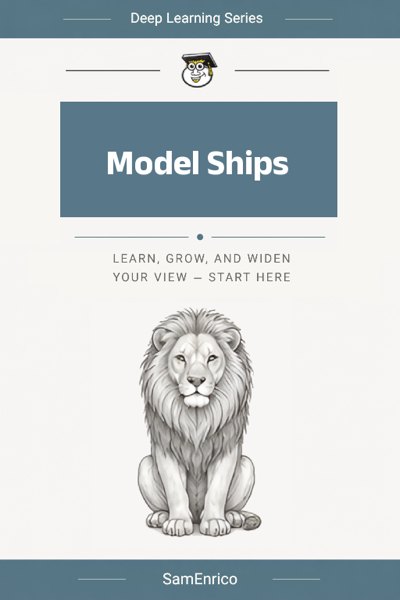
Non-FictionInformativeEducational
Model Ships eBook
A Coursebook on Model Ships
A Coursebook on Model Ships
Formats
Free sample
Chapter 1: The Miniature Ocean...--Every ship model begins as a story. Before the first cut of wood, before the selection of plans or the organization of tools, there is a question that hovers over the workbench like the first breath of wind before a voyage: Why am I building this?The answer to that question will determine everything that follows—the scale you choose, the materials you invest in, the hours you spend sanding a single plank into submission, the patience you summon when a shroud snaps or a cannon misaligns. Without a clear answer, the model risks becoming not a labor of love but a chore abandoned halfway through, gathering dust on a shelf, its rigging half-tied and its hull only partially planked.This chapter is not about technique. You will find no diagrams of dovetail joints here, no instructions for bending wood or reading a lines plan. Those lessons come later, in their proper time and place.
Instead, this chapter is about orientation. It is the compass by which you will navigate the entire journey of building model ships. By the time you finish reading, you will understand not only what you are about to build but why it matters to you personally. You will have chosen your path among three great traditions of ship modeling. And you will have looked backward across four thousand years to see how your own hands are connecting to an unbroken chain of craftspeople, dreamers, and sailors who have done the same thing across millennia.The Four-Thousand-Year Conversation The oldest surviving ship model in the world was found in an Egyptian tomb at Meir, buried around 2000 BCE.
It is a small wooden boat, less than two feet long, carved with astonishing care. It has a mast, a rudder, a shelter for the deceased to sit beneath. It was not a child's toy, nor a decorative object in the way we understand that term today. It was a vessel in the most literal sense: the Egyptians believed that the soul of the dead—the ba—would need to travel across the waters of the underworld, and this model was the vehicle for that journey. A real boat, shrunk to miniature size, retained its real power.Four thousand years later, a model maker in a dimly lit workshop in Portsmouth, England, carved a tiny cannon carriage for a 1:96 scale replica of HMS Victory.
The cannon was smaller than a grain of rice. The maker used a magnifying lens and a blade no wider than a splinter. When asked why he did it—why anyone would spend four hours on a detail no one would ever see without a microscope—he said: "Because it's there. Because the real Victory had them. Because if I leave it out, I'm not building Victory.
I'm building something less."Between that Egyptian tomb and that English workshop lies the entire history of ship modeling. It is a conversation across time. The Egyptian built his boat for the afterlife. The Chinese of the Han Dynasty buried model ships with their emperors. The Vikings carved small boats to accompany their chieftains to Valhalla.
In the 17th century, the British Admiralty commissioned "dockyard models"—exact replicas of ships proposed for construction, built to win the approval of kings and the funding of parliaments. These were not small. Some were fifteen feet long, built with the same materials and methods as the ships they represented, every timber in place, every gun mounted. They were proposals, arguments made in wood.In the Napoleonic Wars, French prisoners held in British hulks carved astonishingly detailed models from beef bones and scavenged wood. With no proper tools, no plans, no hope of release, they built miniature French frigates and British men-of-war, selling them to local civilians for pennies to buy food.
Their models survive in museums today, testaments to the human need to create order and beauty in the midst of chaos and captivity.And then came the plastic kit. In the 1950s, companies like Revell and Airfix began mass-producing injection-molded ship models. For the first time, a twelve-year-old could build a 1:600 scale USS Arizona in an afternoon for the price of a movie ticket. The hobby democratized. Millions of models were built.
Most ended up in landfills. Some were painted with clumsy brushes, their decals peeling, their plastic masts bent. But a fraction of those builders—a tiny percentage—caught the fever. They wanted more. They wanted wood.
They wanted authenticity. They wanted to know what it felt like to bend a real plank, to tie a real knot, to hold in their hands a thing that had the weight and warmth of history.That fraction is you. That fraction is every reader of this book.The Three Great Paths Before you select a single tool or glue a single joint, you must choose which of the three great traditions of ship modeling you wish to follow. Each path has its own rewards, its own frustrations, its own definition of success. None is superior to the others.
But they are profoundly different, and mixing them without intention leads to frustration.Path One: The Period Sailing Ship This is the traditional heart of the craft. You will build a model of a ship that existed—or could have existed—between roughly 1500 and 1850. Galleons, frigates, brigs, schooners, clippers, men-of-war with three masts and thirty guns. The materials are almost always wood: basswood for the hull, walnut or pear for the details, boxwood for the masts. The construction methods mirror (or suggest) the methods used by the original shipwrights.
You will cut frames, bend planks, install decking, shape spars, rig hundreds of lines, and sometimes—if you are a glutton for punishment—sew your own sails.The reward of this path is authenticity. When you finish a period sailing ship, you have not merely assembled a kit. You have recreated a piece of history. Your model connects you, hand to hand, to the shipwrights of the 18th century. You understand, in your muscles and your fingertips, why a futtock is shaped the way it is, why a garboard strake must be thicker than the others, why a captain would sacrifice speed for stability.The frustration is complexity.
A fully rigged frigate at 1:96 scale contains hundreds of individual lines. Some modelers spend two years on a single ship. The learning curve is steep, and the margin for error is small. A misplaced plank can ruin the fairness of the entire hull. A mis-tied knot can throw off the tension of an entire mast.
This path is not for the impatient. It is for the obsessed.Who should choose this path? You, if you love history. You, if you find yourself staring at paintings of the Battle of Trafalgar and wondering what it felt like to stand on that deck. You, if you have the patience to sand the same curve for an hour and feel satisfaction, not boredom.
You, if you want a model that looks like it sailed out of a museum.Path Two: The Modern Naval Vessel This path focuses on ships from the mid-19th century to the present day. Ironclads, battleships, aircraft carriers, destroyers, submarines, container ships, tankers.…
This is the end of the free sample. Get the eBook to keep going. Buy now
About this book
Details
- Author
- Savoy Matthew
- Publisher
- SamEnrico
- Language
- English
- Genre
- Non-Fiction, Informative, Educational
- Released
- 2026-05-11
- Pages (approx.)
- 134
- Available as
- eBook, Audiobook

Read better in the ZLOADR app
Your eBooks on your phone or tablet. Sign in with your SamEnrico account and start reading.
More by Savoy Matthew
 The Listening Manager PlaybookSavoy Matthew$11.99
 Emotion Regulation For HealthcareSavoy Matthew$11.99
 The Spaced Repetition GuideSavoy Matthew$11.99
 DBT For Homelessness SurvivorsSavoy Matthew$11.99
 The Restraining Order Digital GuideSavoy Matthew$11.99
 The Phantom Phreaker: The Rise and Fall of John DraperSavoy Matthew$11.99
 How to Start a NAAFI Shop Without Alcohol Licence (retail) Business (Beginners Guide)Savoy Matthew$11.99
 Trademark Search ARIPOSavoy Matthew$12.99
 Green Credit Documentation VaultSavoy Matthew$12.99
 Understanding TeratocarcinosarcomaSavoy Matthew$17.99
You may also like
 Hong Kong Handover 1997Dunn Johnnie$11.99
 Zumba For Postnatal Recovery CourseNeal Christian$11.99
 Zumba for BeginnersLadner Nikia$11.99
 YouTube Comment Mining GuideHumes Pandora$12.99
 Worry Box MeditationCarlin Rudy$11.99
 Workplace Stress MeditationNguyen Lynn$11.99
 Workplace Stress and Sleep RepairHawley Ivory$11.99
 Workplace Perfectionism CureDelaney Jeffry$11.99
 Workplace Injustice Anger GuideWallen Isabelle$11.99
 Work Addiction and Burnout LinkGreenwood Ester$11.99
 Women in Yoga and WellnessBeattie Galina$11.99
 Women in Stand Up ComedyChun Evangeline$11.99