
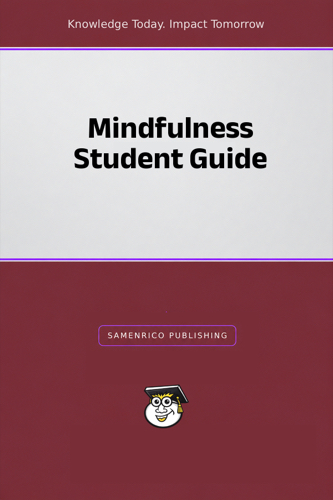
Non-FictionSelf-HelpMindfulness
Mindfulness Student Guide eBook
Practice present moment awareness between classes.
by Jung Reid
Practice present moment awareness between classes.
Formats
Free sample
Chapter 1: The Disappearing Day...--–- You wake up. The alarm is angry. You swipe it off, scroll for ten minutes in a half-sleep haze, then drag yourself to the bathroom. Breakfast is a protein bar eaten while watching a video you won't remember by second period. The bus is a blur of faces and phone screens.
You walk through the front doors of your school, and then... what? What color are the lockers in the science wing? What did the person in front of you in line smell like? What was the last thing your teacher said before the bell?If you cannot answer these questions, you are not alone.
You are also not really living inside your own life. You are running on autopilot.Welcome to the first and most important truth of this book: Most students spend nearly 80% of their waking school day in "doing mode"—planning, worrying, rehashing, scrolling, rushing—and almost no time in "being mode," which is the simple, non-judgmental experience of actually being present.This chapter is called The Disappearing Day because that is exactly what is happening to you. Your hours are evaporating. Not because you are lazy or unfocused, but because your brain has developed a super-efficient, energy-saving habit of ignoring most of your own experience. The good news?
That habit can be broken. And you can start breaking it in the next 47 seconds between classes.The Great Blur: Why You Can't Remember the Walk to Third Period Let us run a small experiment. Think back to your morning today. Not the big events—not the quiz or the argument or the announcement. Think about the small, invisible glue of the morning: the walk from first period to second period.
What did you see? What did you hear? What did the air feel like? What was the exact expression on the face of the person who passed you?If you are like 95% of the students I have asked this question, your mind just went blank. You know that you walked.
You have a vague sense of where you walked. But the actual texture, the sensory reality, the experience of walking—that is gone. It dissolved into what psychologists call habituation.Habituation is your brain's energy-saving superpower. Imagine if you had to consciously notice the feeling of your socks against your skin every single second of every single day. You would go insane.
So your brain learns to filter out the familiar, the repetitive, the "non-threatening." The smell of the cafeteria after the first week? Gone. The sound of lockers slamming? Background noise. The feel of your backpack straps?
You only notice them when they hurt.This is efficient. It is also a tragedy.Because habituation does not just filter out discomfort. It filters out life. The hallways, the laughter, the light through the windows, the small kindnesses, the momentary beauty—all of it becomes invisible. You are living inside a video game where the graphics have been turned down to "low resolution" to save processing power.
You are getting through the day, but you are not in the day.And here is the deeper problem: habituation is not just about sensory input. It is about emotional input too. You stop noticing that low-grade anxiety in your chest because it is always there. You stop noticing the exhaustion because it has become your new normal. You stop noticing that you are rushing because rushing is just what you do.This is the autopilot trap.
And the first step out of the trap is simply noticing that you are in it.Doing Mode vs. Being Mode: The Two Ways to Live a Day To understand why your day feels like a blur, you need to understand two fundamentally different ways your brain can operate. Psychologists call them Doing Mode and Being Mode. Most students live almost exclusively in Doing Mode. Here is what that looks like.Doing Mode is goal-directed.
It is the part of your brain that asks, "What do I need to do next? How do I get from here to there? What is the most efficient way to avoid a problem or achieve an outcome?" Doing Mode is brilliant. It got you out of bed, onto the bus, through the hallway, and into your seat. It wrote your essay and solved your equations.
Doing Mode is not the enemy.The problem is that Doing Mode never shuts off. Even when there is nothing to do, it keeps scanning for threats and opportunities. Between classes, you are not resting. You are mentally rehearsing what you will say to your friend, worrying about the quiz you just took, calculating how to avoid the person who annoyed you yesterday, and checking your phone to make sure you are not missing out—all at the same time. This is not a break.
This is overtime for your brain.Being Mode is radically different. Being Mode has no goal. It does not ask, "How do I get somewhere?" It asks, "What is happening right now?" Being Mode notices the temperature of the air, the color of the sky, the sensation of your feet on the floor. It does not judge these things as good or bad. It just experiences them.When you are in Being Mode, you are not trying to fix the past or control the future.
You are simply here. Most students experience Being Mode only in rare, accidental moments: staring out a bus window, lying in bed before sleep, watching a flame or a river or a screen saver. These moments feel peaceful because your brain has finally stopped doing and started being.Here is the radical claim of this book: You can learn to access Being Mode in the 47 seconds between classes, in the lunch line, in the bathroom stall, in the hallway crowd. You do not need a meditation cushion or twenty minutes of silence. You need to understand one more piece of science: what constant transitions are doing to your brain.The Hidden Exhaustion of Switching Gears Why do you feel exhausted after four back-to-back classes, even if you spent those classes sitting in a chair?
You did not run a marathon. You did not lift weights. You sat. And yet, by the end of the day, your brain feels like mush.The answer lies in cognitive switching costs. Every time you shift from one task to another—from math to history, from history to lunch, from lunch to English—your brain has to perform a complex neurological maneuver.
It must deactivate the neural network associated with the previous task and activate the network associated with the next task. This switch burns glucose, creates mental friction, and leaves behind a residue of fatigue.Research shows that it can take up to fifteen minutes to fully regain deep focus after a task switch. In a typical six-period school day, with five transitions, you are spending over an hour of your day in a state of cognitive limbo—not fully engaged in the last class, not yet engaged in the next class. And during that limbo, most students are doing something that makes the problem worse.They pull out their phones.The Phone Trap: Why…
This is the end of the free sample. Get the eBook to keep going. Buy now
About this book
Details
- Author
- Jung Reid
- Publisher
- SamEnrico
- Language
- English
- Genre
- Non-Fiction, Self-Help, Mindfulness
- Released
- 2026-06-09
- Pages (approx.)
- 140
- Available as
- eBook, Audiobook

Read better in the ZLOADR app
Your eBooks on your phone or tablet. Sign in with your SamEnrico account and start reading.
More by Jung Reid
 Nicotine Blood Test Reduction GuideJung Reid$11.99
 Mindfulness for Smoking CessationJung Reid$11.99
 Financial Stress and Natural DisasterJung Reid$11.99
 The Siege of Xanadu: Kublai Khan’s Unbreakable FortressJung Reid$11.99
 How to Produce Auto Detailing ServicesJung Reid$11.99
 Panel Data Analysis WorkbookJung Reid$12.99
 How to Start a Ferro Nickel Business (Beginners Guide)Jung Reid$11.99
 Engineer TechnicianJung Reid$11.99
You may also like
 Hong Kong Handover 1997Dunn Johnnie$11.99
 Zumba For Postnatal Recovery CourseNeal Christian$11.99
 Zumba for BeginnersLadner Nikia$11.99
 YouTube Comment Mining GuideHumes Pandora$12.99
 Worry Box MeditationCarlin Rudy$11.99
 Workplace Stress MeditationNguyen Lynn$11.99
 Workplace Stress and Sleep RepairHawley Ivory$11.99
 Workplace Perfectionism CureDelaney Jeffry$11.99
 Workplace Injustice Anger GuideWallen Isabelle$11.99
 Work Addiction and Burnout LinkGreenwood Ester$11.99
 Women in Yoga and WellnessBeattie Galina$11.99
 Women in Stand Up ComedyChun Evangeline$11.99