
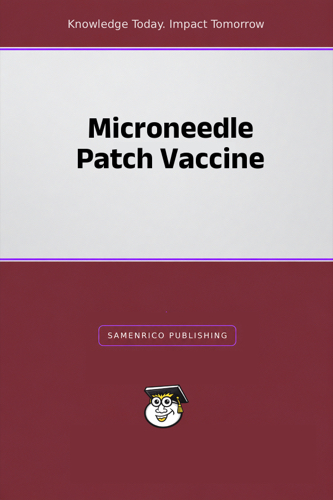
Non-FictionHealth & WellnessDrug Delivery
Microneedle Patch Vaccine eBook
Painless skin patch delivery for flu and measles.
by Gilliam Nada
Painless skin patch delivery for flu and measles.
Formats
Free sample
Chapter 1: The Childhood Scar--–- The scar was small, silver-white, and shaped like a comma. It sat on the inside of my left forearm, just above the wrist, a souvenir from the smallpox vaccine I received at age five. For years, I traced it with my fingertip during long car rides, feeling the slight ridge where the bifurcated needle had pierced my skin not once but fifteen times, in rapid succession, as the nurse rotated her wrist like she was whisking eggs. I did not remember the pain. What I remembered was the waiting—the dread that built as I watched the child ahead of me emerge from the clinic room crying, holding their arm as if it had been bitten by something.
I remembered my mother’s grip on my shoulders, firm and unyielding. I remembered the nurse saying “This will only take a second” in a voice that suggested she had said those same words ten thousand times before. And I remembered the strange, liberating realization afterward: I had survived. The scar would remain for decades, a permanent badge of participation in one of the greatest public health achievements in human history.That scar is gone now, faded into the ordinary texture of middle-aged skin. But the memory of that moment—the fear, the pressure, the strange wetness of the vaccine droplet before the needles came—has never faded.
And neither has the question that lodged itself in my mind like a splinter: why did it have to hurt? Why did protection require penetration? Why could the miracle of immunity not arrive like a bandage, painless and forgettable?This book is the product of three decades spent chasing that question. It is the story of a technology that most people have never heard of, even though it has been tested on thousands of human beings, even though it has been shown to work as well as the needle, even though it could transform the way we protect ourselves and our children from infectious disease. It is the story of the microneedle patch—a small, painless adhesive array that delivers vaccine through the skin without a syringe, without a nurse, without a freezer, and without a scar.And it is the story of why you do not already have one on your arm.The Silence of Success Vaccines suffer from a peculiar marketing problem: their greatest achievements are invisible.
When a child receives the measles vaccine and never gets measles, there is no dramatic before-and-after. There is no heroic rescue. There is only a healthy child growing into a healthy adult, completely unaware of the bullet they dodged. This is, of course, the entire point. But it creates a strange asymmetry in how we think about vaccination.
We remember the rare adverse event, publicized and amplified by activists and algorithms. We forget the millions of deaths that did not happen, the epidemics that did not spread, the hospital beds that remained empty.Edward Jenner, the English physician who invented the first vaccine in 1796, understood this asymmetry intuitively. He did not call his procedure “vaccination” at first. He called it “variolae vaccinae”—cowpox—and he promoted it not by promising safety or comfort, but by demonstrating effectiveness. The famous image of Jenner inoculating eight-year-old James Phipps with cowpox material, then later exposing the boy to smallpox, is often reproduced as a triumph of scientific reason.
What the image does not show is the lancet. It does not show the scraping, the bleeding, the sore that formed on James’s arm, the fever, the weeks of uncertainty before Jenner declared the experiment a success.The procedure worked. James Phipps survived. Smallpox would eventually be eradicated—the only human disease ever eliminated by deliberate intervention. But the cost of that achievement, measured in pain and fear and scars, was not zero.
And we have been paying that cost ever since, in every clinic, in every country, for every vaccine.The hypodermic syringe, introduced in 1853, was meant to be an improvement over the lancet. And in some ways, it was. The syringe could deliver a precise dose. It could reach deep tissues. It could be sterilized and reused (a practice we now recognize as dangerous).
But the syringe did not solve the problem of pain. It merely changed its quality—from the scratching of a lancet to the stinging of a hollow needle. Patients still flinched. Children still cried. Adults still avoided.For 170 years, we have accepted this as the price of immunity.
We have built elaborate systems around the needle: the cold chain to keep vaccines refrigerated, the sharps disposal containers to manage waste, the training programs to teach nurses how to find a vein or a muscle. We have never asked whether there might be a better way. Or rather, some people have asked. But their answers have taken decades to reach the threshold of public awareness.The Boy Who Asked the Right Question In 1995, a chemical engineering graduate student named Mark Prausnitz was working on his doctorate at the Massachusetts Institute of Technology. His research focused on a problem that seemed esoteric at the time: how to deliver drugs through the skin using microscopic needles.
The idea was not entirely new. Researchers had been experimenting with “microneedles” since the 1970s, but the manufacturing technology had not yet caught up. You could design a needle smaller than a human hair, but you could not mass-produce it reliably or cheaply.Prausnitz, who would later join the faculty at Georgia Tech, had a different problem. He was watching his wife struggle with infertility treatments that required daily hormone injections. The injections were effective, but they were also painful, inconvenient, and emotionally draining.
Watching her brace herself each morning for the needle, Prausnitz asked himself a question that seems obvious only in retrospect: what if the injection did not have to be an injection at all? What if the drug could be delivered through a patch—something like a nicotine patch, but with microscopic needles that painlessly penetrated the skin?The question led to a decade of research, then two decades more. Prausnitz and his collaborators published their first paper on microneedles for drug delivery in 1998. They filed patents. They built prototypes.
They tested the devices on themselves—a common practice in labs where human subjects are scarce and researchers are impatient. (Prausnitz still has a photograph of his own forearm, dotted with the tiny red marks left by an early microneedle array.) They showed that microneedles could deliver insulin, hormones, and small-molecule drugs. But the real breakthrough came when they turned their attention to vaccines.The logic was compelling. Vaccines do not need to enter the bloodstream to work. They need to encounter immune cells.
And the skin, as we will explore in Chapter 3, is packed with immune cells—far more, per square inch, than the muscle tissue where most vaccines are currently injected. If you could deliver a vaccine directly to those skin-resident immune cells, you might need less vaccine, you might get a stronger response, and you might avoid the pain of a deep needle stick entirely.The challenge was engineering. A microneedle for vaccine delivery had to be strong enough to…
This is the end of the free sample. Get the eBook to keep going. Buy now
About this book
Details
- Author
- Gilliam Nada
- Publisher
- SamEnrico
- Language
- English
- Genre
- Non-Fiction, Health & Wellness, Drug Delivery
- Released
- 2026-06-09
- Pages (approx.)
- 137
- Available as
- eBook, Audiobook

Read better in the ZLOADR app
Your eBooks on your phone or tablet. Sign in with your SamEnrico account and start reading.
More by Gilliam Nada
 Emotional Intelligence in TechGilliam Nada$11.99
 TM For Elderly Practitioners CourseGilliam Nada$11.99
 Lighthouse Beam GuideGilliam Nada$11.99
 Self Esteem for People With DisabilityGilliam Nada$11.99
 The Last Dive of the LeviathanGilliam Nada$11.99
 Understanding Mutations In Estradiol ReceptorGilliam Nada$17.99
 How to Become a Spool MakerGilliam Nada$11.99
 Procter Gamble SWOT GuideGilliam Nada$12.99
 AI Financial Data CollaborationGilliam Nada$12.99
 The Screenwriter's StructureGilliam Nada$11.99
You may also like
 Hong Kong Handover 1997Dunn Johnnie$11.99
 Zumba For Postnatal Recovery CourseNeal Christian$11.99
 Zumba for BeginnersLadner Nikia$11.99
 YouTube Comment Mining GuideHumes Pandora$12.99
 Worry Box MeditationCarlin Rudy$11.99
 Workplace Stress MeditationNguyen Lynn$11.99
 Workplace Stress and Sleep RepairHawley Ivory$11.99
 Workplace Perfectionism CureDelaney Jeffry$11.99
 Workplace Injustice Anger GuideWallen Isabelle$11.99
 Work Addiction and Burnout LinkGreenwood Ester$11.99
 Women in Yoga and WellnessBeattie Galina$11.99
 Women in Stand Up ComedyChun Evangeline$11.99