
Non-FictionBusiness BriefLeadership Development
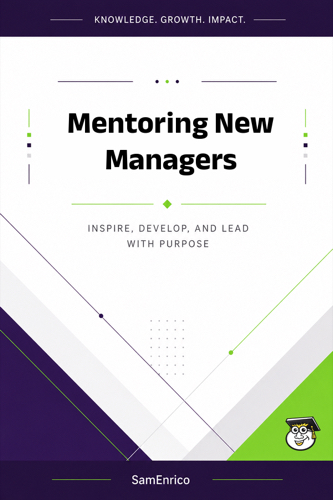
Mentoring New Managers eBook
Teaches experienced leaders how to develop first-t
Teaches experienced leaders how to develop first-time supervisors effectively.
Formats
Free sample
Chapter 1: The Superstar Trap--–- Sarah had been the best account executive at Nexus Financial for three consecutive years. She closed deals that seemed impossible, she knew the product better than the engineers who built it, and when a client was in crisis, Sarah was the person everyone called. So when the regional director position opened up, her promotion felt inevitable. She had earned it. She deserved it.But six months later, Sarah sat in her mentor's office with dark circles under her eyes and a confession she could barely bring herself to make: "I think I'm failing.
My team's numbers are down. Two of my best people have updated their Linked In profiles to 'open to work.' And I'm working sixty-hour weeks just to keep things from falling apart completely. I don't understand what happened. I'm doing everything I used to do—plus managing everyone else. Shouldn't that be enough?"Her mentor, a veteran leader named David who had seen this exact scene play out a dozen times over his career, leaned forward.
"Sarah, can I tell you something that might sound harsh?" She nodded. "You're not failing because you're a bad manager. You're failing because you're still trying to be a great account executive. You're trapped in the Superstar Trap, and until you get out, nothing will change."This chapter addresses the most common failure point in leadership development: promoting a high-performing individual contributor into management without preparing them for the fundamental identity shift required. The "Superstar Trap" occurs when a top salesperson, engineer, analyst, or any other expert suddenly finds themselves responsible for a team's output but continues to act like an individual hero.
The result is almost always the same: the new manager burns out, the team underperforms, and everyone wonders why a brilliant individual contributor turned into such a struggling supervisor.The Superstar Trap has a name because it has a pattern, and it has a pattern because it is pervasive. In study after study, across industries and geographies, the same story repeats. The Peter Principle—the observation that people rise to their level of incompetence—is not actually a law of nature. It is a failure of mentorship. It is the predictable outcome of throwing high performers into management without teaching them that the game has fundamentally changed.The Anatomy of the Trap To understand why the Superstar Trap is so effective at ensnaring new managers, we need to look at the psychological machinery underneath it.
Most first-time managers are not promoted because they demonstrated managerial potential. They are promoted because they were exceptional at something else. And because they were exceptional, they developed a set of habits, identities, and reward mechanisms that are perfectly calibrated for individual contribution—and perfectly misaligned with leadership.The first mechanism is identity anchoring. Sarah did not think of herself as a manager. She thought of herself as a great account executive who now had some managerial duties tacked on.
Her sense of self-worth, her professional identity, and her internal definition of success were all still tied to closing deals, solving client problems, and being the smartest person in the room. When she stopped doing those things, she felt like she was failing—even if her team was succeeding. So she kept doing them.The second mechanism is competency confusion. High performers are used to being the best. They are used to knowing the answers.
They are used to stepping in and fixing problems faster than anyone else can. These are precisely the behaviors that made them successful as individual contributors. But as managers, these same behaviors become liabilities. When Sarah jumps in to rewrite her team member's report, she is not being helpful. She is being a bottleneck.
When she takes over a difficult client call instead of coaching her rep through it, she is not being efficient. She is being a thief of growth opportunities.The third mechanism is reward misalignment. Most organizations continue to reward the behaviors that got the person promoted, not the behaviors that will make them successful as a manager. Sarah's bonus was still tied to her region's overall numbers, but her performance reviews still asked about her individual deal-closing rate. Her boss still praised her for rescuing a floundering account.
The organization was sending her mixed signals: "Be a manager, but also keep being a superstar individual contributor." That is an impossible ask.The Unified Mentor Framework: Three Hats, One Leader Before we dive into the specific tools and exercises that will help you guide your mentee out of the Superstar Trap, we need to establish something important. Throughout this book, you will encounter three distinct ways of showing up as a mentor. These are not different identities, and they are not contradictory. They are three hats that you will wear at different times, depending on what your mentee needs in the moment.The first hat is the Performance Architect. You wear this hat when your mentee needs to build a specific skill—delegation, feedback, meeting management, hiring.
The Performance Architect teaches frameworks, runs drills, audits behavior, and provides structured feedback. This is your teaching hat.The second hat is the Political Interpreter. You wear this hat when your mentee is struggling to navigate the broader organization—the unwritten rules, the power dynamics, the stakeholder relationships that don't appear on any org chart. The Political Interpreter translates the hidden curriculum of the workplace. This is your guide hat.The third hat is the Emotional Anchor.
You wear this hat when your mentee is in crisis—imposter syndrome, burnout, fear of failure, shame about struggling. The Emotional Anchor normalizes the struggle, shares vulnerability, and provides psychological safety. This is your human hat.In this chapter, you will primarily wear the Performance Architect hat, because getting out of the Superstar Trap is fundamentally a skillset problem. But you will also wear the Emotional Anchor hat, because admitting that you are trapped requires vulnerability. And you may need to wear the Political Interpreter hat if your mentee's organization is actively rewarding superstar behaviors over managerial ones.The key is knowing which hat to put on and when.
A simple diagnostic question will help: Is my mentee struggling because they don't know how to do something (Performance Architect), because they don't understand the hidden rules (Political Interpreter), or because they are terrified and ashamed (Emotional Anchor)? Let that question guide you.The Me to We Framework At the heart of escaping the Superstar Trap is a single mental shift: moving from "Me" to "We." A manager's success is no longer measured by how much they personally produce, how many hours they work, or how indispensable they appear. A manager's success is measured by one thing and one thing only: how well their team performs when the manager is not in the room.This is a radical reframe for most new managers. Sarah had spent her entire career being told that her value was her individual output. Now she was being told that her individual output was almost irrelevant.
The goal was no longer to be the best account executive. The goal was to build a team of account executives who could operate at her…
This is the end of the free sample. Get the eBook to keep going. Buy now
About this book
Details
- Author
- Steward Dwana
- Publisher
- SamEnrico
- Language
- English
- Genre
- Non-Fiction, Business Brief, Leadership Development
- Released
- 2026-06-08
- Pages (approx.)
- 140
- Available as
- eBook, Audiobook

Read better in the ZLOADR app
Your eBooks on your phone or tablet. Sign in with your SamEnrico account and start reading.
More by Steward Dwana
 Mindful Healthcare Professional GuideSteward Dwana$11.99
 Calf Strain Recovery ProtocolSteward Dwana$11.99
 UK CMA Merger BlocksSteward Dwana$11.99
 Metta For Evening Wind DownSteward Dwana$11.99
 Trace Evidence Collection GuideSteward Dwana$11.99
 Good Father, Bad AngerSteward Dwana$11.99
 Assertiveness For FreelancersSteward Dwana$11.99
 A B Testing BiasesSteward Dwana$11.99
 The Clockwork Dreamer: How a 19th-Century Engineer Built the First Practical Steam-Powered CarSteward Dwana$11.99
 The Codebreaker of Southeast Asia: Hoang Tuan's Mathematical RevolutionSteward Dwana$11.99
 The Last Charge of the Qing: The Fall of the Boxer Rebellion (1900)Steward Dwana$11.99
 How to Start a Marine Insurance Survey Business (Beginners Guide)Steward Dwana$11.99
You may also like
 Hong Kong Handover 1997Dunn Johnnie$11.99
 Zumba For Postnatal Recovery CourseNeal Christian$11.99
 Zumba for BeginnersLadner Nikia$11.99
 YouTube Comment Mining GuideHumes Pandora$12.99
 Worry Box MeditationCarlin Rudy$11.99
 Workplace Stress MeditationNguyen Lynn$11.99
 Workplace Stress and Sleep RepairHawley Ivory$11.99
 Workplace Perfectionism CureDelaney Jeffry$11.99
 Workplace Injustice Anger GuideWallen Isabelle$11.99
 Work Addiction and Burnout LinkGreenwood Ester$11.99
 Women in Yoga and WellnessBeattie Galina$11.99
 Women in Stand Up ComedyChun Evangeline$11.99